
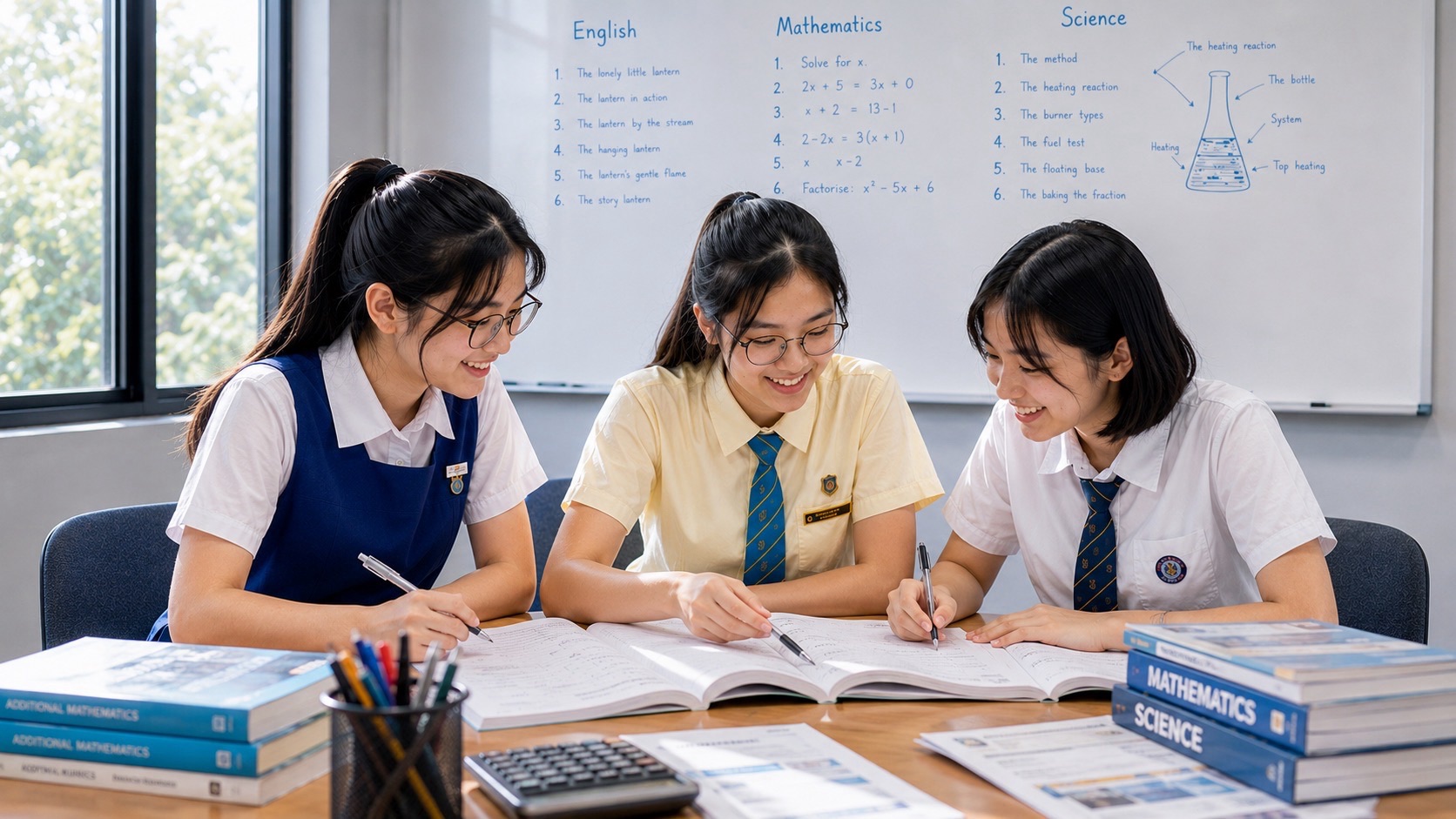
Secondary 4 English Tuition for Kallang Students
Secondary 4 English tuition for Kallang students should be built around prioritisation and performance under real conditions. By the final Secondary year, students do not need an endless expansion of techniques. They need to know which skills are secure, which still leak marks, which weaknesses can realistically be repaired, and how to execute reading, comprehension, situational writing, continuous writing, editing, oral communication and listening with enough control to finish the work they actually receive.
Kallang and Kallang-Whampoa families may search for Secondary 4 English tuition, O-Level English tuition, SEC English tuition, English tutor, small-group tuition, comprehension, essay writing or examination preparation. Those labels describe different routes into the same decision. The useful question is whether a programme can turn a marked script into a precise repair plan and then show that the repair survives unseen, timed work.
The examination context also needs accurate cohort language. Students graduating in 2026 remain within the existing Singapore-Cambridge GCE structure that applies to their cohort. From the 2027 graduating cohort, the Singapore-Cambridge Secondary Education Certificate replaces the previous N(T), N(A) and O-Level certificate structure, with subjects taken at G1, G2 or G3. Tuition should therefore verify the student’s actual syllabus and cohort rather than use one label for everyone.
Secondary 4 Is a Resource-Allocation Year
The final year is not the time to treat every weakness equally. One repeated inference problem may lose more marks than several minor vocabulary gaps. One sentence-control pattern may affect every writing task. One timing habit may damage an entire final section. A useful programme should identify the small number of constraints with the largest performance cost.
Kallang Logistics Matter Because Energy Matters
Final-year students may have long school days, co-curricular commitments, revision and multiple subjects competing for attention. A Kallang tuition choice should therefore consider travel, timing, meals, homework and sleep. Proximity can help, but only if the teaching fit is strong. A nearby class that repeats generic work is not automatically efficient.
Build the Final-Year Diagnostic from Marked Work
Collect recent comprehension scripts, writing, editing work, oral feedback and timed papers. Classify recurring losses. For comprehension, distinguish question misread, weak evidence, unsupported inference, vague answer wording and time pressure. For writing, separate prompt scope, thesis, paragraph development, examples, evaluation, register, grammar and editing. For execution, note planning overruns, question stalls, unfinished sections and whether the student can recover after difficulty. The diagnostic should end with priorities.
Iona: Final-Year Comprehension Is Precision Under Pressure
Iona’s final-year rule is simple: answer no more and no less than the evidence permits.
Secondary 4 students often lose marks in two opposite ways. Some copy large chunks because they fear leaving something out. Others write short, confident interpretations that exceed the evidence.
A strong answer identifies the exact task, selects sufficient evidence and explains the relationship precisely.
Students should be able to remove material that does not help the answer.
Precision is not merely stylistic. It saves time and reduces the chance of adding an unsupported claim.
Read for Passage Architecture
Strong readers notice structure before hunting for individual answers.
Where is the issue introduced?
Where does the writer change direction?
Which paragraph supplies evidence?
Which paragraph qualifies an earlier claim?
Where does tone change?
What does the conclusion add?
A short paragraph map can make later questions faster.
Students may not write a full map in every examination, but practice builds an internal sense of organisation.
Inference Calibration
Final-year comprehension requires calibrated inference.
Suppose a speaker pauses before agreeing.
The pause may indicate reluctance, thoughtfulness, uncertainty or discomfort.
The wider passage decides.
The student should use language that matches the strength of the evidence.
“Suggests hesitation” is different from “proves fear.”
This discipline applies to essays too.
Strong claims require strong support.
Qualified claims can be more defensible.
Language Effect and Writer’s Choice
Technique names are not enough.
If a writer describes traffic as “a river with no bank,” identifying the metaphor is only the start.
The student should explain what the image suggests and why that meaning matters in context.
The strongest response connects wording, meaning and effect.
The same applies to repetition, contrast, sentence length and rhetorical questions.
Iona teaches students to ask what the choice makes the reader notice.
Summary as Information Control
Summary practice forces the student to separate central information from examples and repetition.
This is useful for comprehension, note-making and writing.
The student should be able to group related details and compress them without changing meaning.
A good exercise is to reduce a long paragraph to one or two sentences, then explain what was removed.
Compression becomes a reasoning task.
The aim is controlled information density.
Maren: The Final-Year Writing Question
Maren begins with one question: what exactly is this piece trying to achieve?
In argumentative or expository writing, the student must answer the prompt.
In personal or reflective writing, the student must develop meaningful insight.
In narrative writing, the student must shape cause, consequence and change.
In situational writing, the student must communicate to a specific audience for a specific purpose.
Every sentence should serve that job.
Final-year writing becomes stronger when students stop asking which impressive phrase to add and start asking what the reader needs next.
Interpret the Essay Prompt Before Planning
A weak essay can fail before the first sentence is written.
Students should identify the command, key concept, population and scope.
“Is social media harmful to young people?” is different from “Should governments regulate young people’s social media use?”
One asks about effects.
The other asks about policy.
A question about technology improving education is different from a question about technology reducing the importance of teachers.
Before planning, the student should paraphrase the task in plain language.
If the paraphrase changes the job, stop and repair the interpretation.
Thesis Control
A thesis should guide the essay.
A weak thesis simply says there are advantages and disadvantages.
A stronger thesis makes a judgment and identifies conditions.
For example, digital tools may improve learning when they increase access to feedback and information, but their value can fall when they replace active thinking or increase distraction.
Now the body has a direction.
Each paragraph can be tested against the thesis.
If a paragraph is interesting but does not help establish the judgment, it may not belong.
Paragraph Development Under Time Pressure
Final-year paragraphs must complete their reasoning without becoming unnecessarily long.
A practical sequence is claim, mechanism, evidence or example, interpretation and link.
The mechanism is essential.
Suppose the claim is that volunteering can strengthen community trust.
The student explains how repeated cooperation allows people who might otherwise remain strangers to build familiarity and responsibility.
An example illustrates the process.
Interpretation explains why that example matters.
This is development.
Evaluation Across the Essay
Evaluation should not appear only in the conclusion.
Students can evaluate by comparing significance, identifying conditions, weighing trade-offs, distinguishing short-term from long-term effects or asking which groups are affected differently.
A policy may be effective but costly.
Another may be affordable but limited.
A solution may work where support is strong and fail where infrastructure is weak.
These distinctions make arguments more realistic.
Maren helps students distribute judgment across the essay.
Evidence Banks, Not Model Essays
Secondary 4 students need examples, but complete model essays are fragile.
Build evidence banks by mechanism.
For technology, examples might relate to access, attention, privacy, productivity or misinformation.
For environment, examples might relate to incentives, infrastructure, consumption or behaviour.
For education, examples might relate to feedback, assessment, equity or opportunity.
For each example, record what it demonstrates and what limitation should be remembered.
The prompt comes first.
The evidence follows.
Narrative Writing Under Examination Conditions
Final-year narrative writing should prioritise coherence over spectacle.
A manageable story with clear cause and consequence is often stronger than an elaborate plot that cannot be controlled within time.
Plan the central change.
What does the character want?
What complicates that goal?
What decision creates the turning point?
What consequence follows?
Slow the decisive moment.
Compress transitions that do not need full scene treatment.
Spend words where the story changes.
Reflective Writing with Genuine Insight
Reflective writing should not end with a generic moral.
What expectation did the writer hold before the event?
What did the event reveal?
What remains difficult?
Has the perspective changed completely or only partly?
Nuance creates credibility.
A student can practise by writing the same incident once as a recount and again as a reflective piece.
The comparison reveals the difference between event sequence and thought.
Situational Writing: Task Fulfilment First
Before drafting, identify role, audience, purpose, required content and source material.
Then ask what the reader should understand or do by the end.
The information does not always need to appear in the order given in the stimulus.
Students can group details in a way that helps the reader.
Register should remain stable.
The response should feel usable.
This is disciplined communication.
Source Development Without Inventing Facts
Source points may need explanation.
If a programme includes mentoring, the student may explain why mentoring benefits the intended recipient.
If an event offers flexible timing, the writer may connect that feature to the audience’s schedule.
The development must remain faithful to the given information.
Do not invent facts.
Iona protects source accuracy.
Maren shapes the information for the reader.
Register and Tone
Register is more than formal versus informal.
A message to a school leader differs from a message to a close friend.
A proposal differs from a complaint.
A report differs from an invitation.
Tone can be respectful, firm, encouraging, apologetic, enthusiastic or neutral.
Vocabulary, sentence structure and amount of explanation all contribute.
Students should compare versions written for different audiences.
This creates adaptable register control.
Grammar in the Final Year
Final-year grammar should be targeted.
If a student repeatedly loses control of subject-verb agreement, repair that family.
If pronoun reference is unclear, train reference.
If long sentences break, practise clause boundaries.
If tense shifts repeatedly, create a tense-check routine.
There is little value spending equal time on grammar the student already controls.
The error ledger should determine priority.
Editing Under Pressure
“Check your work” is too vague.
Leonie helps students build a short personal editing routine.
One student may check sentence boundaries, then verbs, then pronouns.
Another may check missing words, articles and punctuation.
The routine should fit the time actually available.
Students should search for known risks first.
Final-year editing is triage.
Protect the highest-frequency errors.
Oral Communication in Secondary 4
Oral preparation should build flexible thinking rather than predicted scripts.
Students can prepare broad knowledge around education, technology, community, health, media and environment, but the exact question remains unseen.
A strong response states a position, explains it, supports it and qualifies when appropriate.
Follow-up questions should be welcomed as reasoning practice.
Maren helps organise the answer.
Iona checks whether examples support the claim.
Leonie helps the student recover when the first response is imperfect.
Oral Recovery
If a word disappears, paraphrase.
If the first example is weak, add another.
If the question is broad, define the part you will answer.
If challenged, respond to the challenge instead of repeating the original point.
These are practical fluency behaviours.
Confidence is partly the knowledge that a small mistake does not have to end the response.
Listening in the Final Year
Listening preparation should combine prediction, attention and recovery.
Before the recording begins, identify what each item requires.
During the audio, listen for emphasis, contrast, correction and final decisions.
A speaker may change a plan.
The first option mentioned may not be the final answer.
If an item is missed, protect the next mark.
Do not let one uncertain answer consume the rest of the audio.
Leonie’s Execution System
Leonie divides examination performance into prepare, perform, recover and verify.
Prepare means knowing the paper structure and personal risk patterns.
Perform means using the trained method rather than inventing a new one under pressure.
Recover means moving forward after a difficult question, weak paragraph or temporary blank.
Verify means using remaining time to check the highest-value risks.
This system turns examination behaviour into something trainable.
Timing as Resource Allocation
Time is a finite resource.
Students often make emotional decisions about it.
They spend extra minutes on one difficult question because leaving it feels uncomfortable.
Those minutes may be taken from easier marks later.
A better approach uses section budgets and checkpoints.
The budget is flexible, but the student should know when a delay becomes dangerous.
Leonie trains that decision before the examination.
The Final-Year Practice Ladder
Practice should progress from repair to integration.
Stage one isolates the weak component.
Stage two uses short unseen tasks.
Stage three introduces normal section timing.
Stage four combines sections.
Stage five runs a full simulation.
After the simulation, return to repair.
This prevents the common mistake of completing paper after paper while repeating the same losses.
A mock examination should update the next training cycle.
Full Papers Are Measurement Plus Diagnosis
A full paper is useful when the review is strong.
After completion, classify errors into knowledge, reasoning, language and execution.
Knowledge asks whether the student lacked required information or vocabulary.
Reasoning asks whether scope, evidence or development failed.
Language records grammar, wording and register.
Execution records timing, sequencing and recovery.
Then identify the three largest losses.
Those become the next priorities.
The 72-Hour Feedback Loop
Important feedback should be used quickly.
Within a few days of a marked task, the student should revisit the key errors while the decisions are still memorable.
Rewrite only the relevant parts.
Three comprehension answers may be enough.
One body paragraph may be enough.
A situational-writing opening may be enough.
Then test the same skill on an unfamiliar task.
This turns correction into transfer.
What to Do After a Bad School Examination
A poor result should trigger analysis, not panic.
First separate knowledge from execution.
Did the student genuinely not know how to answer?
Or did a known skill collapse under time?
Second identify clusters.
Several wrong answers may come from one repeated inference problem.
Third choose the smallest effective repair.
Fourth retest on unseen material.
One bad paper should not automatically change the entire learning plan.
What to Do After a Good School Examination
A good result also needs analysis.
Were old weaknesses genuinely absent?
Was the paper representative?
Did the student perform independently?
Were there familiar topics or lucky guesses?
The purpose is not to discount success.
It is to decide what can move into maintenance.
Stable skills should require less training time.
That frees resources for remaining constraints.
The Personal Error Ledger
Keep the ledger short and active.
Record the category, one example, the replacement rule and the date it last appeared.
For example: unsupported inference; claimed “furious” where the evidence showed irritation; use intensity that matches the evidence.
Or: thin evaluation; paragraph ended after example; add condition or significance judgment.
The date helps show improvement.
When a pattern disappears across several unseen tasks, move it to maintenance.
The Personal Writing Corpus
Keep selected pieces, not everything.
Choose one strong introduction, one improved body paragraph, one repaired situational-writing section, one narrative turning point and several before-and-after sentence edits.
Annotate why each revision works.
Before an examination, review the principle rather than memorising the exact wording.
A personal corpus is powerful because it reflects the student’s actual tendencies.
Compact Knowledge Banks
Final-year students need knowledge without overwhelming notes.
For each major theme, record a few mechanisms, examples and trade-offs.
Technology may include access, attention, privacy, misinformation and productivity.
Environment may include incentives, infrastructure, regulation and behaviour.
Education may include motivation, feedback, assessment and equity.
Community may include trust, participation and responsibility.
The aim is flexible reasoning.
Reading Still Matters in Secondary 4
Do not stop reading because examinations are approaching.
Regular reading maintains vocabulary, sentence familiarity, knowledge and comprehension stamina.
A few well-chosen articles each week can help.
Students can annotate lightly: main claim, evidence, one effective phrase and one limitation.
Examination preparation should not shrink English into examination papers only.
The language system still needs input.
Small-Group Tuition in the Final Year
Small groups can be useful when the tutor makes reasoning visible.
Students can compare comprehension evidence, challenge essay claims, test examples, edit sentences and practise oral responses.
However, final-year work also requires individual diagnosis.
The tutor should know each student’s error ledger and timing risks.
The group provides comparison.
The individual plan provides precision.
Both matter.
A Secondary 4 Weekly Lesson Cycle
Begin with retrieval of a known risk.
Then teach or repair one high-value problem.
Use a short unseen task.
Add realistic timing when the method is accurate.
Give feedback.
Require revision.
Finish with a transfer target.
Periodically replace the component task with an integrated simulation.
The weekly lesson should always connect back to the current priority map.
The Last Twelve Weeks
In the final twelve weeks before a major examination, training should become increasingly selective.
Do not introduce ten new systems.
Identify what is stable and maintain it lightly.
Identify what remains repairable and focus there.
Use timed sections to test transfer.
Use full simulations periodically.
Review the error ledger and personal writing corpus.
Reduce unnecessary experimentation.
The student should arrive with familiar routines.
The Last Four Weeks
The final four weeks should emphasise stability.
Comprehension practice should target known loss patterns.
Writing practice should protect planning, development and editing.
Situational writing should rehearse task extraction and register.
Oral practice should keep ideas flexible.
Listening should maintain attention and recovery.
Sleep and routine matter.
The examination rewards what the student can execute, not how many resources were collected.
When to Stop Adding New Techniques
Late-stage strategy churn can reduce performance.
If a comprehension method works, stabilise it.
If an essay-planning routine produces relevant arguments, practise it.
If an editing routine catches the main errors, keep it.
A new technique should solve a demonstrated problem.
Do not change methods simply because another framework looks impressive.
Leonie treats late preparation as configuration control.
Reduce unnecessary change.
The Exam-Day Start Sequence
The opening minutes should feel familiar.
Read the task.
Identify the output.
Note the time budget.
Begin with the same reliable process used in practice.
If the first question feels difficult, that does not define the paper.
Iona returns to evidence.
Maren returns to scope.
Leonie protects forward movement.
A rehearsed start sequence turns uncertainty into actions.
Full Subject-Based Banding and Subject-Level Accuracy
Secondary 4 students may take English at different subject levels.
Tuition must know the exact syllabus and assessment pathway that applies.
Do not use a generic Secondary 4 label to ignore those differences.
Materials, text complexity and assessment demands should match the learner’s course.
At the same time, transferable capabilities remain central: reading, evidence, communication, language control and execution.
O-Level and SEC Terminology During the Transition
During the transition period, cohort accuracy matters.
Students graduating in 2026 may still sit the relevant GCE examinations for their cohort.
From the 2027 graduating cohort, students sit the Singapore-Cambridge Secondary Education Certificate, reflecting subjects taken at G1, G2 or G3.
An evergreen tuition guide should therefore verify the student’s cohort.
The learning system remains useful through the transition, but paper details should come from current official syllabus information.
Kallang Parent Decision Framework
Kallang families should begin with recent marked work.
Ask the tutor to identify the first two priorities.
Ask why those priorities matter.
Ask how they will be trained.
Ask how transfer will be retested.
Ask how timed practice is introduced.
Then examine logistics.
Can the student attend consistently with enough energy to think?
The best plan fits both the academic need and the actual week.
Location Is Part of the System, Not the Whole Decision
A shorter journey can protect time and sleep.
That matters.
But location should not replace diagnostic quality, feedback, revision and syllabus fit.
This Secondary 4 page serves the narrow Kallang-plus-final-year job.
It should link upward to the SETC Secondary 4 owner, across to the Kallang Secondary 1–3 pages and outward to the broad Kallang English route.
Each owner should have a distinct job.
Maren, Iona and Leonie: A Secondary 4 Kallang Case
Imagine a fictional final-year student whose marks have stalled.
Iona notices that comprehension errors cluster around overstrong inference.
Maren notices that argumentative essays contain relevant examples but weak evaluation.
Leonie notices that the last writing section is repeatedly rushed because too much time is spent perfecting the opening.
The repair plan is narrow.
Iona calibrates inference.
Maren adds evaluative moves to existing paragraphs.
Leonie limits planning and introduces a midpoint checkpoint.
Several weeks later, an unseen timed task tests all three changes.
When Tuition Is Working
The strongest signs are specific.
The student loses fewer marks for the same reason.
Comprehension answers become more exact.
Writing paragraphs contain clearer mechanisms and evaluation.
Repeated grammar errors decline.
Situational writing maintains audience and register.
Timing becomes more stable.
The student can name personal risks before a test.
The tutor needs to rescue fewer steps.
Marks may rise, but process evidence shows whether the improvement is becoming reliable.
When the Plan Needs to Change
If several weeks of targeted practice produce no transfer, investigate.
Perhaps the diagnosis was wrong.
Perhaps the task is still too difficult.
Perhaps the student understands during lessons but cannot retrieve independently.
Perhaps practice volume is too low.
Perhaps fatigue is interfering.
Do not repeat the same intervention forever because it was part of the original plan.
Evidence should change the plan.
Common Secondary 4 Traps
One trap is panic-driven resource collection.
Another is excessive full-paper practice without error analysis.
Another is memorising model essays and forcing them into new prompts.
Another is using advanced vocabulary that reduces clarity.
Another is spending too long on one comprehension question.
Another is rewriting an introduction repeatedly while the conclusion remains unfinished.
Another is learning new strategies in the final days.
Each trap consumes time without guaranteeing better performance.
Frequently Asked Questions
Is it too late to start Secondary 4 English tuition?
It depends on the problem and the time remaining. Narrow, clearly diagnosed weaknesses can sometimes improve relatively quickly. Broader language development requires longer.
Should Secondary 4 students complete a full paper every week?
Not automatically. Full papers test integration, but targeted component repair may produce more learning when one weakness repeatedly causes losses.
How should O-Level and SEC terminology be handled?
Use the official examination framework that applies to the student’s actual graduating cohort and subject level.
What if the student understands the passage but loses comprehension marks?
Check question scope, evidence selection, inference strength, answer wording and time behaviour.
What if vocabulary is strong but writing marks remain weak?
Inspect task interpretation, thesis, paragraph development, examples, evaluation, grammar and editing. Vocabulary is only one component.
Should students memorise model essays?
Study models for decisions, structure and language, but do not depend on reproducing complete answers. Unseen prompts require adaptation.
How should parents monitor the final months?
Track recurring error categories, timed performance, revision quality and independence rather than reacting to every individual score.
The Goal of Secondary 4 English Tuition in Kallang
Secondary 4 English tuition for Kallang students should convert preparation into dependable performance.
Iona protects evidence, inference and answer scope.
Maren protects writing architecture, development and judgment.
Leonie protects timing, recovery and final verification.
Together, these lenses help the learner read accurately, answer precisely, write purposefully, edit known risks and finish under real conditions.
The strongest final-year programme does not make the student dependent on more and more material.
It helps the student know what matters, practise it deliberately and carry a stable system into the examination.
Continue through the Kallang and Secondary English routes
Use the SETC Secondary 4 owner for the whole-year framework. Use the Kallang quartet to move across Secondary 1–4. Use the broad Kallang English page for location-level context. Use current SEAB pages for cohort-specific examination and subject-level information.
Secondary 4 Exam-Simulation Audit
A full examination simulation should generate more than a score. After the paper, the student should conduct an audit while the decisions are still fresh. Divide the review into four categories: knowledge, reasoning, language and execution.
Knowledge asks whether the learner lacked vocabulary, background understanding or familiarity with a task. Reasoning asks whether the student misread scope, selected weak evidence, overreached in inference, failed to explain a mechanism or used an example without interpretation. Language records grammar, sentence control, register and word choice. Execution records timing, question order, planning, checking and recovery.
The audit should then identify the three largest losses. Not the three most annoying errors. Not the three easiest corrections. The three losses that most affected performance.
Those become the next training priorities.
A mock paper is therefore not the end of a cycle. It is the diagnostic that defines the next cycle.
The Secondary 4 Two-Pass Comprehension Check
Students need a verification routine that is fast enough to use under examination conditions.
On the first pass, answer the question as accurately as possible.
On the second pass, ask two questions: does my answer respond to the exact command, and does every important claim have support in the passage?
This is not a full rewrite.
It is a scope check.
Iona encourages students to look especially for words that make a claim stronger than the evidence: always, completely, furious, terrified, definitely, only, never.
Sometimes one overstrong word is the difference between a defensible answer and an unsupported one.
The two-pass check trains restraint without making the student timid.
Essay Evidence Quality Control
A final-year evidence bank should not be judged by size.
A smaller set of well-understood examples can be more useful than dozens of facts remembered vaguely.
For every example, ask four questions.
What happened?
What mechanism does it illustrate?
What kind of claim could it support?
What limitation should I remember?
Suppose an example concerns a digital-learning programme. The useful mechanism may be access to immediate feedback. That example may support a claim about responsiveness or personalised learning. It may not support a broad claim that technology always improves education.
Maren teaches students to select evidence only after interpreting the prompt.
This prevents the essay from becoming an excuse to unload memorised material.
The Six-Week Final Repair Sequence
When approximately six weeks remain before a major examination, the training sequence should become highly selective.
Week one identifies the current top two loss patterns through recent marked work.
Week two isolates the first pattern and retests it on unseen material.
Week three isolates the second pattern while retrieving the first.
Week four combines both skills under realistic timing.
Week five runs an integrated simulation and reviews the error ledger.
Week six stabilises what works and avoids unnecessary strategy changes.
The exact schedule can change according to school dates and the learner’s needs, but the principle is consistent: repair, transfer, integrate, verify.
Do not spend the final weeks collecting new frameworks simply because they are new.
A Ten-Minute Oral Rehearsal Routine
Oral preparation does not always require a full mock interview.
A ten-minute routine can maintain flexibility.
Choose one broad issue.
Spend one minute identifying a position and two reasons.
Speak for two minutes without reading a script.
Use the next two minutes to challenge the response: what limitation exists, who might disagree, what example would make the point stronger?
Then answer one follow-up question.
Finish by noting one vocabulary choice, one organisational strength and one recovery problem.
This routine trains spontaneous organisation.
Maren helps structure the response. Iona checks whether examples genuinely support the claim. Leonie keeps the student moving when a sentence does not come out perfectly.
A Final-Year Kallang Schedule Stress Test
A timetable that looks manageable in January may become unsustainable as school assessments, revision and other subjects intensify.
Kallang families can run a simple stress test.
Record the student’s school dismissal time, regular co-curricular commitments, travel, meals, tuition, homework and average bedtime for one representative week.
Then ask where learning quality collapses.
Does the student arrive at English tuition already exhausted?
Does tuition push schoolwork too late?
Is the lesson placed immediately before an important school commitment?
Does travel consume the only available recovery period?
A schedule problem should not be misdiagnosed as a motivation problem.
Sometimes the correct intervention is moving a lesson, reducing low-value homework or protecting sleep.
Final-year preparation depends on cognitive energy as well as curriculum quality.
The Stop, Continue, Change Review
Every few weeks, the student and tutor can run a three-column review.
Stop: which practices are consuming time without producing useful improvement?
Continue: which routines are working and should remain stable?
Change: which recurring losses show that the current intervention needs adjustment?
A student might stop rewriting entire essays after every correction, continue the evidence-scope check that is reducing comprehension errors, and change the timing routine because conclusions are still rushed.
This review prevents inertia.
Good tuition should not keep doing the same thing simply because the programme originally planned it.
Evidence should control the next action.
The Final Readiness Dashboard
A final-year student can track readiness using a small dashboard rather than one overall confidence score.
For reading and comprehension, record whether evidence selection, inference and answer scope are stable on unseen work.
For writing, record whether prompt interpretation, paragraph development, evaluation and language control remain reliable under time.
For situational writing, track task fulfilment, source accuracy, register and reader usability.
For oral and listening, track response development, attention and recovery.
For execution, track completion, checkpoints, editing and the ability to move on after a difficult item.
The dashboard should use recent evidence.
A student is not “ready” because one paper went well.
Readiness becomes more credible when several different unseen tasks show the same strengths.
What Parents Should Do in the Final Month
Parents can support the final month by reducing unnecessary noise.
Avoid changing tuition providers repeatedly unless there is a serious fit problem.
Avoid buying large new resource bundles that the student cannot realistically use.
Avoid interpreting every practice fluctuation as a crisis.
Instead, protect routine.
Ask what the current top two priorities are.
Ask whether the old error categories are shrinking.
Help the student maintain sleep, meals and a workable timetable.
If a practice paper goes badly, encourage diagnosis before adding more work.
The final month is usually better served by stability than by panic.
What the Student Should Know Before the Examination
A prepared Secondary 4 student should know more than content.
The learner should know personal comprehension risks.
The learner should know which writing structures feel reliable.
The learner should know the grammar errors most likely to recur.
The learner should know how long planning can reasonably take.
The learner should know what to do after getting stuck.
The learner should know how to use the final checking period.
This self-knowledge reduces decision load on the day.
The exact question is unseen, but the working system should feel familiar.
Final-Year Independence
The strongest sign of progress is not that the tutor can explain everything.
It is that the student increasingly knows what to do without the tutor.
Can the learner identify why an answer is weak?
Can the learner choose between two pieces of evidence?
Can the learner revise a paragraph after feedback?
Can the learner recognise a recurring grammar pattern?
Can the learner decide when to move on from a difficult question?
Can the learner explain what should be practised next after a mock paper?
These are signs that tuition is transferring ownership back to the student.
That is especially important in the final year because the examination room contains no tutor.
The Kallang Final-Term Decision Rule
For Kallang families, the final-term question should not be whether a programme offers the largest amount of material.
The better question is whether the student’s remaining time is being spent on the highest-value work.
If comprehension scope is now stable, maintain it lightly.
If essay evaluation remains weak, prioritise it.
If timing repeatedly causes unfinished work, simulate and repair execution.
If vocabulary is adequate but sentence control is unstable, stop adding lists and repair sentences.
A useful final-term programme becomes narrower as the student becomes clearer about what still matters.
The purpose is not maximum activity.
It is maximum relevant learning before the assessment.
Kallang Local Discovery Note
This page is a local discovery and decision guide for families around Kallang, Bendemeer, Geylang Bahru, Boon Keng and Lavender. It does not claim or imply that SETC operates a physical branch at every location named here. Families should compare educational fit, diagnosis, feedback, class size, travel load, school commitments and whether the Secondary 4 English programme remains sustainable across the week.