
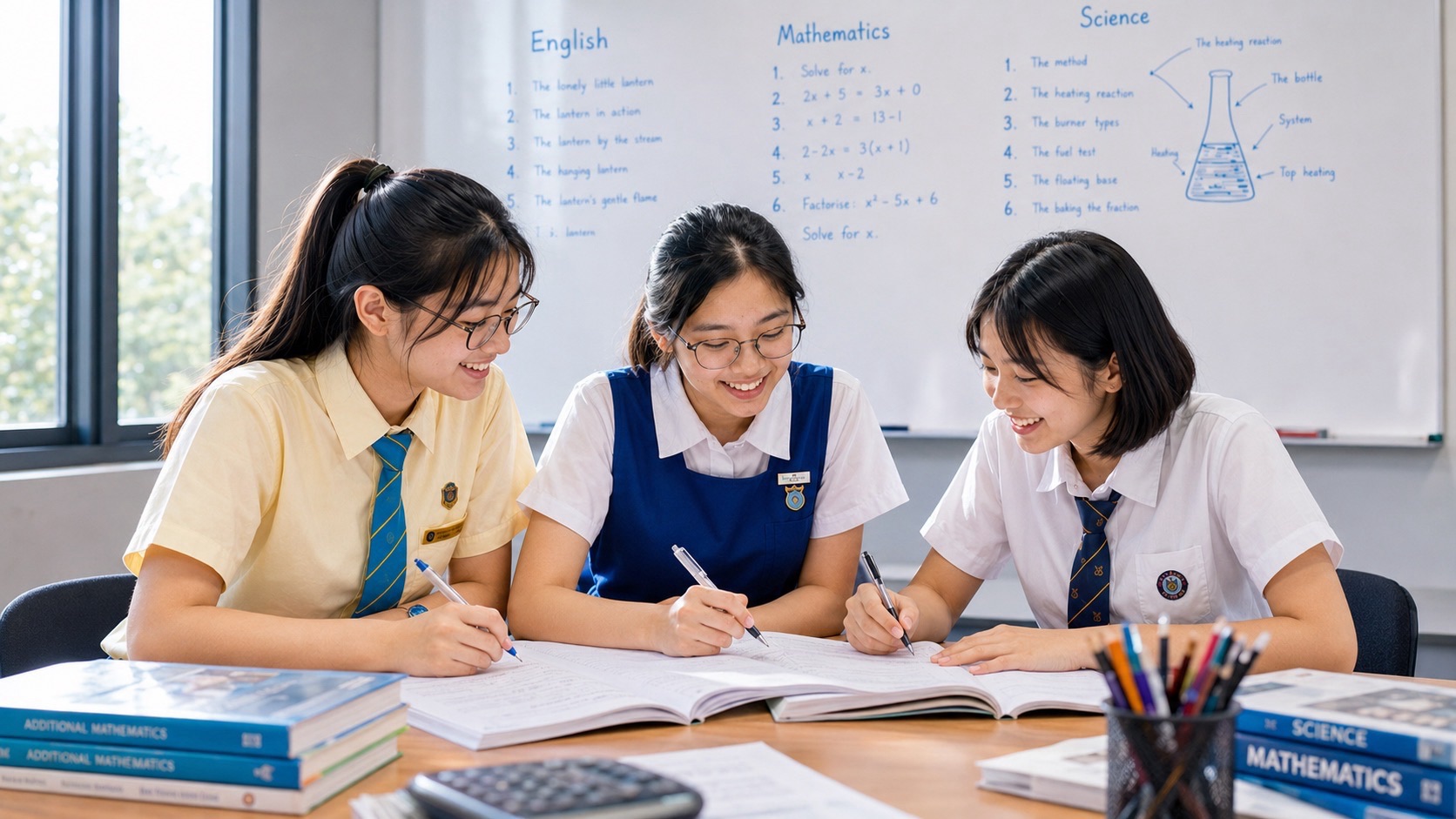
Secondary 3 English Tuition for Kallang Students
Secondary 3 English tuition for Kallang students should be designed around upper-secondary readiness. The learner is no longer only adjusting to Secondary school. Reading becomes denser, essay questions demand stronger interpretation, examples need explanation, situational writing requires sharper audience control, and time pressure begins to expose weaknesses that were previously hidden by guided practice.
Families searching for Secondary 3 English tuition in Kallang or Kallang-Whampoa may be looking for comprehension, essay writing, grammar, vocabulary, oral communication, editing or examination preparation. The most useful programme should connect those areas instead of treating them as unrelated worksheets. A weak evidence habit can damage comprehension and argument. Weak sentence control can reduce marks in continuous writing and situational writing. Poor timing can damage every component at once.
Secondary 3 is therefore the year to turn general English ability into deliberate performance. The student needs to know what a question is asking, what the evidence permits, how an argument develops, how examples function, how language changes with purpose and audience, and how to keep those skills available under realistic conditions.
Kallang Location Fit and Upper-Secondary Workload
Upper-secondary students often carry heavier school, project and co-curricular commitments. For Kallang families, convenience can therefore matter genuinely. Yet a nearby class is useful only if it addresses the learner’s actual needs. Compare travel time and timetable fit together with diagnostic quality, writing feedback, revision practice and syllabus alignment.
The Secondary 3 Readiness Audit
A readiness audit should use recent marked work. For comprehension, classify losses by question interpretation, evidence, inference, language effect and answer scope. For writing, separate prompt interpretation, thesis, development, examples, organisation, register, grammar and editing. For execution, record planning time, question stalls, unfinished sections and whether the student can recover after a difficult item. The audit should end with a priority order, not a list of every possible weakness.
Upper Secondary Needs Transfer, Not Familiarity
A student may perform well on a topic practised in class and still struggle on an unseen task. Secondary 3 tuition should therefore test transfer deliberately. Change the topic, text type, question wording and time conditions while keeping the underlying skill constant. Real learning appears when the student recognises the principle beneath the surface change.
Iona: Evidence Has to Become Argument
At Secondary 3, comprehension work should move beyond locating information. Iona asks what the evidence actually proves and how strongly it proves it. Students should distinguish between a passage that suggests hesitation and one that shows outright refusal, between a writer who questions a policy and one who condemns it, and between a character who appears uncomfortable and one whose fear is explicitly established.
This is the year to calibrate interpretation. Strong comprehension answers are not confident guesses. They are evidence-bounded judgments.
The student should be able to identify the relevant clue, state the conclusion, explain the bridge between them and keep the claim inside the evidence boundary.
Read the Whole Passage as a Structure
Upper-secondary comprehension becomes easier when students see the passage as organised thought.
Where does the writer introduce the issue? Which paragraph supplies evidence? Where does the viewpoint shift? Which paragraph introduces a complication? What does the conclusion add?
A useful exercise is paragraph-function mapping.
Students label each paragraph with a short job such as introduce, explain, illustrate, contrast, qualify, challenge or conclude.
The labels do not need to be perfect.
Their purpose is to make structure visible.
A student who can see structure searches less randomly for answers.
Language Effect: Move Beyond Technique Names
Students often identify a metaphor, repetition or rhetorical question and assume the answer is complete.
It is not.
The useful question is what the wording does in this context.
If a policy is described as “a net stretched over every small decision,” the student should explain the image of restriction and how it supports the writer’s concern about excessive control.
Technique, meaning and contextual effect belong together.
Iona teaches students to move from label to interpretation.
Writer’s Purpose and Attitude
A writer’s purpose is rarely captured by a generic word such as “persuade.”
Students should ask what the writer wants the reader to notice, reconsider, question or accept.
Attitude also needs calibration.
Concerned is not the same as outraged. Skeptical is not the same as dismissive. Amused is not the same as mocking.
The evidence is usually found in patterns of word choice and selection of detail.
Secondary 3 students should learn to support attitude claims rather than merely naming emotions.
Summary and Synthesis
Secondary 3 students need to combine information across a text.
Synthesis means grouping related details without flattening important distinctions.
A useful exercise gives students eight details and asks them to reduce them to three broader ideas.
The learner must explain which details belong together and why.
This skill supports summary, note-making and essay planning.
Students who can synthesise often write more coherent arguments because they see categories and relationships rather than disconnected facts.
Vocabulary for Upper-Secondary Thinking
Vocabulary should help the student think more precisely.
Words such as credible, superficial, sustainable, restrictive, proportionate, ambiguous, resilient and marginal can be useful when understood accurately.
So can verbs such as reinforce, constrain, undermine, facilitate, justify, acknowledge and distort.
The objective is not to sound academic.
The objective is to express a more exact relationship.
“Bad” is too broad when the writer means ineffective, unfair, intrusive, costly or counterproductive.
Precision improves thought.
Collocation and Register
A student may know the meaning of a word and still use it awkwardly.
Collocation solves part of this problem.
We raise a concern, pose a risk, draw a distinction, reach a conclusion and allocate resources.
Students should collect useful word partnerships from reading.
Register matters too.
A phrase appropriate in a formal argument may sound unnatural in a personal narrative.
Maren teaches vocabulary as a choice made for purpose.
Build Vocabulary Through Contrast
Contrast exposes semantic boundaries.
How is efficient different from effective?
How is skeptical different from cynical?
How is confident different from arrogant?
How is significant different from dramatic?
Students define the distinction, create examples and test substitution.
If replacing one word with another changes the meaning, the boundary becomes visible.
This practice produces more reliable active vocabulary than memorising a long synonym list.
Grammar Under Real Writing Conditions
Secondary 3 grammar should increasingly be tested inside authentic writing.
Isolated drills remain useful for repair, but they are not the final test.
A student may know subject-verb agreement and still lose control while writing a complex argument quickly.
Common upper-secondary risks include unclear pronoun reference, modifier placement, fragments, comma splices, tense inconsistency and overlong sentences.
The tutor should identify each student’s recurring error families.
Those become the editing priorities.
Sentence Logic
Grammar and reasoning meet inside the sentence.
A sentence can be mechanically correct but logically confused.
Connectors should express real relationships.
Although signals concession.
Because signals cause.
Therefore signals consequence.
However signals contrast.
For example signals illustration.
Students can practise by removing connectors from a paragraph and restoring them according to meaning.
Another exercise gives an incorrect connector and asks how it changes the logic.
This improves writing and reading simultaneously.
Maren: What Is the Essay Trying to Prove?
Secondary 3 essays become stronger when students stop treating them as several paragraphs to fill.
The essay is one answer to one question.
Maren begins with scope.
What is the command? What population or context matters? Which key terms need definition? Is the task asking for causes, effects, evaluation, comparison or recommendation?
Only then should the student build a thesis.
A thesis should guide the body rather than repeat the prompt.
Thesis Control
A weak thesis often says that an issue has advantages and disadvantages.
A stronger thesis makes a judgment and identifies conditions.
For example, a student may argue that competition can motivate improvement when it remains proportionate and does not destroy collaboration, but excessive ranking can distort the purpose of learning.
Now the body has direction.
Each paragraph can be tested against the thesis.
If it does not help establish the judgment, it may not belong.
Develop the Mechanism
A body paragraph needs more than a point and an example.
The mechanism explains how the point works.
Suppose the claim is that public libraries remain valuable despite digital access.
The mechanism might be that libraries reduce access barriers by providing physical study space, internet access, curated resources and human support.
An example can then illustrate that mechanism.
The writer then interprets the example.
This creates development.
Use Examples as Evidence
Students often insert examples because they remember them.
Maren asks: what does the example prove?
A useful example demonstrates a mechanism, tests a claim or shows a consequence.
A weak example merely shares the topic.
The student should be able to write one sentence explaining why the example matters.
If that sentence is impossible, the example may not be useful.
This habit prepares students for more demanding evaluation later.
Counterarguments and Qualification
Secondary 3 students should learn that acknowledging another view can strengthen an argument.
A counterargument should be reasonable, not deliberately weak.
Suppose the student argues that online learning increases flexibility.
A reasonable limitation is that flexibility can reduce structure for learners who struggle with self-management.
The writer can then refine the original claim.
Online learning works best when flexibility is paired with clear routines and support.
The argument becomes more precise because it has survived challenge.
Build Knowledge by Mechanism
Students often worry that they do not know enough examples.
The solution is not to memorise hundreds of facts.
Build knowledge by mechanisms and themes.
For technology: access, productivity, privacy, misinformation, automation and attention.
For education: motivation, feedback, assessment, opportunity and equity.
For environment: consumption, incentives, infrastructure, regulation and behaviour.
Examples can then be attached to a mechanism.
This makes knowledge flexible.
Narrative Writing: Earn the Turning Point
Upper-secondary narrative writing should not depend on random surprises.
The turning point should grow from earlier decisions and pressures.
If a character confesses, the reader should understand why the confession becomes necessary.
If a friendship changes, earlier interactions should make the change plausible.
Students can plan backwards from the decisive moment.
What must the reader know before this point?
What pressure has to build?
What consequence follows?
This creates narrative coherence.
Personal and Reflective Writing
Reflective writing should contain thinking, not only recount.
What did the writer believe before the event?
What challenged that belief?
What did the experience reveal?
What remains unresolved?
A convincing reflection does not need a perfect moral.
Partial insight can be more credible.
Students can compare a simple recount with a reflective rewrite of the same event.
The difference becomes visible.
Situational Writing: Adapt the Source to the Reader
Secondary 3 situational writing is a decision-making task.
Students need role, audience, purpose, content and register.
They also need to develop source information appropriately.
If the stimulus says an activity includes mentoring, the writer may need to explain why mentoring matters to the recipient.
That explanation must remain faithful to the source.
Do not invent facts.
Iona protects accuracy while Maren shapes usefulness.
Register Stability
Students sometimes begin with the correct register and drift.
A formal request becomes casual.
A message to a friend becomes stiff.
A proposal sounds like an advertisement.
Register is not a greeting.
It is a pattern of language choices across the entire response.
Training should compare audiences and purposes.
Students should be able to explain why one phrasing fits better than another.
Paraphrasing Is Not Synonym Replacement
Weak paraphrasing changes individual words.
Strong paraphrasing begins with understanding.
The student identifies the core relationship and then expresses it naturally in a form suited to the new sentence.
This prevents distorted meaning.
The skill matters in situational writing, comprehension and later academic tasks.
Students should practise paraphrasing short ideas before attempting long passages.
Oral Communication: Reason in Real Time
Secondary 3 oral work should become more flexible.
Students can use a simple sequence: position, reason, example, qualification.
Then the tutor challenges the response.
The student learns to respond rather than repeat.
Iona checks whether the example supports the claim.
Maren checks organisation.
Leonie helps the student recover when the first answer is imperfect.
This creates spoken reasoning rather than memorised scripts.
Listening: Anticipation and Recovery
Before audio begins, students can predict the type of information each question requires.
During listening, they should notice contrast, correction and changes of mind.
A speaker may mention one plan and later reject it.
The first familiar word is not always the answer.
If one item is missed, Leonie’s rule applies: protect the next mark.
Attention has to return to the current audio.
Leonie: Timing Becomes Strategic
Secondary 3 is the right stage to make time allocation explicit.
Students should know which tasks tend to expand.
One difficult comprehension question can consume time needed for several easier ones.
An introduction can absorb too many minutes while the final paragraph is rushed.
Leonie uses checkpoints.
At a planned point, the student checks progress and adjusts.
The checkpoint is a guardrail, not a rigid prison.
Build Timing Gradually
Start untimed when a skill is new.
Then use a generous limit.
Then use a normal section budget.
Then combine several sections.
Finally run integrated simulations.
This progression separates knowledge problems from execution problems.
If accuracy is weak without time pressure, speed is not the first issue.
If accuracy is strong untimed and collapses under a clock, execution becomes the priority.
Full Papers Are Tests, Not the Only Training
Full papers are useful, but they are expensive in time.
If a student repeatedly loses inference marks, fifteen targeted inference problems may teach more than another full paper.
If paragraphs lack development, three carefully revised body paragraphs may be more valuable than another complete essay.
Training should alternate between component repair and integrated performance.
Repair builds the mechanism.
Full papers test whether mechanisms work together.
The Secondary 3 Error Ledger
Students should track recurring losses.
Comprehension categories can include question misread, wrong evidence, incomplete evidence, unsupported inference, vague wording and over-answering.
Writing categories can include scope drift, thin development, weak example, missing interpretation, grammar pattern and rushed conclusion.
Execution categories can include planning overrun, question stall and skipped checking.
The ledger should stay short.
Its purpose is to guide the next practice.
From Marked Paper to Next Action
After a school assessment, ask what should change.
Suppose the student lost six comprehension marks, four through overstrong inference.
That is one major pattern.
Suppose three grammar errors all involve pronoun reference.
That becomes a language priority.
Suppose the last section is unfinished.
Timing may be the constraint.
Marked work is valuable when it changes the plan.
A Personal Writing Corpus
Secondary 3 students should keep selected before-and-after writing.
Save one original paragraph, the feedback and the revised version.
Record what changed.
Perhaps the claim became narrower.
Perhaps the mechanism was added.
Perhaps the example became more specific.
Perhaps a sentence was divided for clarity.
Over time, the corpus becomes a personal revision guide.
Reading Outside Examination Passages
Students should continue reading widely.
Journalism, essays, reviews, speeches, narrative nonfiction and fiction provide different structures and vocabularies.
Not every text needs analysis.
Once or twice a week, ask four questions.
What is the main claim or tension?
What evidence is used?
What phrase or sentence is especially effective?
What assumption or limitation could be questioned?
This keeps critical reading alive.
A Secondary 3 Weekly Lesson Cycle
Begin with retrieval.
Revisit one vocabulary item, one grammar risk and one reading decision.
Then teach the main skill.
Model the difficult decision.
Students practise collaboratively.
Then use an unseen task.
Feedback identifies the priority.
Students revise.
Add time pressure only when the method is accurate enough.
Finish by naming the transfer target for schoolwork.
The Twelve-Week Secondary 3 Kallang Plan
Weeks one and two establish the readiness baseline.
Weeks three and four repair the highest-impact weakness.
Weeks five and six add a second priority while retrieving the first.
Weeks seven and eight test both skills on unfamiliar material.
Weeks nine and ten add realistic timing.
Weeks eleven and twelve run an integrated task and compare it with the baseline.
Then the next cycle begins.
The plan changes when evidence changes.
Full Subject-Based Banding
Secondary 3 students may take English at different subject levels.
Tuition should align with the learner’s actual syllabus and requirements.
The same student may need different challenge levels across skills.
Reading may be secure while writing is weak.
Grammar may be stable while oral reasoning needs development.
A good tutor calibrates difficulty component by component.
Productive challenge matters more than simply making every worksheet harder.
The SEC Transition
Students in cohorts moving into the Singapore-Cambridge Secondary Education Certificate need current, cohort-specific information.
Under the SEC framework, subjects are taken at the relevant G1, G2 or G3 level.
The practical learning principle remains stable.
Read accurately.
Interpret evidence.
Write with purpose.
Control language.
Execute under conditions.
Paper details can change, but these capabilities continue to matter.
Kallang Parent Decision Framework
Kallang families should bring recent marked work when comparing Secondary 3 tuition.
Ask what the first constraint appears to be.
Ask what the first month would train.
Ask how writing is revised.
Ask how unseen transfer is tested.
Ask when timed practice begins.
Then consider travel and workload.
A useful programme should fit both the academic need and the student’s actual week.
Kallang, Travel and Cognitive Energy
Upper-secondary students may have long school days.
A tuition slot that looks convenient can still be poor if the student arrives exhausted.
Families should consider food, travel, homework, co-curricular activities and sleep.
The best schedule is one the student can sustain.
A slightly later or different-day lesson may produce better attention.
Learning depends on cognitive energy, not just attendance.
How to Use the Kallang English Guides
The eduKate guides include a broader introduction to English tuition in Kallang.
This page focuses on Secondary 3 English needs.
Use the SETC Secondary 3 guide for the whole-year framework, the Kallang Secondary 1, 2 and 4 pages for those year levels, and the broader Kallang English guide for local context.
Choose the guide that answers your current question.
Start here for local Secondary 3 support, then follow the related guides when you need another year level or broader local context.
Maren, Iona and Leonie: A Secondary 3 Kallang Case
Imagine a fictional Secondary 3 student with acceptable overall marks but inconsistent upper-secondary performance.
Iona notices that inference answers are plausible but too strong.
Maren notices that essay examples are relevant but insufficiently explained.
Leonie notices that the student spends too long planning the introduction and rushes the final body paragraph.
The interventions differ.
Iona calibrates claims.
Maren trains mechanism and interpretation.
Leonie introduces a planning limit and midpoint checkpoint.
The next unseen timed task tests whether all three changes survive together.
Build an Evidence Bank Without Memorising Essays
Students need examples, but they need flexible examples.
Organise evidence by mechanism rather than by model essay.
For each example, record what it demonstrates, which kinds of claims it could support and what limitation should be remembered.
This prevents students from forcing a remembered example into an unsuitable question.
The prompt should come first.
Evidence selection should follow.
Maren teaches the student to build the argument before choosing the supporting example.
Better Introductions
Upper-secondary introductions should clarify the issue.
Avoid broad openings such as “In today’s modern society.”
Define the key distinction.
Establish scope.
State the thesis.
If a question concerns smartphones in schools, the introduction might distinguish unrestricted recreational use from purposeful teacher-directed use.
That distinction immediately creates a sharper argument.
The introduction should prepare the body rather than perform for the reader.
Better Conclusions
A conclusion should return to the thesis after the argument has done its work.
It should not merely repeat body paragraphs.
The final judgment can become more precise by acknowledging the main condition or trade-off.
Do not introduce a completely new major argument.
A strong conclusion sounds as though the essay has learned something.
Maren asks whether the final judgment is sharper than the opening claim.
The Exam-Simulation Ladder
Use a ladder rather than jumping from explanation to full papers.
First prove the skill untimed.
Then use a generous limit.
Then use normal section timing.
Then combine sections.
Finally use a full simulation.
After each stage, analyse performance.
Which error categories remain?
Which time behaviours appear?
Which skills are stable enough for maintenance?
The simulation should update the plan.
Independence as the Readiness Measure
A Secondary 3 student is becoming ready when the tutor no longer has to rescue every step.
The student should be able to interpret the question, choose evidence, plan a paragraph, identify a grammar risk, revise after feedback and recover after difficulty.
This does not mean help is no longer needed.
It means help can move to higher-value problems.
Tuition should reduce unnecessary dependence over time.
Common Secondary 3 Traps
Common traps include full-paper drilling before component repair, memorised introductions, difficult vocabulary without register control, long comprehension answers that exceed evidence and examples that replace reasoning.
Another trap is assuming that confidence makes a claim true.
Upper-secondary English rewards defensibility.
The student needs to show why a conclusion follows.
Another trap is leaving timing until the final year.
Secondary 3 is the safer place to build execution habits.
Frequently Asked Questions
Is Secondary 3 too late to repair foundations?
No. There is still meaningful time, but diagnosis should be precise and practice should target recurring losses.
Should Secondary 3 tuition be exam-focused?
It should become more assessment-aware, but technique should sit on top of reading, writing and language competence.
How often should timed practice happen?
Use short timed components once the skill is accurate. Add integrated simulations periodically.
What if the student has strong ideas but weak essays?
Inspect scope, paragraph development, mechanisms, examples, sentence control and revision. Ideas need architecture.
What if comprehension answers are almost correct?
Check evidence sufficiency, inference strength and answer scope.
Should students memorise essays?
No. Study models for decisions, structure and language, then practise adapting those principles to unseen prompts.
How should parents judge progress?
Compare unseen work, recurring error categories, timing stability and independence over time.
The Goal of Secondary 3 English Tuition in Kallang
Secondary 3 English tuition for Kallang students should build upper-secondary readiness without panic.
Iona protects evidence, inference and reading precision.
Maren protects thesis, development, vocabulary and writing architecture.
Leonie protects timing, recovery and transfer under conditions.
When those systems work together, the student enters Secondary 4 with fewer hidden weaknesses and a clearer method for unfamiliar English.
Continue through the Kallang and Secondary English routes
Use the SETC Secondary 3 guide for the whole-year framework. Use the Kallang quartet to move between Secondary 1, 2, 3 and 4. Use the broad Kallang English guide for location-level context. Check current SEAB information when cohort-specific subject-level or examination details matter.
Secondary 3 Comprehension Laboratory: Calibrate the Strength of the Claim
Upper-secondary students often produce answers that are plausible but too strong. A useful laboratory begins with pairs of statements. One statement is cautiously worded; the other is more absolute. Students decide which one the evidence supports and explain the difference.
For example, a passage may show a student delaying a reply. “The student appears uncertain” may be defensible. “The student is afraid of the consequences” may require additional evidence.
The exercise teaches claim strength.
Next, students rewrite previously marked answers by changing only the intensity of the conclusion. They learn that precision may depend on one verb or adjective.
Finally, Iona gives a fresh unseen passage. If the student now calibrates the inference without prompting, the skill has begun to transfer.
This laboratory is valuable because many almost-correct comprehension answers are not failures of understanding. They are failures of evidential control.
Secondary 3 Argument Laboratory: Mechanism Before Example
A common upper-secondary weakness is the example-heavy paragraph. The student remembers a relevant event, organisation or trend and assumes that mentioning it creates an argument.
Maren reverses the sequence.
First write the claim.
Then explain the mechanism without using any example.
Only after the mechanism is clear may the student select evidence.
Suppose the claim is that public spaces can reduce social isolation. The mechanism might be that repeated low-pressure encounters create familiarity and make social contact more likely. Now an example has a job: it illustrates the mechanism.
Then the student adds interpretation. Why does the example strengthen the claim? Under what condition might the effect be weaker?
This sequence forces reasoning to carry the paragraph.
Secondary 3 Evaluation Laboratory
Evaluation can be taught through contrasts.
Give the student two solutions to the same problem. Ask which one is more effective, which one is more feasible, which one reaches more people, which one is faster, which one is more sustainable and what trade-off separates them.
The student cannot answer every question with the same judgment.
This teaches that evaluation depends on criteria.
Next, the student applies one criterion inside an essay paragraph.
Instead of writing, “This solution is good,” the student writes why it may be more practical in a particular context while acknowledging a limitation.
Evaluation becomes a repeatable intellectual move rather than a final paragraph added for sophistication.
Secondary 3 Source-Use Laboratory
Situational writing and analytical tasks both require disciplined source use.
Give the student a short source with six facts.
Ask the learner to write for three different audiences: a friend, a school leader and a community organisation.
The factual core remains the same, but selection, order, tone and explanation change.
Iona checks that no fact has been distorted.
Maren checks that the information is useful to the intended reader.
This exercise shows that adaptation is not invention.
It is the controlled reshaping of accurate material for a different communicative purpose.
The Secondary 3 Timed-Paragraph Test
Before running full essays, test whether one strong paragraph can be produced within a realistic budget.
Give the student a new question.
Allow a short planning interval.
Then require one complete body paragraph with claim, mechanism, example and interpretation.
Afterward, the student marks where time was spent.
Was planning too long?
Did the example consume too many words?
Did the student stop to search for sophisticated vocabulary?
Did the final interpretation disappear because the clock was running?
Leonie uses this information to refine the routine.
A timed paragraph isolates execution without the complexity of a full paper.
Four Kinds of Secondary 3 Reading
Students benefit from different reading modes.
The first is extensive reading: read for continuity and exposure.
The second is structural reading: identify how a text is organised.
The third is evidential reading: locate what supports a specific claim.
The fourth is critical reading: ask what is assumed, omitted or qualified.
Not every text needs all four modes.
A novel chapter may be read extensively.
A newspaper commentary may be used for structural and critical reading.
A comprehension passage may require evidential reading.
Students become stronger when they know what kind of reading the task requires.
Build a Secondary 3 Knowledge Grid
Instead of a long list of facts, create a grid.
Use columns for theme, mechanism, example, limitation and possible questions.
For technology, one row might concern attention. Another might concern access. Another privacy.
For education, rows might include feedback, motivation, assessment and inequality.
This grid helps students see that one example can support more than one question if the mechanism is understood.
It also shows when an example does not fit.
The grid should remain small enough to review.
Knowledge should support thought, not become another burden.
How to Review an Essay Without Rewriting the Whole Essay
Students sometimes avoid revision because rewriting a complete essay feels expensive.
Use targeted revision.
Choose the weakest paragraph.
Rewrite only the thesis if scope is wrong.
Rewrite only the mechanism if development is thin.
Replace only the example if it does not support the claim.
Add one evaluative sentence if judgment is missing.
Repair the two most frequent grammar patterns.
This makes revision faster and more diagnostic.
The student can then use an unseen prompt to test whether the repaired skill transfers.
Secondary 3 Reading Speed Without Skimming Meaning Away
Students often respond to time pressure by trying to read faster.
Speed without structure can reduce comprehension.
A better approach is to reduce unnecessary rereading.
Preview paragraph boundaries.
Notice connectors.
Mark where the writer changes direction.
Read the question carefully enough that the search for evidence has a purpose.
When a question points to a particular phrase, return directly to the local context.
Efficiency comes from better navigation, not merely faster eye movement.
The Secondary 3 End-of-Term Readiness Review
At the end of a term, compare a recent unseen task with one from earlier in the term.
Look at evidence precision.
Look at paragraph development.
Look at recurring grammar errors.
Look at timing.
Then ask the student to identify the first remaining constraint.
A useful answer might be: “My evidence is usually correct, but I still overstate what it proves.”
Or: “My body paragraphs are stronger, but I lose evaluation when I am timed.”
This level of self-diagnosis shows growing maturity.
The next term can then begin from the real learning state.
Kallang Parent Questions for Upper-Secondary Tuition
Parents can ask whether the programme distinguishes component repair from full-paper practice.
Ask how comprehension errors are classified.
Ask whether essays are revised after marking.
Ask how examples and knowledge are taught.
Ask how timing is introduced.
Ask how current subject-level and examination information is checked.
Ask what the tutor expects the student to manage independently by the end of the term.
These questions reveal whether the programme is designed for transfer or only for repeated completion.
Secondary 3 Should Reduce Future Panic
One purpose of Secondary 3 tuition is to make Secondary 4 less chaotic.
If evidence habits are repaired now, final-year comprehension becomes easier to stabilise.
If paragraph development is trained now, the final year can focus more on evaluation and timing.
If personal grammar risks are known now, editing becomes more efficient.
If the student already has a knowledge grid and evidence bank, later essay preparation is less dependent on last-minute memorisation.
If timing routines are introduced gradually, full simulations become diagnostic rather than frightening.
Secondary 3 should build runway.
It should not wait for the final year to discover every weakness at once.
Kallang Local Discovery Note
This page is a local discovery and decision guide for families around Kallang, Bendemeer, Geylang Bahru, Boon Keng and Lavender. It does not claim or imply that SETC operates a physical branch at every location named here. Families should compare educational fit, diagnosis, feedback, class size, travel load, school commitments and whether the Secondary 3 English programme remains sustainable across the week.