
Creative writing classes should make a student more capable of creating, shaping and revising ideas—not more dependent on a bank of memorised stories.
When a child says, “I don’t know what to write,” the problem is not always a lack of imagination. The child may have experiences, observations and ideas but no method for finding them quickly. Another student may have many ideas but no way to organise them. A third may write vividly for one paragraph and then lose control because the story has no structure. A fourth may produce technically correct sentences that never become a compelling piece.
That is why our approach to creative writing classes in Singapore separates creativity from decoration. Creative writing is not a contest to use the largest number of adjectives, idioms or memorised phrases. It is the ability to notice, choose, shape and revise material so that a story becomes purposeful and readable.
This page is the dedicated creative-writing route at Singapore English Tuition Centre. It sits beside, but does not replace, our English Composition Tuition Singapore page. Composition tuition is tighter and more examination-directed. Creative writing has a wider field: story craft, voice, observation, character, scene, perspective, experimentation and the ability to build an idea before an examination constraint is applied.
Both routes connect to the broader English Writing and Composition library, our Primary English route and the PSLE English performance system.
Creative Writing Is a System of Choices
A blank page can feel unlimited. That is precisely why it can be difficult. Without constraints, the young writer must decide almost everything at once: who is involved, where the piece begins, what changes, what matters, what to leave out, what tone to use, how much description is enough, and where the piece should end.
We make those choices visible. A creative-writing lesson may focus on one or two decisions at a time:
- finding a workable central idea;
- choosing a viewpoint;
- building a character who wants something;
- creating a problem or pressure;
- deciding where the story should begin;
- turning summary into a scene;
- using dialogue to change the situation;
- selecting details that reveal rather than decorate;
- controlling pace;
- ending with consequence rather than stopping abruptly;
- revising weak sentences; and
- carrying a learned craft principle into a new piece.
Creativity becomes less mysterious when students can see the decisions inside it.
Why Students Run Out of Ideas
Idea generation is often treated as a personality trait: some children are “creative” and others are not. We take a more teachable view. Students can learn how to search for material.
A writer’s usable material comes from several places:
- memory;
- observation;
- reading;
- conversation;
- images;
- places;
- conflicts;
- relationships;
- questions;
- imagined alternatives;
- unexpected combinations; and
- the writer’s own emotional experience.
A child who says, “Nothing interesting has happened to me,” may be assuming that stories need extraordinary events. We show how ordinary material becomes interesting through selection and attention. A lost object can become a story about responsibility. A late bus can become a story about impatience, embarrassment or unexpected kindness. A disagreement can reveal loyalty, pride or misunderstanding. A small decision can carry a large consequence.
The important shift is from hunting for a spectacular event to noticing the human movement inside an ordinary event.
Maren, Iona and Leonie: Three Different Writing Bottlenecks
Maren can generate ten possible plots in five minutes. Her creativity is not the problem. Her difficulty is commitment. Because every new idea seems attractive, she keeps changing direction. The story expands faster than she can control it. Her training focuses on selection: choose one movement, define the turning point, and make each paragraph serve that movement.
Iona notices subtle things. She sees expressions, gestures and changes in mood, but her writing remains compressed. She assumes the reader can see what she sees. Her training focuses on externalising the observation: convert an internal impression into specific action, dialogue, setting or thought.
Leonie writes confidently until she starts judging every sentence as she produces it. She stops, deletes, rewrites, searches for a better word and loses momentum. Her training separates drafting from editing. First move the piece forward. Then return with a defined revision job.
All three students may appear to have a “creative writing problem.” The actual bottleneck is different. That is why small-group writing instruction benefits from close observation of process, not only marking of finished work.
The Story Engine: Want, Pressure, Choice, Consequence
Young writers sometimes think a story is simply a sequence of events: first this happened, then this happened, then something else happened. Events alone do not guarantee movement. A story becomes more coherent when the writer understands what is changing and why it matters.
One useful story engine is:
- want: what does the character hope to achieve, protect, hide or avoid?
- pressure: what makes that difficult?
- choice: what must the character decide or do?
- consequence: what changes because of that choice?
This is not a formula that every story must follow in exactly the same way. It is a diagnostic lens. If a draft feels flat, we can ask whether anyone wants anything, whether meaningful pressure exists, whether the character makes a choice, and whether the choice changes the situation.
Once students understand story movement, they can bend it, delay it, hide it or make it subtle. Structure becomes a tool rather than a cage.
Begin Where the Story Becomes Necessary
Many young writers begin too early. They wake the character, describe the weather, explain the entire family, show breakfast, travel to school and only then reach the event that matters.
We ask a sharper question: where does the story become necessary?
If the piece is about a friendship tested by a mistake, the story may begin near the mistake. If it is about overcoming fear, it may begin when the character can no longer avoid the feared situation. If the point is a difficult decision, the opening should move the reader toward that decision rather than spending half the word count on background.
Students learn to distinguish context from story. Context helps the reader understand. Story begins when the situation starts to change.
Character Is Revealed Through Behaviour
“She was nervous” tells the reader the emotion. Sometimes that direct statement is exactly right. At other times, the writer can make the emotion more vivid through behaviour: the repeated checking of a phone, the unfinished sentence, the grip on a bag strap, the decision to stand near the exit.
Creative writing classes should expand the student’s options. We do not ban direct statements. We teach students to decide when to state, when to show, when to imply and when to combine them.
Character can be built through:
- action;
- inaction;
- dialogue;
- word choice;
- what the character notices;
- what the character avoids;
- contradiction between speech and behaviour;
- relationships with other people;
- response under pressure; and
- change after consequence.
This gives the student more than a list of character adjectives. It gives the writer methods for making character visible.
Description Should Change What the Reader Understands
Description is often over-taught as a collection of sensory phrases. The result can be technically descriptive but narratively useless. A writer describes every object in the room while the story waits outside.
We teach selective description. A detail earns its place when it helps establish mood, reveals character, creates contrast, signals change, slows an important moment, or makes the setting relevant to what happens next.
Consider a classroom before results are returned. The writer does not need to describe every desk, fan and window. A single unused correction pen on the table, the unusually quiet row behind the protagonist, or the teacher holding the stack face-down may create more tension than a paragraph of general adjectives.
The skill is not “add more description.” It is “choose the detail that does work.”
Dialogue Must Do More Than Sound Realistic
Children often enjoy dialogue because it makes a composition move quickly. But realistic conversation can still be weak writing if nothing changes.
Useful dialogue may:
- reveal information;
- hide information;
- create conflict;
- show relationship;
- force a decision;
- change the character’s understanding;
- increase pressure;
- create humour;
- expose misunderstanding; or
- move the story into a new phase.
We also teach the mechanics that keep dialogue readable: punctuation, paragraphing, speaker clarity, interruption and the balance between speech and action.
Vocabulary: Build Range, Then Build Judgment
Creative writing benefits from a wide vocabulary because a writer with more precise words has more choices. But vocabulary growth should not become a hunt for words that merely sound advanced.
We develop vocabulary in usable clusters. A word may be learned with:
- its core meaning;
- common combinations;
- near-synonyms and differences;
- tone and strength;
- sentence patterns;
- examples in reading;
- retrieval prompts; and
- application in an original sentence or paragraph.
The writer then needs judgment. “Walked,” “hurried,” “staggered,” “paced” and “wandered” do not differ because some are better words. They differ because they describe different movement. Precision is the point.
The broader vocabulary route is English Vocabulary in Use | Choose Words That Do the Job.
Sentence Craft: Rhythm Follows Meaning
A sentence is not strong because it is long. Nor is a short sentence automatically dramatic. Sentence craft begins with the relationship between meaning and form.
Students learn to notice how sentence choices affect reading:
- short sentences can isolate a moment;
- longer sentences can accumulate detail or show a chain of thought;
- parallel structures can create emphasis;
- variation can prevent monotony;
- delayed information can create anticipation;
- precise verbs can reduce unnecessary description;
- punctuation can clarify relationships; and
- sentence openings can control pace and focus.
We connect craft to grammar because creativity without control can make meaning unstable. See English Grammar and Sentence Control.
Scene and Summary: Writers Need Both
Students are often told to “show, don’t tell.” The phrase can be useful, but taken literally it creates bloated writing. A story that shows everything moves unbearably slowly.
We teach the difference between scene and summary. A scene slows down an important moment so that the reader experiences action, speech, detail and decision. Summary compresses less important time so the story can move.
The writer’s job is to decide where the reader should stay and where the reader should travel quickly.
This distinction is especially valuable for school composition because word count and time are limited. A student who turns every event into a full scene may never finish. A student who summarises everything may produce a flat recount. Control comes from switching deliberately between the two.
Endings: Consequence, Recognition and Change
A weak ending often appears because the student treats the conclusion as a separate decoration added after the “real story” is finished.
We ask students to plan the ending condition earlier. What is different at the end? What has been learned, lost, repaired, understood, accepted or changed? The answer does not need to be dramatic. It needs to complete the movement of the piece.
An ending can work through:
- consequence;
- recognition;
- changed relationship;
- new understanding;
- irony;
- return to an earlier image;
- a restrained final action; or
- a decision that shows who the character has become.
The student learns that an ending is not simply where the word count stops.
Revision Is a Creative Skill
Young writers sometimes assume that creativity happens only during the first draft. In reality, revision is where many strong writing decisions are made.
Revision can involve:
- removing an unnecessary event;
- moving the story closer to the central moment;
- replacing a vague verb;
- turning explanation into action;
- adding one clarifying sentence;
- cutting repetitive dialogue;
- changing paragraph order;
- strengthening the consequence;
- correcting a point-of-view break; or
- rewriting the ending so it completes the story.
We teach students to revise with a job in mind. “Make it better” is too vague. “Find the paragraph where the tension stops increasing and repair the movement” gives the writer something teachable to do.
Creative Writing and School Composition: Where They Meet
Creative writing classes and school composition overlap because both require ideas, organisation, language and revision. The difference is the degree of constraint.
In creative writing, students may experiment more widely with viewpoint, form, pacing, voice and subject. In school composition, the task usually sets firmer boundaries. The student must remain relevant, demonstrate control, complete the piece under time pressure and respond to the prompt.
The broader creative environment can strengthen examination writing when transfer is taught deliberately. A student who learns to build character in creative writing should later recognise when characterisation is useful in a school composition. A student who learns scene control should understand when a PSLE or Secondary narrative needs a developed moment rather than a rushed summary.
We do not assume that transfer happens automatically. We make the bridge explicit.
Creative Writing by Stage
Lower Primary: Language, sequence and confidence
For younger writers, the aim is not to force sophisticated storytelling too early. Students need to form complete sentences, sequence events, describe familiar experiences, build vocabulary, connect cause and consequence, and discover that writing can communicate something they imagined or noticed.
Activities may include short scenes, picture prompts, character choices, dialogue, sentence expansion and simple planning. The emphasis is on control and enjoyment growing together.
Middle Primary: Build a usable craft toolkit
As students become more fluent, they can handle stronger story movement, paragraph functions, character development, selective description, vocabulary nuance and revision. They also begin learning that a good idea must fit the task and available space.
Upper Primary and PSLE: Transfer craft into constraint
Upper Primary writers need to keep creativity while becoming more deliberate about relevance, planning, pacing, accuracy and completion. At this stage, creative-writing skills should be tested against unfamiliar prompts and school-style conditions so that craft becomes examination-usable rather than remaining a separate hobby.
The connected examination route is PSLE English.
Secondary: Voice, genre and deeper control
Secondary students can explore subtler character motives, more controlled viewpoint, stronger narrative compression, reflective writing and the relationship between voice and genre. Creative practice can also support descriptive and reflective tasks by teaching students how perspective shapes selection.
For examination-specific Secondary composition mechanics, move to English Composition Tuition Singapore and Secondary English.
What Happens in a Three-Student Creative Writing Class
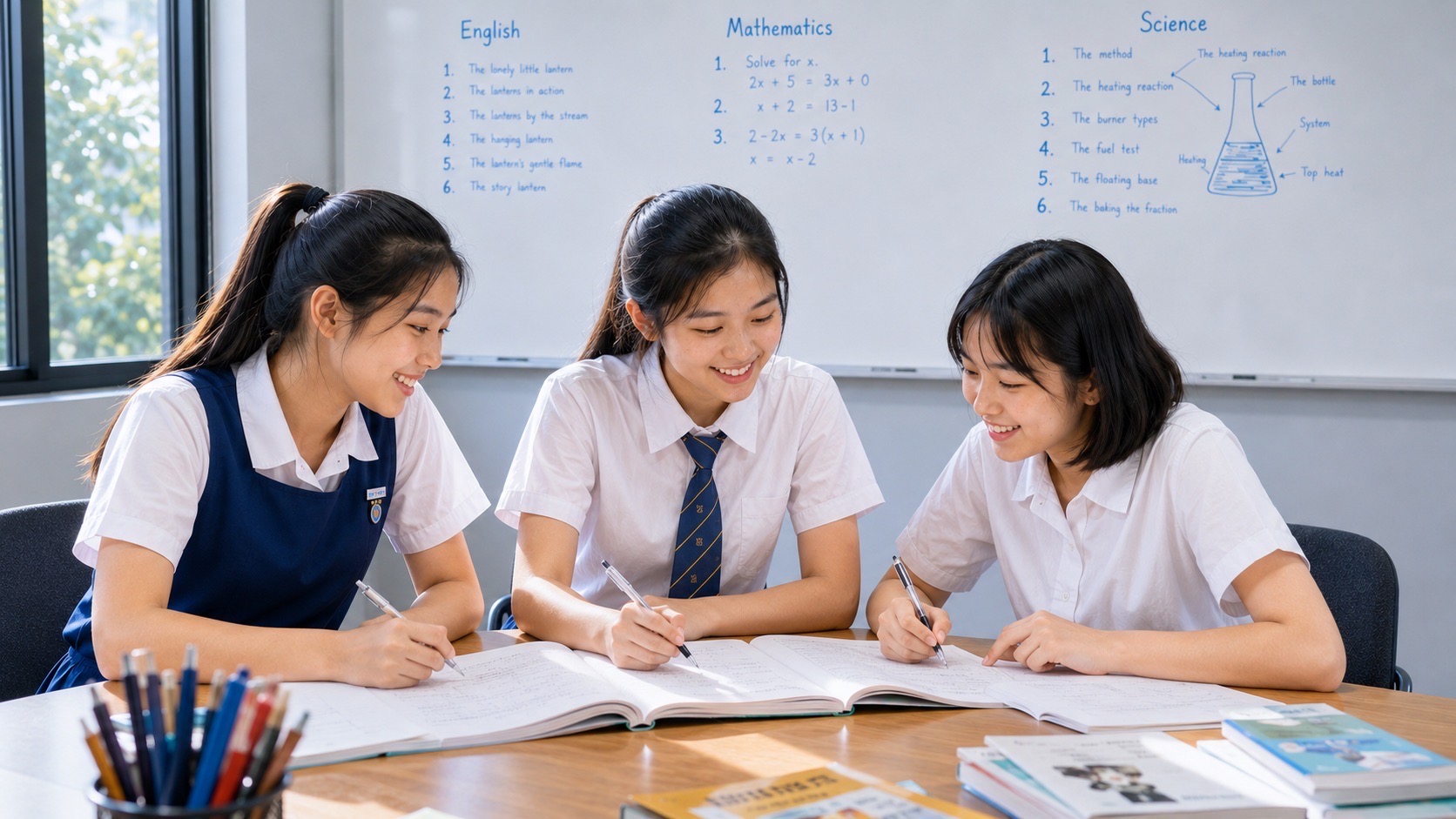
Creative writing needs individual response, but it also benefits from hearing how other writers solve the same problem. A three-student tutorial allows both.
A typical 90-minute lesson may include:
- a short observation or vocabulary warm-up;
- reading and discussing a strong passage;
- identifying one craft principle;
- generating several possible ideas;
- choosing and narrowing one idea;
- planning the movement of a scene or story;
- guided writing;
- independent writing;
- peer comparison without ranking;
- targeted tutor feedback;
- a short revision task; and
- a later transfer prompt that tests the same skill in a new context.
Students may share the same prompt but receive different feedback. Maren may be asked to remove two events. Iona may be asked to expand one revealing moment. Leonie may be asked to draft continuously for eight minutes before editing. The class remains shared; the teaching remains diagnostic.
For the small-group rationale, see Three-Student English Tutorials | Visibility, Feedback and Independent Performance.
Reading Feeds Writing
Students cannot build a rich writing life from writing exercises alone. Reading provides models of pacing, character, sentence rhythm, viewpoint, humour, description and structure. It also expands the student’s sense of what a story can be about.
We do not read only to collect “good phrases.” We ask questions such as:
- Where did the writer begin?
- What information was delayed?
- Which detail changed the mood?
- How did the character become visible?
- Why was this sentence short?
- What did the writer choose not to explain?
- Where did the scene speed up?
- How did the ending echo or transform the opening?
Reading becomes an apprenticeship in decisions.
Students who need broader reading development can use Stories, Literature and a Reading Life and English Reading and Comprehension.
Common Creative-Writing Failure Patterns
The phrase bank story
The student assembles memorised descriptions that do not belong to the event. The piece sounds decorated but emotionally empty. We repair this by choosing language after the scene and purpose are clear.
The everything story
The writer includes every idea that appears. The plot becomes impossible to develop. We teach selection, compression and one central movement.
The action-only story
Events happen rapidly, but the reader never understands why they matter. We add consequence, motivation and selected interior thought.
The description-only story
The writing is rich in adjectives but weak in movement. We ask what changes and which details contribute to that change.
The perfect-first-draft trap
The student edits every line while composing and loses flow. We separate drafting and revision into different jobs.
The borrowed voice
The piece sounds like a model essay because the student is reproducing someone else’s patterns. We use imitation temporarily as study, then require variation and original decisions.
What Progress Should Look Like
Progress in creative writing is not measured only by longer stories or more difficult vocabulary. Parents may notice that the student:
- generates ideas more quickly;
- chooses among ideas instead of using all of them;
- starts closer to the important moment;
- creates clearer character motives;
- uses dialogue with purpose;
- selects details rather than describing everything;
- varies sentence structure more naturally;
- uses vocabulary more precisely;
- finishes stories with stronger consequences;
- can revise a paragraph without needing it rewritten by the tutor;
- recognises craft choices while reading; and
- transfers a learned technique into a new prompt.
These changes show that the student is developing a writing toolkit rather than collecting model products.
When Creative Writing Classes May Be Useful
Creative writing classes may be useful when a student:
- freezes at open-ended prompts;
- repeats the same basic plot;
- has ideas but cannot structure them;
- writes event after event without development;
- relies heavily on memorised phrases;
- uses vocabulary inaccurately in an effort to sound advanced;
- avoids revision;
- finds school composition mechanical and wants a broader writing experience;
- reads widely but does not yet transfer what is noticed into writing;
- enjoys writing and needs more demanding craft instruction; or
- needs a stronger creative foundation before examination constraints are tightened.
If the main problem is specifically examination composition—question choice, prompt interpretation, timed planning, genre control or finishing under a clock—the more direct route is English Composition Tuition Singapore. If the learner needs reading, grammar, oral and broader school support as well, use English Tuition Singapore.
What Parents Can Bring to a Writing Consultation
Useful evidence includes school compositions, independent stories, teacher comments, unfinished drafts, planning notes, vocabulary lists, model essays the student has been studying and examples of prompts that create hesitation.
We look for patterns rather than isolated errors. Does the student always start too early? Does every story contain too many events? Are characters passive? Is dialogue decorative? Does vocabulary become less accurate when the student tries to sound sophisticated? Is the ending consistently rushed? Does feedback disappear in the next piece?
The purpose is to identify the first craft or control problem that, when repaired, improves more than one part of the writing.
Frequently Asked Questions About Creative Writing Classes Singapore
Are creative writing classes only for children who already enjoy writing?
No. Some students join because they enjoy writing and want more challenge. Others join because open-ended writing feels difficult. The teaching should meet the learner at the correct point: confidence and language foundations for one student, craft and experimentation for another.
Will creative writing help PSLE composition?
It can, especially by strengthening idea generation, story movement, character, selective description, vocabulary and revision. However, PSLE composition also requires prompt relevance, examination pacing and task-specific control. We therefore teach the transfer explicitly rather than assuming creative practice automatically becomes exam performance.
Do students memorise model compositions?
We may study strong models, but the purpose is to inspect decisions. Students identify how the piece begins, develops, controls detail and ends. They then apply the principle to a different prompt. Memorisation without transfer is not the goal.
What if my child has no ideas?
We teach idea generation as a search process using memory, observation, reading, images, relationships, conflict and alternative possibilities. The student does not need to wait for inspiration. A set of useful questions can make idea generation more reliable.
What if my child has too many ideas?
That is a different problem. We teach selection and compression: one central movement, fewer events, clearer consequences and more development of what remains. Strong writing often comes from what the writer chooses not to include.
Should creative writing focus on vocabulary?
Vocabulary is important, but it should be integrated with meaning. Students need words that are accurate, retrievable and natural in context. A vocabulary list becomes useful when the learner can recognise nuance and apply the word independently in new writing.
How much writing should happen in class?
Students need real writing time, but a useful class also includes reading, discussion, planning, craft instruction, feedback and revision. Writing volume without diagnosis can repeat weak habits. We balance production with the thinking that improves production.
Why use a three-student format?
Three students create enough variety for comparison while preserving close tutor attention. Writers can see that the same prompt allows different solutions, yet each learner still receives specific feedback on structure, language, pacing and revision.
Build Creativity That Remains Usable
A strong creative-writing programme does not ask a child to choose between imagination and control. The two support each other. Structure gives the idea somewhere to go. Vocabulary gives the writer more precise options. Reading expands possibility. Revision turns the first attempt into a better decision. Examination practice later adds constraint without needing to erase the writer’s voice.
Our aim is a student who can notice more, imagine more, choose more carefully and revise with purpose—and who can later carry those skills into school composition without becoming dependent on a memorised story.
Continue through English Writing and Composition, move into the exam-focused English Composition Tuition Singapore route, return to English Tuition Singapore, or explore the broader English Enrichment Class Singapore route.
Properly taught kids shine a bright light into the future.
Explore the decisions behind a story
Use these explanations alongside the creative writing lessons when an idea, scene or revision needs closer attention.