
Secondary 1 writing introduces a quiet but important shift.
Students are no longer expected only to produce correct sentences. They must begin organising those sentences around an idea, supporting it and moving the reader through a coherent paragraph.
A paragraph is therefore not a length. It is a unit of thought.
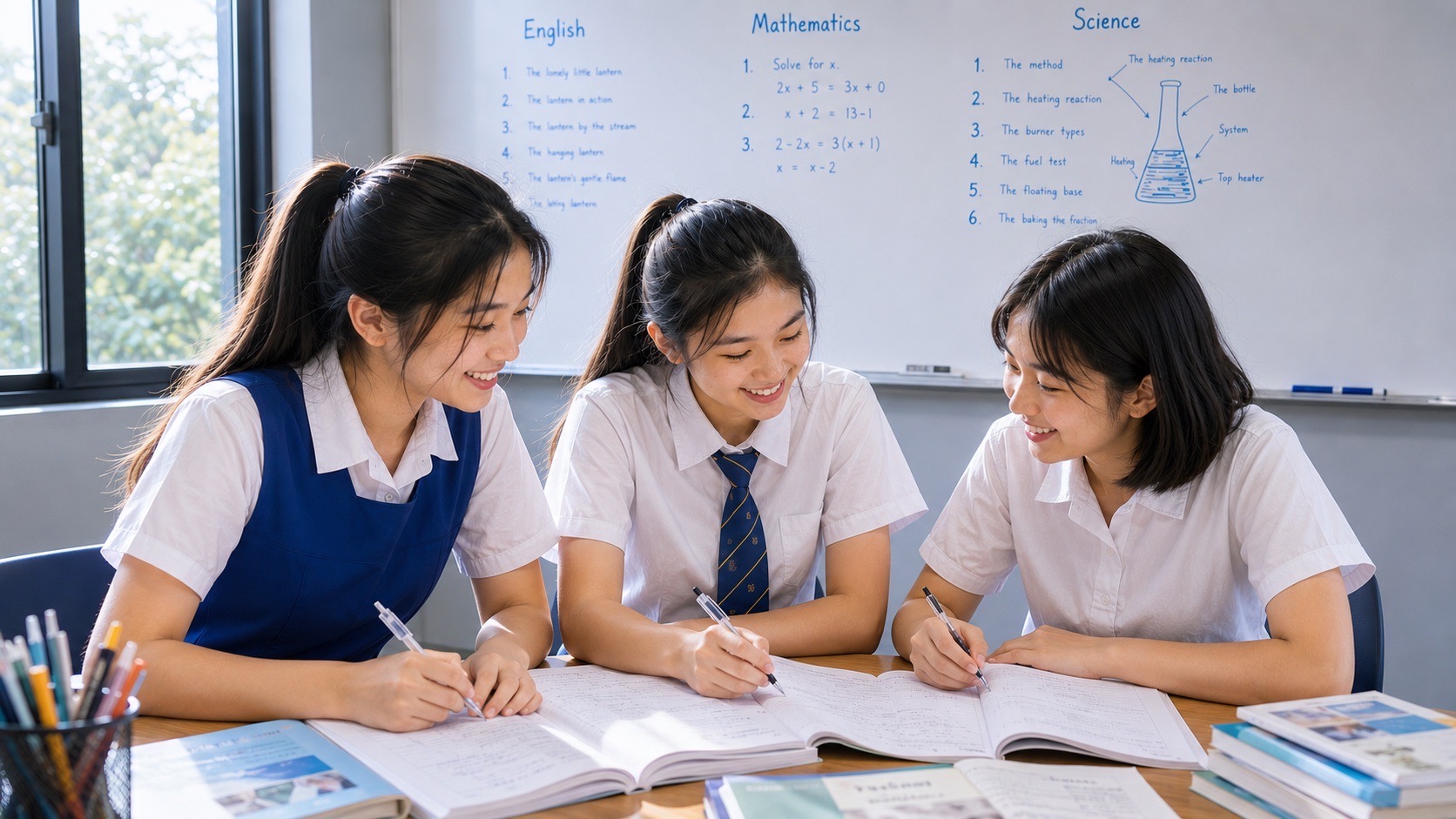
This page expands our Secondary 1 English tuition guide and focuses on the writing bridge from Primary-school sentence production to sustained secondary explanation and development.
A Paragraph Needs a Job
Students often create paragraphs by counting lines or inserting a break after several sentences. That may produce tidy formatting, but it does not create coherence.
A strong paragraph has a job: introduce a reason, describe a turning point, explain a consequence, present an example, compare viewpoints or develop one part of an argument.
The Point → Support → Explain → Develop Pattern
- Point: state the central idea of the paragraph.
- Support: add an example, detail, observation or evidence.
- Explain: show why the support matters.
- Develop: extend the idea through consequence, contrast, qualification or connection.
This pattern is not a rigid essay formula. It is a diagnostic frame. If a paragraph feels thin, we can ask which function is missing.
Maren, Iona and Leonie Build Weak Paragraphs Differently
Maren makes a strong point but moves immediately to the next point. Iona includes an example but assumes the reader will understand why it proves anything. Leonie explains well but keeps adding loosely related ideas until the paragraph loses its centre.
The tutor therefore repairs development, explanation and boundary control separately.
Topic Sentences Should Create Direction
A topic sentence is useful when it tells the reader what the paragraph is about and gives the writer a boundary.
We avoid teaching ornamental topic sentences that sound impressive but say little. The sentence should help the writer decide what belongs next and what does not belong in the paragraph.
Examples Need Interpretation
Secondary writing increasingly expects students to explain why an example matters. A paragraph that says, “For example…” and then stops may contain evidence but no reasoning.
We train students to add the bridge: what does this example show, change or prove?
Narrative Paragraphs Also Need Structure
The same principle applies to narrative writing. A paragraph may establish a setting, show a decision, develop conflict or reveal a consequence. It should not simply contain whatever happened during the next minute of the story.
Paragraph breaks become part of pacing and meaning.
Cohesion Is More Than Connectors
Students often try to improve cohesion by adding furthermore, however or therefore. Connectors help only when the underlying relationship is real.
Cohesion also comes from consistent reference, deliberate repetition of key concepts, pronouns, parallel structure and a logical sequence of ideas.
Sentence Variety Must Serve the Paragraph
A paragraph made entirely of short simple sentences can feel mechanical. A paragraph made entirely of long complex sentences can become difficult to control.
We vary sentence structure by function: a short sentence can emphasise a conclusion; a complex sentence can show cause or contrast; a compound sentence can connect related actions or claims.
A 90-Minute Paragraph-Control Tutorial
- Retrieve one sentence relationship and one transition pattern.
- Diagnose a weak paragraph and identify its missing function.
- Build one paragraph orally from point to development.
- Write independently.
- Compare three student versions for clarity and boundary control.
- Revise for support, explanation and cohesion.
- Transfer the method to a fresh topic or narrative scene.
Why Three Students Helps
Paragraph writing improves when students can compare different ways of developing the same idea. Three students create enough variation for useful discussion while keeping the tutor close enough to inspect each writer’s decision-making.
Common Secondary 1 Paragraph Errors
- One-sentence paragraphs that never develop.
- Several points mixed into one paragraph.
- Examples without explanation.
- Topic sentences that are too broad to guide the paragraph.
- Connectors chosen for sophistication rather than logic.
- Pronouns that make reference unclear.
- Repetition that adds no new meaning.
- Paragraph endings that stop rather than complete the idea.
What Progress Looks Like
- Each paragraph has a recognisable purpose.
- Ideas receive enough support.
- Examples are explained.
- Paragraph boundaries become more logical.
- Transitions reflect real relationships.
- Sentence variety improves without reducing clarity.
- Students can revise a weak paragraph independently.
- Longer pieces become easier to organise.
The Secondary 1 Writing Goal
Secondary 1 is the right time to stop treating writing as a string of sentences.
When students understand that paragraphs are units of thought, later essays become far easier to plan, develop and edit.