
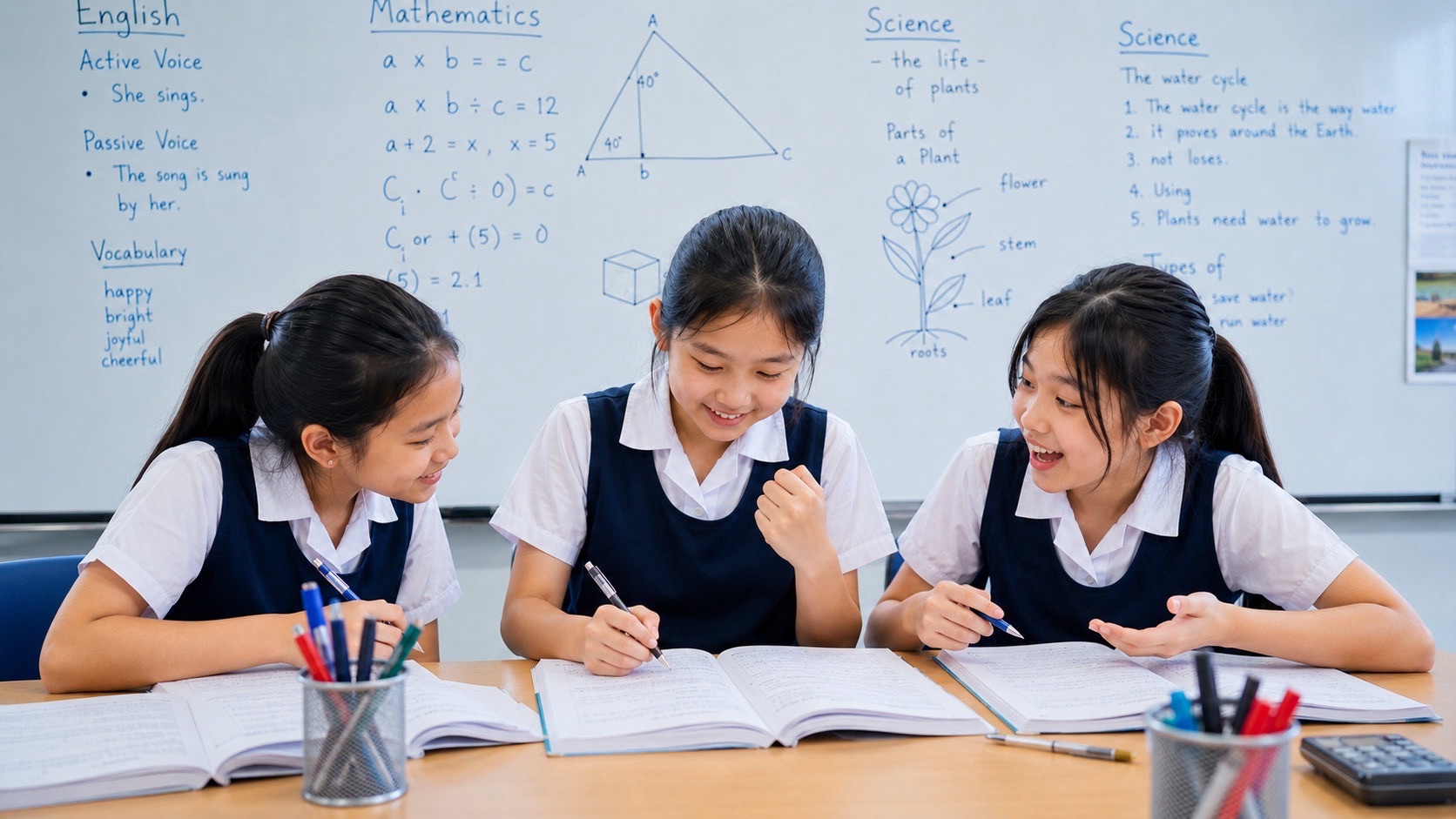
Primary 3 English becomes more demanding when meaning is no longer contained inside one continuous paragraph.
Children increasingly meet pages that combine headings, paragraphs, captions, diagrams, labels, tables, maps, photographs and short source boxes. The reading problem changes. The learner must decide where each kind of information lives, what each source contributes and whether two sources repeat, extend or disagree with one another.
This is not only a reading-comprehension skill. It is a study skill, a knowledge skill and an early form of source synthesis. A student who learns to compare information across modes becomes better prepared for Upper Primary English, Science, project work and the wider world of digital reading.
This page expands our Primary 3 English tuition guide by focusing on information texts, diagrams, tables and simple source comparison: locate, interpret, connect, compare, explain and verify.
The Page Has More Than One Voice
A short information page may contain several meaning systems at once.
- The heading tells the reader what topic is coming.
- The paragraph explains the main idea.
- The photograph shows appearance or setting.
- The caption adds a specific fact.
- The diagram shows structure or process.
- The table organises comparison.
- The label names a part.
A child who reads only the central paragraph may miss important information. A child who looks only at the diagram may lose explanation. Primary 3 reading increasingly requires coordination.
The Preview → Locate → Read → Connect → Compare → Explain Routine
- Preview: inspect the title, headings and visual features.
- Locate: identify where the relevant information is likely to sit.
- Read: process the words and visuals accurately.
- Connect: combine information that belongs together.
- Compare: decide whether two sources repeat, extend or differ.
- Explain: state the meaning in the child’s own words.
The routine teaches the child to treat the page as an organised information system rather than a collection of decorations.
Maren: She Reads the Paragraph and Ignores the Diagram
Maren reads an explanation of the water cycle accurately. The diagram beside it shows evaporation, condensation and rain with arrows. When asked what happens after water rises, she searches only the paragraph.
We ask Maren to identify what the diagram does better than the paragraph. The arrows make sequence visible immediately.
She learns that some information is easier to understand spatially than verbally. Reading means selecting the right source for the job.
Iona: She Loves Pictures but Treats Them as Complete Evidence
Iona sees a photograph of a polar bear standing on ice and concludes that polar bears live only on ice. The caption explains that they spend time on sea ice but also move across land.
The picture is real evidence, but it is not complete evidence.
We teach Iona to ask what the image shows directly and what the text adds. One source can be accurate without telling the whole story.
Leonie: She Understands Both Sources but Cannot Compare Them
Leonie can explain a paragraph and a table separately. Asked how they relate, she repeats each one.
We introduce three comparison relationships:
- Repeat: both sources give the same information.
- Extend: one source adds something the other does not.
- Differ: the sources present different details, categories or perspectives.
Leonie now has a language for comparing, not merely summarising twice.
Headings Are Navigation Tools
As texts grow longer, children need to stop reading every page as one undivided block.
Headings predict information categories. A page titled “How Mangroves Survive” may contain sections on roots, salt and tides. The child can use the heading to anticipate where a question about salt is likely to be answered.
This improves both comprehension and search efficiency.
Captions Can Contain Testable Information
Children sometimes treat captions as optional because they are visually smaller than the main paragraph.
We deliberately ask questions whose answer appears only in the caption. The child learns that information value is not determined by font size.
Captions may identify a place, explain a process, name a person or supply a date. Skipping them can create incomplete reading.
Diagrams Are Relationship Machines
Diagrams often show relationships more efficiently than prose.
They can show:
- parts of an object;
- sequence;
- cause and effect;
- direction;
- location;
- change over time;
- comparison.
We ask children to turn the diagram back into language. If the student cannot explain the arrows or labels verbally, the visual may have been looked at without being understood.
Tables Require Coordinate Reading
A table changes the reading path. Information is found at the intersection of row and column rather than by reading left to right continuously.
We teach a simple routine: find the row label, find the column label, trace to the correct cell, then interpret what the value means.
Primary 3 children can use small tables comparing animals, weather, transport or survey results. The English task is to convert the structured information into an accurate sentence.
Maps and Simple Plans Require Spatial Language
Maps introduce language such as north, beside, between, opposite, along, near, across and from…to….
The child must combine labels, symbols and spatial relationships.
We may ask the learner to give directions using a simple plan, explain where one place is relative to another, or compare two routes.
This develops precise language and prepares children for real-world reading beyond traditional passages.
Source A and Source B Do Not Need to Say the Same Thing
Simple source comparison begins when two short pieces of information address the same topic from different angles.
Source A may explain that cycling reduces pollution. Source B may show a chart comparing travel times. Both concern transport, but they answer different questions.
We ask:
- What does both material share?
- What appears only in Source A?
- What appears only in Source B?
- Does one source help explain the other?
This is an early form of synthesis without overwhelming the child with complex research language.
Comparison Words Give the Thinking a Sentence Shape
Children need language for comparison.
- Both sources show…
- Source A explains…, while Source B shows…
- Unlike Source A, Source B…
- Source B adds that…
- The diagram supports the paragraph by showing…
These frames are temporary. They help the learner organise relationships until the language becomes more independent.
Do Not Confuse More Detail with Better Evidence
A photograph can contain many visible details that are irrelevant to the question. A table can contain many numbers that do not answer the required comparison.
We teach children to return to the task: what information is needed now?
Selective attention prevents multimodal pages from becoming visually overwhelming.
The Same Fact Can Be Expressed in Different Modes
A paragraph may say that rainfall increased from Monday to Wednesday. A bar chart may show the same increase visually.
We ask children to translate between modes: turn the chart into a sentence; turn the sentence into a simple diagram; explain which format makes the trend easier to see.
This strengthens comprehension because the learner must preserve meaning while representation changes.
Vocabulary Is Often Distributed Across the Page
A new word may be introduced in the paragraph, clarified by a label and made concrete by an image.
Instead of teaching the word from one definition alone, we combine those sources.
For example, camouflage may be explained in prose and demonstrated by an animal blending into its surroundings. The visual makes the concept memorable; the sentence makes the relationship explicit.
Background Knowledge Helps, but the Source Still Controls the Answer
A child may know additional facts about dolphins, planets or transport. That knowledge can help interpretation.
But if the task asks “According to the diagram,” the response must come from the diagram. We teach children to distinguish what they know from what this source shows.
This is an early foundation for source discipline.
Simple Reliability Questions Can Begin in Primary 3
Primary 3 students do not need advanced source criticism, but they can begin asking sensible questions.
- Is this a photograph, drawing or advertisement?
- Does the image show one example or every possible case?
- Is the source trying to explain, inform or persuade?
- Does another part of the page support the same claim?
These questions help children avoid treating every visual or sentence as equally complete evidence.
Digital Pages Make Navigation Even More Important
On a screen, children may encounter menus, links, images, expandable sections and videos beside the main text.
We teach a simple priority: identify the main reading object before interacting with surrounding elements.
The child learns to distinguish navigation from content and evidence from decoration. This protects attention as digital reading becomes more common.
Note-Making Can Begin with One Line per Source
Primary 3 children can begin simple note-making without copying whole sentences.
After reading a paragraph and diagram, the learner may write:
- Paragraph: explains why roots spread widely.
- Diagram: shows where the roots grow.
Those notes capture the job of each source. They also prepare the child for later synthesis and study skills.
Turn Two Sources into One Explanation
After comparing, the child should sometimes integrate.
Paragraph: “Mangrove roots spread widely through soft mud.” Diagram: shows roots extending above and below the surface.
Integrated response: “Mangrove roots spread widely through the soft mud, and the diagram shows that some roots also rise above the surface.”
The learner has preserved both sources without merely copying them separately.
Information Reading Can Feed Composition and Explanation
World knowledge gives children material to write about. A short information text about storms can supply vocabulary and concepts that later appear in description or narrative.
We keep the distinction clear: factual reading provides knowledge; composition transforms that knowledge into another purpose.
This makes reading and writing part of one language ecosystem.
A Three-Student Source-Reading Tutorial Makes Comparison Visible
Three students can each take responsibility for one source or feature, then combine their findings.
One child reads the paragraph, another interprets the diagram, another checks the caption or table. They then compare what each source contributes.
The tutor can hear whether students understand relationships or simply report isolated facts.
A 90-Minute Primary 3 Information-Reading Lesson
- Preview: inspect title, headings, paragraph, diagram and captions.
- Purpose read: identify what the page is mainly teaching.
- Feature read: explain what each visual element contributes.
- Comparison: classify source relationships as repeat, extend or differ.
- Vocabulary: learn one or two topic words using multiple sources.
- Question work: answer from the correct source.
- Integration: combine two sources into one explanation.
- Transfer: apply the routine to an unseen page.
Home Practice Is Available Everywhere
- Read a museum panel and compare photo with caption.
- Use a weather chart and explain the trend in a sentence.
- Compare a recipe image with its written instructions.
- Read a simple map and describe one route.
- Use a children’s nonfiction book and ask what the diagram adds.
- Compare two short descriptions of the same animal or place.
The world already contains many multimodal reading opportunities. The teaching move is to make the relationships visible.
What Parents Should Avoid
- Reading only the paragraph and skipping all other features.
- Allowing pictures to replace print processing.
- Assuming every visible detail matters equally.
- Copying whole source sentences instead of comparing their jobs.
- Letting background knowledge replace “according to the source” evidence.
- Treating charts and diagrams as Mathematics or Science only rather than language-bearing texts.
Common Primary 3 Information-Reading Failure Patterns
- Headings are ignored.
- Captions are skipped.
- The diagram is described but not interpreted.
- The child uses the wrong row or column in a table.
- Two sources are summarised separately but never compared.
- An image is treated as proof of something it does not actually show.
- Outside knowledge is substituted for source evidence.
- The child copies details without identifying the main information job.
- Digital navigation distracts from the central text.
These patterns reveal whether the weak link is navigation, integration, evidence control or comparison language.
What Progress Looks Like
- The child previews a page before reading linearly.
- Headings and captions are used as information sources.
- Diagrams can be translated into clear sentences.
- Tables are read more accurately.
- The learner can state what each source contributes.
- Repeat, extend and differ relationships are recognised.
- Answers are taken from the correct source.
- Two sources can be integrated into one explanation.
- Background knowledge supports rather than replaces evidence.
- Digital reading becomes more selective and controlled.
The Primary 3 to Primary 4 Source-Reading Bridge
Upper Primary English increasingly asks children to process longer, richer and more varied texts. Outside English, Science and project work also depend on diagrams, labels, tables and explanatory prose.
A strong Primary 3 bridge therefore includes a learner who can navigate a page, choose the correct source, compare information forms and explain how evidence fits together.
That is the beginning of synthesis: not merely finding information, but coordinating it.
Frequently Asked Questions
Are diagrams part of English comprehension?
Yes. When meaning is communicated through a diagram, chart, image or label, interpreting and explaining that meaning is part of literacy. English increasingly operates across multiple modes.
Should my child read every page from top to bottom?
Not always. Information texts often benefit from previewing headings, visuals and layout first. The reading path should match the task and text structure.
What is the difference between comparing and summarising?
Summarising states the important information in each source. Comparing identifies the relationship between them: what they share, how they differ or what one adds to the other.
Should Primary 3 children evaluate sources?
At a simple level, yes. They can distinguish photograph from drawing, explanation from advertisement, and one example from a universal claim. Advanced source criticism can come later.
The Primary 3 Goal: Read the Relationships Between Sources
A modern page does not always speak in one continuous paragraph. Meaning may be distributed across words, visuals and structures.
Preview. Locate. Read. Connect. Compare. Explain.
When the child can perform those moves independently, diagrams stop being decorations, captions stop being optional and multiple sources begin to form one coherent body of meaning.
Continue through the Primary 3 English tuition guide, English Reading and Comprehension and English Listening and Viewing.
Properly taught kids shine a bright light into the future.