
Primary 2 children often know the answer before they know how to express it clearly.
A child may point to the correct person, explain the reason aloud or identify what happened, yet write a fragment that does not fully answer the question.
This page expands our Primary 2 English tuition guide by focusing on question meaning and complete answer construction.
Question Words Give the Answer a Job
- Who? asks for a person or character.
- What? asks for an event, action, object or idea.
- Where? asks for a place.
- When? asks for time.
- Why? asks for a reason or cause.
- How? asks for a method, manner or explanation.
Children become more accurate when they identify the job before searching for the answer.
Maren, Iona and Leonie Need Different Answer Repairs
Maren finds the right detail but writes only one word. Iona writes a full sentence but answers “what” when the question asks “why”. Leonie gives the right reason but adds an unrelated detail.
The repairs are completeness, question matching and scope.
Use the Question to Build the Answer
At first, we teach children to reuse useful parts of the question. “Why did Sam run home?” can become “Sam ran home because…” This reduces writing load while making the answer structure visible.
As confidence grows, the child learns to vary the sentence naturally.
Complete Does Not Mean Long
A complete answer contains what the question needs. It does not need extra material simply to look impressive.
We teach children to stop when the requested meaning is clear.
Oral Answers Can Diagnose the Real Problem
If the child answers correctly aloud but not in writing, the problem may be sentence construction rather than comprehension. If the oral answer is also wrong, we return to reading meaning.
A Primary 2 Question-and-Answer Tutorial
- Read a short passage.
- Sort questions by who, what, where, when, why and how.
- Answer orally first.
- Turn the oral answer into a complete written sentence.
- Check whether every word in the answer belongs.
- Transfer the routine to a fresh passage.
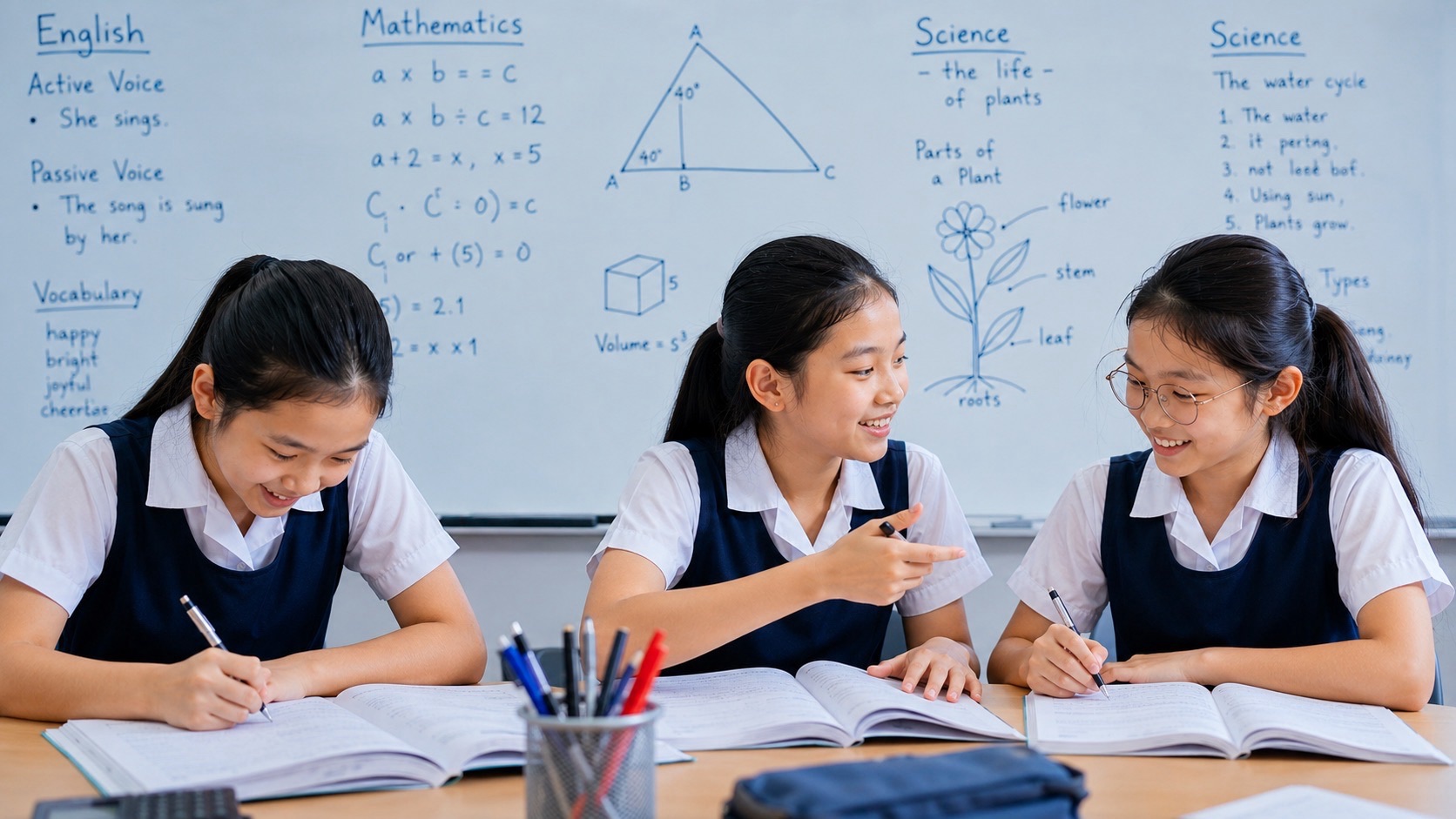
Why Three Students Helps
Three children can compare answers to the same question and see that several sentences may be acceptable while still needing to answer the same job. The tutor can also identify each child’s recurring pattern quickly.
Common Primary 2 Answer Errors
- Writing fragments.
- Answering the topic rather than the question word.
- Copying a whole sentence from the passage when only one detail is needed.
- Giving a reason when the question asks what happened.
- Adding unrelated details.
- Using unclear pronouns in the answer.
What Progress Looks Like
- Question words are recognised faster.
- Oral and written answers match more closely.
- Fragments decrease.
- Why and how answers become more complete.
- Extra unrelated information decreases.
- The child checks whether the answer matches the question before moving on.
The Primary 2 Goal
The aim is simple but powerful: understand the question, find the answer, express it completely and stop when the job is done.