
Primary 2 reading is not only about whether a child can read a page. It is about whether the child can stay with enough pages to build, hold and update meaning independently.
A learner may read one paragraph fluently and still struggle across a longer story. Another may enjoy narrative books but tire quickly when information texts introduce unfamiliar vocabulary. A third may finish every page yet remember almost nothing because reading became a race to the end.
This is where reading stamina matters. Stamina is not simply sitting still for longer. It is maintaining useful reading behaviour across a longer stretch: decoding accurately enough, preserving meaning, tolerating some difficulty, recovering when comprehension slips, and continuing without an adult carrying the process.
This page expands our Primary 2 English tuition guide by focusing on independent reading stamina across stories and simple information texts, including book choice, pause-and-recap routines, vocabulary tolerance, rereading, reading logs, digital reading and the transition toward Primary 3.
Reading Stamina Means Sustaining Meaning
A child who reads for twenty minutes while mentally disconnected has not built useful stamina. We care about whether comprehension remains alive.
Useful Primary 2 stamina includes the ability to:
- continue reading after a difficult word;
- remember who or what the passage is about;
- connect one paragraph to the next;
- notice when meaning has disappeared;
- reread a useful section without being told;
- hold a question across several sentences;
- tolerate a small amount of unfamiliar vocabulary;
- finish a short text without repeated adult prompting;
- retell or explain the main idea afterwards.
Stamina is therefore a combination of fluency, comprehension, attention, recovery and independence.
The Preview → Read → Pause → Rebuild → Continue → Recall Routine
- Preview: inspect the title, obvious text features and likely topic.
- Read: process a manageable stretch with attention to meaning.
- Pause: stop at a natural point rather than only when confused.
- Rebuild: state what has happened or what has been learned so far.
- Continue: read the next stretch with the mental model still active.
- Recall: retell, explain or respond after reading without immediately looking back.
The pause is important. It prevents longer reading from becoming a blur.
Maren: She Reads Fast and Reaches the End with Nothing Left
Maren is proud of speed. She can finish a short book quickly, but when asked what happened in the middle, she guesses from the ending.
Her problem is not reading volume. It is monitoring.
We introduce planned recap points. After two or three pages, Maren must say one sentence: “What is happening now?” Later, she chooses her own stopping point.
The goal is not to make reading slow. It is to make comprehension durable enough to survive the full text.
Iona: She Reads Stories Happily but Avoids Information Books
Iona enjoys characters, dialogue and events. A short nonfiction book about oceans feels harder because the vocabulary is denser and the page structure is less familiar.
We do not conclude that she dislikes reading. She may dislike this particular reading demand.
We begin with high-interest information texts containing supportive pictures, clear headings and manageable paragraphs. Before reading, we activate a little relevant knowledge. After each section, Iona states one fact and one new word.
Her stamina grows because the text type becomes more predictable and meaningful.
Leonie: One Unknown Word Stops the Whole Page
Leonie wants full certainty. When she reaches an unfamiliar word, she stops reading and asks immediately.
We teach vocabulary tolerance. First, decide whether the word blocks the sentence. Can its rough meaning be inferred? Can the sentence continue? Does the next line clarify it?
If the word is essential, we solve it. If it is not essential, Leonie marks it lightly and keeps reading.
She learns that independent reading does not require knowing every word before moving forward.
Book Choice Is Part of Reading Skill
A child cannot build sustainable reading stamina if every book is too difficult, too easy or completely uninteresting.
We teach children to inspect a book before committing:
- Read the title and blurb or first page.
- Try several sentences.
- Notice whether too many words are stopping meaning.
- Ask whether the topic genuinely interests you.
- Decide whether this is an independent book, a stretch book or a read-aloud book.
This gives the child agency without pretending every choice is equally productive.
Independent, Stretch and Read-Aloud Books Serve Different Jobs
An independent book should be accessible enough that the child can keep meaning alive with limited help. A stretch book may contain more demanding vocabulary or structure and require occasional support. A read-aloud book can expose the child to language and ideas far above independent decoding level.
Families sometimes make the mistake of replacing read-alouds once the child can read alone. We prefer all three lanes.
Independent reading builds autonomy. Stretch reading develops strategies. Read-alouds expand vocabulary and knowledge.
Reading Longer Stories Requires State Tracking
Across several pages, the reader must remember a changing situation: who is present, what each person wants, what problem exists, what has changed and what remains unresolved.
We call this keeping the story state alive.
At recap points, we may ask:
- Who is the story mainly following now?
- What problem is still active?
- What changed on this page?
- What does the character know now that they did not know before?
- What do you expect next, and why?
These questions train continuity rather than isolated detail retrieval.
Reading Information Texts Requires Topic Tracking
Information texts have a different state. Instead of character and problem, the reader may track topic, subtopic, category, sequence, comparison or explanation.
A page about frogs may contain sections on habitat, food and life cycle. The child should understand that these are different information jobs under one larger topic.
We use headings as mental containers. After each section, the child says what was learned under that heading.
This makes longer nonfiction less like a wall of facts and more like an organised map.
A Difficult Word Should Trigger a Decision, Not Panic
We teach three possible responses to an unfamiliar word:
- Solve now: the word is essential or decodable.
- Approximate and continue: the context gives enough meaning for the passage to survive.
- Mark and return: the word is interesting or potentially important but not urgent.
This is a more realistic reading strategy than stopping for every unknown word or ignoring every unknown word.
Rereading Is a Strategy, Not a Sign of Failure
Some children believe strong readers understand everything on the first pass. That belief makes them reluctant to return to a difficult sentence.
We normalise purposeful rereading. A reader may return because:
- a pronoun became unclear;
- a new detail changed the interpretation;
- a question requires evidence;
- a word meaning is uncertain;
- the sequence no longer makes sense;
- the reader simply lost attention for a moment.
Good readers repair meaning. They do not pretend comprehension never slips.
Pause Before Meaning Collapses
Children often wait until they are completely lost before stopping. We teach earlier monitoring.
A natural paragraph break, page turn, heading or scene change can become a checkpoint. The child asks: “What do I know so far?”
If the answer is clear, continue. If not, reread a small amount before the confusion grows.
This is one of the central differences between passive page-turning and active reading.
Reading Time Should Increase Gradually
Stamina grows through progressive load. A child who currently sustains meaningful reading for eight minutes may not benefit from being forced immediately into forty minutes.
We increase time or text length while watching quality. If comprehension collapses after twelve minutes, that boundary is useful information.
The next goal might be thirteen or fifteen productive minutes, not an arbitrary hour.
Volume Matters Because Reading Processes Become More Automatic
Children need enough successful reading for common words, sentence patterns and text structures to become familiar. Reading volume also expands vocabulary and knowledge.
But volume should not be confused with page counting. A child who reads one hundred pages too difficult to understand may gain less than a child who reads forty pages attentively and returns voluntarily the next day.
We want sustainable volume: reading that is accessible enough to continue and rich enough to grow from.
Choice Increases Volume When Choice Is Guided
Children read more when some material aligns with genuine interests. Animals, humour, mysteries, transport, football, space, craft, myths and factual curiosities can all create entry points.
We do not require every choice to be educationally identical. We also do not let preference become a permanent tunnel.
A child may choose two familiar-interest books and one teacher-selected book from a different genre. Over time, the reading diet widens without destroying ownership.
Comics and Graphic Texts Can Be Valuable Reading
Graphic texts combine print, sequence, visual inference and dialogue. They can support reluctant readers and teach multimodal comprehension.
We still ask whether the text contains enough language challenge and whether the child can explain the sequence rather than merely look at pictures.
The format should be evaluated by the reading work it creates, not dismissed or praised automatically.
Digital Reading Requires Attention Management
On a screen, links, notifications, video and scrolling can interrupt the sustained construction of meaning.
Primary 2 children can learn simple digital habits:
- finish a short section before switching;
- use audio support purposefully rather than automatically;
- pause and retell after a screenful of information;
- distinguish navigation elements from the main text;
- return to the sentence if an image or animation distracts from meaning.
Digital access does not remove the need for reading discipline. It often increases it.
Reading Logs Should Capture Thinking, Not Administration
A reading log that records only title, author and page count can become clerical work.
We prefer one small response:
- one surprising event;
- one new word;
- one question;
- one fact worth remembering;
- one sentence explaining a character’s choice;
- one connection to another book or experience.
The log becomes evidence of comprehension and reflection rather than proof that pages were turned.
Library Habits Are Part of Reading Independence
A child who can navigate a library has access to a learning system far larger than any tuition worksheet bank.
We teach children to use shelves, categories, covers, blurbs, tables of contents and first pages to make choices. We also teach that abandoning an unsuitable book and choosing again can be intelligent, provided the child is not abandoning every book at the first challenge.
Selection itself becomes a reading skill.
Reading Across a Week Is Better Than One Weekend Marathon
Regular reading keeps decoding, vocabulary and comprehension active. Long gaps make every session feel like restarting.
For many Primary 2 children, a sustainable pattern might involve shorter sessions on several days rather than one long forced session on Sunday. The exact schedule depends on the child and family.
The principle is consistency without turning reading into punishment.
Independent Reading Does Not Mean Zero Adult Support
Independence means the child increasingly manages the reading process. Adults can still provide books, discuss ideas and help with genuinely difficult words.
The question is whether support is reducing or whether the adult remains responsible for every page.
We may move from sitting beside the child, to checking after a section, to discussing only at the end. The learner gradually carries more of the process alone.
Reading Aloud Still Has a Place
Silent reading becomes more important in Primary 2, but occasional oral reading remains diagnostically useful.
We can hear skipped words, awkward phrasing, overreliance on guessing and loss of punctuation. We can then compare oral fluency with comprehension.
Reading aloud should not dominate every independent-reading session. It is one window into the reading process, not the whole process.
Silent Reading Needs Evidence Too
A child sitting quietly with a book may be reading deeply, skimming, daydreaming or rereading the same line.
We keep accountability light but real. After a reading stretch, the child may retell one event, explain one fact or answer one open question.
We do not interrogate every page. The aim is to make meaning visible often enough to guide teaching.
Knowledge and Stamina Reinforce Each Other
A text becomes easier to sustain when the child knows something about the topic. Prior knowledge reduces the number of ideas that must be built from scratch.
This is one reason broad reading matters. A child who has read about weather, animals, places, transport and simple history carries more knowledge into future texts.
Knowledge makes comprehension easier; easier comprehension makes longer reading more sustainable; longer reading builds more knowledge. The cycle compounds.
Do Not Turn Every Book into a Worksheet
Comprehension questions are useful. Too many can destroy voluntary reading.
Some reading should end with conversation, laughter, curiosity or a recommendation to a friend. The child needs to experience books as things worth entering, not merely sources of questions.
We balance accountable reading with genuine reading life.
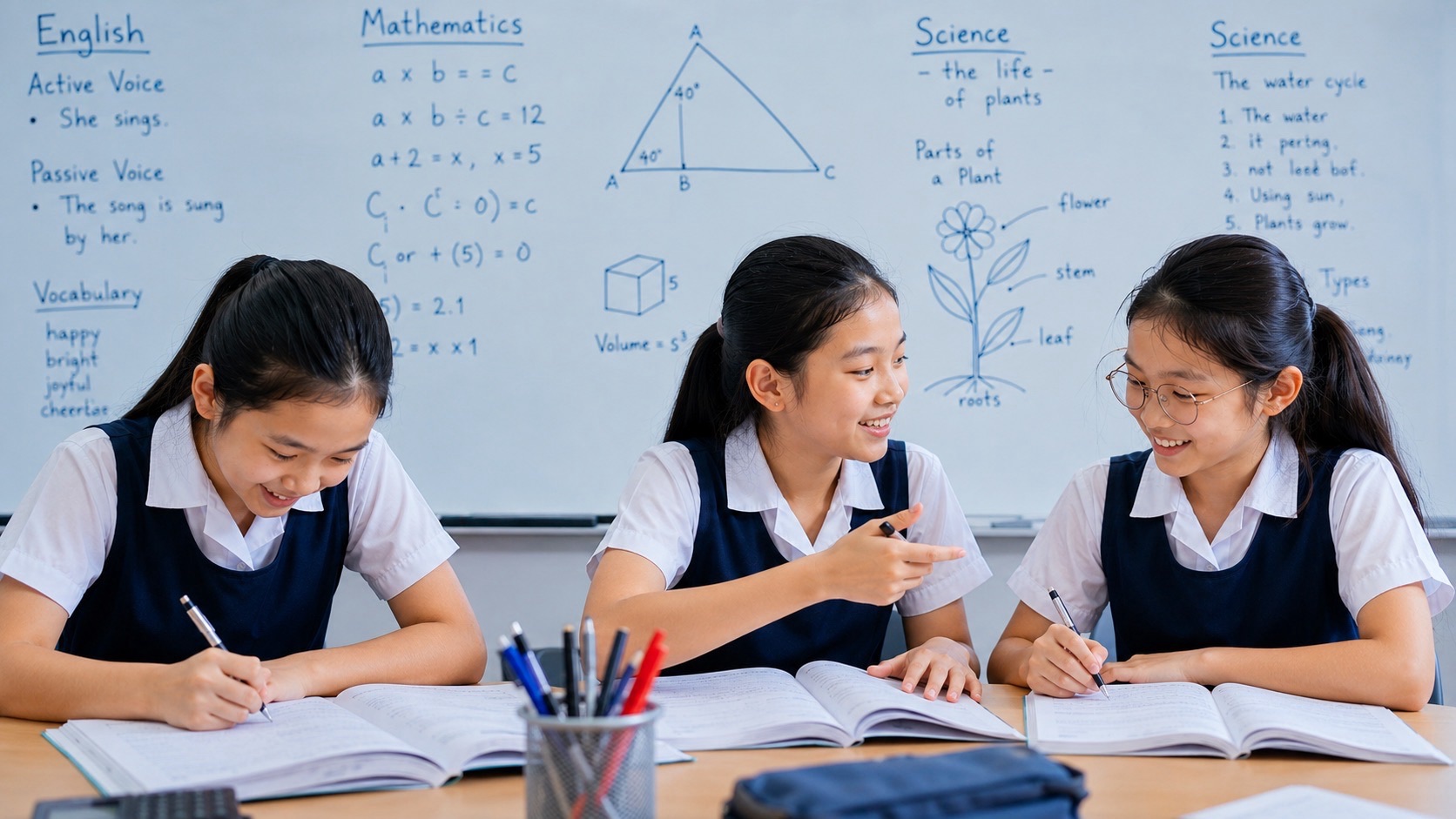
A Three-Student Reading Tutorial Creates Productive Book Talk
Three students can read the same short text and notice different things. One may focus on a character motive, another on a new word, another on a surprising fact.
The tutor can ask students to justify interpretations from the text. Discussion makes reading thinking visible while the class remains small enough for individual fluency and comprehension needs to stay visible.
Children also hear peers model how readers talk about books without reciting model answers.
A 90-Minute Primary 2 Reading-Stamina Lesson
- Fluency warm-up: short oral reading where needed.
- Preview: inspect title, genre and important page features.
- Independent stretch one: read to a planned checkpoint.
- Recap: state story state or topic state in one or two sentences.
- Independent stretch two: continue without tutor narration.
- Vocabulary decision: solve, approximate or mark one difficult word.
- Discussion: explain one inference, event or fact with evidence.
- Transfer writing: record a short response or explanation.
The lesson does not force uninterrupted reading for ninety minutes. It deliberately expands the child’s ability to sustain meaning across repeated independent stretches.
Home Reading Can Be Structured Without Becoming Heavy
A simple home routine may be enough:
- Choose an accessible book.
- Read independently for a manageable period.
- Pause once to say what is happening or what has been learned.
- Continue.
- End with one natural conversation question.
The parent can still read aloud from a richer book afterwards. Independent reading and shared reading do not compete.
What Parents Should Avoid
- Choosing books mainly to impress with reading level.
- Forcing long sessions after comprehension has collapsed.
- Stopping the child for every unfamiliar word.
- Asking a quiz question after every page.
- Counting pages without checking meaning.
- Letting the child read only one narrow genre forever.
- Assuming comics or information books are automatically inferior to stories.
- Doing all the book selection for the child indefinitely.
Common Primary 2 Reading-Stamina Failure Patterns
- The child reads quickly but cannot recall the middle.
- One unfamiliar word stops the whole page.
- The learner depends on an adult to explain every paragraph.
- Stories are manageable but nonfiction causes immediate fatigue.
- The child finishes pages without noticing that meaning has disappeared.
- Book choice is consistently too difficult or too easy.
- Reading logs record pages but not thinking.
- Digital reading fragments attention.
- The child abandons every book at the first challenge or refuses to abandon clearly unsuitable books.
These patterns reveal different weak links: monitoring, vocabulary tolerance, text structure, book fit or independence.
What Progress Looks Like
- Reading stretches become longer without loss of meaning.
- The child pauses and recaps without being prompted every time.
- Unknown words are handled more strategically.
- Rereading becomes self-initiated.
- Stories remain coherent across more pages.
- Information texts are organised by topic and headings.
- Book choices become more suitable.
- The learner reads across a wider range of genres.
- Adult presence decreases.
- After reading, the child can explain rather than merely report page count.
The Primary 2 to Primary 3 Reading Bridge
Primary 3 reading demands increase not only because texts get harder, but because children must sustain comprehension across more material and across more subjects.
A useful Primary 2 bridge includes a child who can choose a workable text, read for a meaningful stretch, monitor comprehension, tolerate some uncertainty, use rereading, preserve the important structure and explain what was read afterwards.
That is a stronger foundation than simply finishing thicker books earlier.
Frequently Asked Questions
How long should a Primary 2 child read each day?
There is no single ideal number. Start from the amount of time the child can read with real comprehension and gradually increase it. Quality, consistency and willingness to return matter more than an arbitrary duration.
Should my child finish every book?
No. Children should learn persistence, but they should also learn to recognise a poor fit. The useful question is why the book is being abandoned: difficulty, lack of interest, confusion, or a habit of avoiding challenge.
Should I correct every word when my child reads aloud?
No. Correct errors that change meaning, reveal an important decoding gap or become repeated. Constant interruption can destroy fluency and comprehension. Give the child a chance to self-correct where appropriate.
Are nonfiction books important in Primary 2?
Yes. They build topic knowledge, academic vocabulary and familiarity with headings, captions, diagrams and explanatory structures. Stories and information texts should both have a place.
What if my child says reading is boring?
Check book fit, topic interest, reading effort and whether reading has become too closely associated with worksheets. Interest is not the only factor, but it can strongly affect the amount of successful reading a child is willing to do.
The Primary 2 Goal: Stay with the Text Long Enough for Meaning to Accumulate
Reading grows when a child can carry meaning beyond one sentence and one page.
Preview the text. Read a manageable stretch. Pause before meaning collapses. Rebuild the situation or topic. Continue. Reread when necessary. Recall what matters afterwards.
That routine builds a reader who can increasingly enter a book without needing an adult to carry the route.
Continue through the Primary 2 English tuition guide, English Reading and Comprehension and the wider Primary English tuition route.
Properly taught kids shine a bright light into the future.