
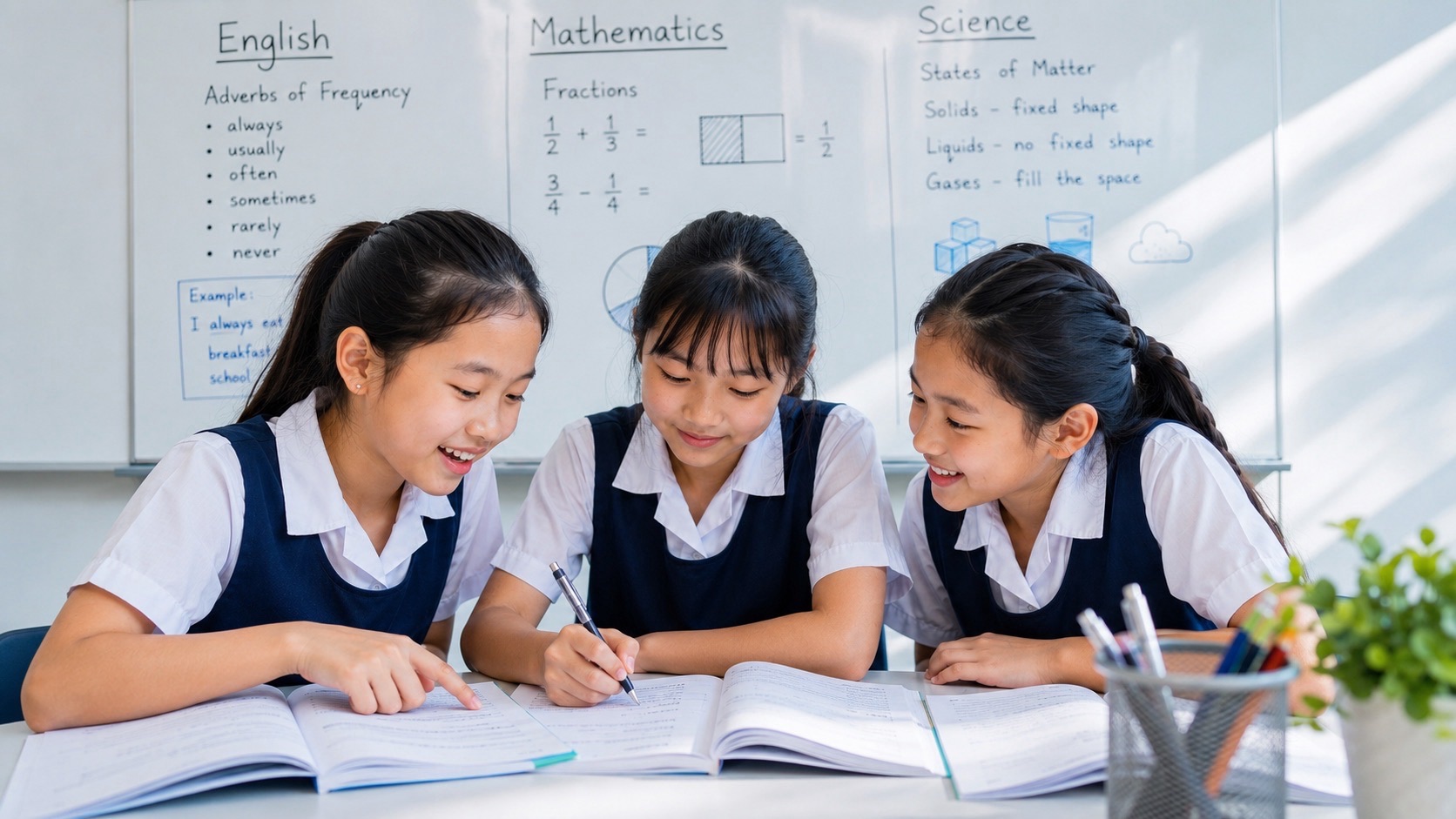
A Primary 1 child can look at a picture, understand the scene correctly and still fail the reading task because the picture has supplied an answer before the words have been read carefully enough to confirm it.
This is not a problem with using pictures. Pictures are valuable reading supports. The problem begins when the child lets the visual become the answer instead of using it as one source of evidence among several.
At Primary 1, this failure can hide behind apparent confidence. The child answers quickly, sounds certain and may even be correct on familiar texts. But when a picture suggests one thing and the sentence says something more specific, the learner often follows the picture and misses the language.
The Scientific Job of This Article
The job is narrow: explain why picture-supported reading can turn into picture-led guessing, identify the point where visual prediction replaces word reading, and build a recovery system that teaches the child to use pictures as clues while keeping printed language in control.
The goal is not to remove pictures from early reading. It is to change the relationship between image and text. A strong beginner reader predicts from the picture, checks the words, notices differences, updates the prediction and answers from the combined evidence. A weak system stops after the first step.
Why the Failure Is Easy to Miss
Picture-led guessing can produce many correct answers in simple books because illustrations often match the sentence closely. A child sees a dog near a bowl and says, “The dog is eating.” If the sentence really says, “The dog is waiting beside its bowl,” the child may not notice the difference because the scene makes the guessed action plausible.
The child appears to understand. In reality, the visual has done too much of the language work.
Maren, Iona and Leonie: Three Versions of the Same Failure
Maren is fast and imaginative. She sees a picture and immediately forms a story, sometimes so confidently that she barely checks the sentence. Iona reads the first one or two words, notices they fit the picture, and then completes the sentence from expectation. Leonie reads more carefully but still changes unfamiliar words into familiar words that would make sense with the illustration.
All three use the picture intelligently. Their failure is that the image becomes stronger than the printed evidence.
1. Pictures Are Predictions, Not Proof
A picture can help a child predict what a sentence may say. It cannot by itself prove the exact wording, action, time, relationship or detail.
Teach one sentence: “The picture gives me an idea; the words tell me exactly.” This keeps the picture useful without giving it final authority.
2. Why Early Readers Depend on Visual Meaning
Pictures are processed quickly. They provide characters, setting, objects, emotion and action in one glance. Printed words must be decoded in sequence. For a beginning reader, the visual route is therefore easier and faster.
When decoding is effortful, the brain naturally leans toward the easier source. The solution is not to shame the child for guessing. It is to strengthen the print route and teach a deliberate evidence check.
3. The First Failure Mode: Reading Only the First Letter
The child sees a picture of a rabbit, notices a word beginning with r, and says “rabbit” even if the word is ran. The picture and first letter agree enough to trigger a guess.
Repair by requiring the whole word to be checked: first sound, middle pattern, ending, then meaning.
4. The Second Failure Mode: Reading the Noun but Guessing the Verb
Pictures make actions look obvious. A child correctly reads “The boy…” then guesses “runs” because the picture shows movement, even though the sentence says “The boy races to the gate.”
This matters because verbs carry precise action. Guessing them from pictures reduces vocabulary growth and weakens sentence comprehension.
5. The Third Failure Mode: Familiar Story Language Replaces the Sentence
A child sees a bedtime picture and says, “The girl went to sleep,” because that is what bedtime stories usually say. The text may say, “The girl switched off the lamp.”
World knowledge helps prediction but can also overwrite the actual sentence.
6. The Fourth Failure Mode: The Picture Is More Interesting Than the Text
Illustrations contain many details. The child may focus on a balloon, bird or toy that is not mentioned in the sentence and answer from the most visually salient object.
Teach the child to ask, “Which part of the picture is the sentence talking about?” Visual attention must be narrowed by language.
7. The Fifth Failure Mode: The Child Stops after a Plausible Meaning
Early readers often believe the goal is to say something that makes sense. But reading requires saying what the text says.
A plausible sentence is not necessarily the printed sentence. This distinction is foundational.
8. Reading Accuracy before Reading Speed
Adults sometimes praise fast reading. A child then learns that hesitation is bad and fills unknown words from context to keep the flow moving.
At this stage, accurate print checking matters more than smooth guessing. Fluency should grow from reliable word recognition, not from skipping uncertainty.
9. The Picture–Word–Meaning Triangle
Use three sources deliberately:
- Picture: what might be happening?
- Word: what does the print actually say?
- Meaning: does the printed sentence make sense in the scene?
A good answer uses all three, but print remains the decisive source for reading.
10. Prediction Is Useful When It Is Revisable
Prediction becomes harmful only when the child refuses to update. Teach a simple rule: “I can guess first, but I must change my guess if the words disagree.”
This turns prediction into a scientific habit rather than a shortcut.
11. The Reveal-Later Drill
Show the picture first. Ask what the child thinks may be happening. Then reveal the sentence. Ask what stayed the same and what changed.
This teaches the child that predictions are provisional and text can refine them.
12. The Cover-the-Picture Drill
For selected sentences, cover the illustration and ask the child to read only the words. Then reveal the picture and discuss how it adds meaning.
This isolates the print system without permanently removing visual support.
13. The Cover-the-Words Drill
Do the opposite. Hide the sentence and ask for several possible interpretations of the picture. Then reveal the text and ask which possibility the writer actually chose.
The child learns that one picture can support many plausible sentences, so the words are necessary for precision.
14. The Mismatch Drill
Deliberately pair a picture with a sentence containing one unexpected detail. A picture shows a cat near a box, but the sentence says, “The kitten sleeps behind the box.” Ask the child to locate the word that changes the expected answer.
Mismatch training is powerful because it rewards checking rather than guessing.
15. The One-Word Difference Drill
Use two sentences that both fit the same picture: “The boy runs to the bus” and “The boy walks to the bus.” Ask what one word changes.
The child begins to experience words as precision controls rather than decorative labels under pictures.
16. The Location-Word Drill
Pictures often contain several possible spatial relationships. Train words such as under, behind, beside, between and inside using nearly identical pictures.
The child must read the location word because the overall scene is otherwise too similar.
17. The Number-Word Drill
A picture may contain several objects while the sentence specifies one, two or all. Ask the child to match number words and plural endings to the visual evidence.
This builds attention to small print features with large meaning effects.
18. The Time-Word Drill
Words such as before, after, now, later and yesterday may not be visible in a single picture. The child must read them.
This is an important step away from concrete image dependence toward language-dependent meaning.
19. The Emotion-Word Drill
Pictures can suggest emotion but remain ambiguous. A character with wide eyes may be surprised, frightened or excited.
Ask the child to read the sentence to decide which interpretation the text supports.
20. Captions and Pictures Work Together
In simple nonfiction, captions often specify what a picture shows. Teach the child to read the caption instead of merely naming visible objects.
The visual gives access; the caption gives classification or explanation.
21. Labels Are Tiny Reading Tasks
Diagrams with labels are useful because the picture remains constant while words identify exact parts. The child learns that text can direct attention within an image.
This prepares later nonfiction reading.
22. Ask “Which Word Proves It?”
After the child answers, ask for one word or short phrase that proves the answer. Keep the request simple at Primary 1.
The habit shifts confidence from visual plausibility to print evidence.
23. Ask “What Did the Picture Make You Think?”
Then ask, “What did the words make you change?” This separates prediction from verification and helps the child notice their own reading process.
Metacognition can begin with very simple language.
24. Do Not Correct Too Quickly
If the child gives a picture-based guess, resist immediately supplying the word. Point to the print and ask, “Does every part match?”
The child needs the experience of discovering the mismatch independently.
25. Teach Productive Uncertainty
A child should be allowed to say, “I am not sure yet.” That is healthier than producing a confident guess from the picture.
Uncertainty triggers checking. False certainty stops it.
26. Use the Finger-Under-Word Habit Carefully
For some learners, pointing under words helps keep visual attention on print. It should not become a permanent requirement, but it can reduce jumping from picture to guess during repair.
Fade the finger support once the eyes track reliably.
27. Phrase Reading without Losing Word Accuracy
Once decoding improves, the child should read meaningful phrases rather than one word at a time. But phrase reading must still preserve every important word.
Fluency means accurate grouping, not skipping.
28. When the Child Substitutes a Synonym
A child may read looked as saw or big as large. The meaning may remain close, but the substitution shows that print has not been read exactly.
During early repair, ask for the exact word, then discuss the similar meaning afterwards.
29. When the Child Adds Words
Pictures can encourage additions: “The little boy is running quickly” when the sentence says “The boy is running.”
Added words reveal that the child is narrating the picture rather than reading the sentence.
30. When the Child Omits Small Words
Words such as the, a, is, to and in may be skipped because the picture preserves broad meaning without them.
But these words build grammar. Accurate reading should include them.
31. When the Child Changes Word Order
A picture-led retelling may contain the right words in the wrong sequence. The child understands the scene but not the sentence structure.
Use short sentence rebuilding to reinforce that word order carries meaning.
32. When the Child Reads Only Content Words
The child may capture nouns and verbs while skipping grammatical words. “Girl jump puddle” can feel enough to identify the picture.
Teach that English sentences need the connecting grammar as well as the main ideas.
33. When the Picture and Text Deliberately Disagree
Some books use irony or surprise: a character says “I am not scared” while hiding behind a chair. Even at a simple level, children can learn that picture and text may contribute different information.
This is an early foundation for multimodal reading.
34. Visual Evidence Can Add, Not Replace
Sometimes the sentence says one fact and the picture adds another. Ask what is learned from the words and what is learned only from the image.
The child begins to coordinate sources instead of allowing one to dominate.
35. Build a Print-First Retest after Picture Reading
After reading a picture-supported sentence, show the same sentence later without the picture. If accuracy collapses, visual support was carrying more of the task than expected.
This is a simple transfer test.
36. Build a Picture-Change Retest
Keep the sentence similar but change the picture. The child must rely on print rather than memorised scene association.
Surface variation reveals whether the word has actually been learned.
37. Build a Sentence-Change Retest
Keep the picture but alter one word in the sentence. Ask the child to notice the difference.
This directly tests whether the visual is overriding print.
38. Reading Books Should Not Become Memory Tests
Repeated reading is useful, but children may memorise familiar books. Retest the same word patterns in new sentences and new books.
Transfer proves reading more strongly than reciting a memorised page.
39. Parent Diagnostic: Watch the Eyes
Does the child look at the picture for most of the sentence? Do the eyes jump to the image whenever a word becomes difficult? Does the answer arrive before the sentence has been fully read?
These behaviours can reveal picture dependence even when many answers are correct.
40. Tutor Diagnostic: Compare Conditions
Use four conditions: text plus picture, text only, picture first then text, and text first then picture. Compare accuracy and speed.
The pattern tells the tutor whether the child is using pictures as support or as substitution.
41. Error Families
- first-letter guessing;
- verb guessing;
- synonym substitution;
- added words;
- omitted grammar words;
- word-order changes;
- picture-only answers;
- failure to update after mismatch.
Track the pattern, not just total errors.
42. A Six-Week Recovery Programme
Week 1: compare picture-supported and text-only reading to identify dependence.
Week 2: use reveal-later and cover-the-picture drills.
Week 3: practise one-word difference, location words, number words and time words.
Week 4: introduce mismatch texts and require “Which word proves it?”
Week 5: transfer target words into new pictures and new sentences.
Week 6: return to normal story and nonfiction reading and compare accuracy, guessing and independence with baseline.
43. What Success Looks Like
The child still uses pictures enthusiastically, but the sequence changes. The picture creates a hypothesis. The words confirm or correct it. Unfamiliar words are decoded instead of replaced. Small grammar words are read. The child can explain when the picture suggested one thing but the sentence said another.
Most importantly, the child can read the same language later without needing the original picture.
44. Expansion to Success
Once print and picture are coordinated correctly, the child gains more than reading accuracy. Vocabulary becomes more precise because the learner attends to exact verbs and adjectives. Grammar strengthens because small function words are no longer skipped. Comprehension becomes evidence-based. Later visual literacy becomes stronger because the child learns that image and text can contribute different information.
The repair therefore builds an early version of a mature academic habit: use every source, but let the evidence determine the answer.
Next Route
Continue through Primary 1 English Tuition, Primary 1 English Tuition | Ask and Answer Story Questions Without Guessing, Primary 1 English Tuition | Read Pictures, Captions and Simple Nonfiction Together and Primary 1 Reading Comprehension Skills.
Primary 1 Recovery Laboratory I | Make Print Stronger Than the Guess
The first laboratory isolates the central mechanism: a child sees enough visual information to form a plausible answer, then stops checking print. Recovery therefore has to make exact word reading more rewarding than fast guessing. The exercises below deliberately create moments where the picture is useful but insufficient, so the child experiences why the printed sentence must still be read.
1. Prediction Is Allowed, but Prediction Must Stay Temporary
Begin with a picture and invite the child to predict freely. Do not criticise imaginative answers. Then reveal the sentence and ask the learner to place the prediction in one of three categories: exactly right, partly right, or changed by the words. This keeps prediction positive while making revision normal. A child who thinks changing an answer means failure will cling to the first guess. A child who learns that good readers update will treat correction as evidence use rather than embarrassment.
2. Use Pictures with Several Plausible Actions
A picture of a girl beside a bicycle could support many sentences: she is riding, pushing, repairing, parking, washing or looking at the bicycle. This is ideal practice because the picture cannot settle the verb. The child must decode the action word. Ask for three plausible predictions before revealing the sentence. The learner sees directly that visual meaning gives a field of possibilities while print selects one. This is far more instructive than using pictures whose meaning is so obvious that guessing is almost always correct.
3. Use Pictures with Several Plausible Emotions
A face with wide eyes may suggest surprise, fear, excitement or confusion. Give the child two or three emotion words before reading. Then read the sentence that contains the deciding clue: “Aisha stepped back when the dog barked.” The picture becomes a starting hypothesis, but the action and wording narrow the emotion. This builds an important early inference habit: emotions are not identified by facial pictures alone; they are supported by language and context.
4. Use Near-Match Nouns
Picture dependence is harder to detect when the guessed noun is semantically close to the printed noun. A child may say dog for puppy, cup for mug, or coat for jacket. The broad meaning is reasonable, so adults may let the substitution pass. During repair, exactness matters. Ask the child to identify the whole printed word and then discuss how the guessed word is related but not identical. Precision in simple nouns becomes precision in later academic vocabulary.
5. Use Near-Match Verbs
Verb substitution is especially important because actions are easily guessed from illustrations. Build sets such as walk / march / creep / race or look / stare / glance / peek. Use the same or very similar pictures so the word must carry the distinction. Ask what changes when the verb changes. This teaches that reading is not merely identifying the event category; the exact verb can reveal speed, attitude, duration and intention.
6. Use Near-Match Location Words
Prepositions are small and visually easy to skip, yet they often decide meaning. Create pairs such as “The ball is under the chair” and “The ball is beside the chair.” The same objects appear in both pictures, so nouns cannot solve the task. The child must attend to the relational word. This is valuable because picture-led readers often capture content words while losing grammar words. Location tasks make the function of those small words concrete.
7. Use Near-Match Number and Quantity Words
Show a picture containing several birds and use sentences such as “Two birds are on the fence,” “Most birds are on the fence,” or “One bird is on the fence.” The image may contain enough objects to make all three broadly plausible at a glance. The child must read quantity language carefully. This prepares later comprehension where words such as some, many, all and none alter claim size.
8. Use Negation Deliberately
Picture-led guessing often ignores not. A picture of a child near a swimming pool may trigger “He is swimming,” even if the sentence says, “He is not swimming today.” Use short, clear negation sentences and ask the child to point to the word that reverses the expected meaning. Negation is an excellent test of whether the learner is reading the sentence or narrating the scene.
9. Use Time Words the Picture Cannot Show
A still image cannot reliably show yesterday, tomorrow, before, later or after. Build sentences where the picture remains constant but the time phrase changes. Ask the child what information comes only from the words. This helps the learner experience that print can carry invisible relationships. It also reduces the assumption that everything important in a sentence should be visible in the illustration.
10. Use Intention Words the Picture Cannot Prove
A picture may show a boy holding an umbrella, but it cannot by itself prove whether he wants to lend it, carry it home, open it or return it. Sentences expressing intention—“He plans to give the umbrella to Mei”—force the child to read beyond visible action. This is an early bridge from concrete perception to language-mediated thought.
11. Train the Whole-Word Check
When a guess begins with the correct letter, ask the child to inspect the rest of the word. A practical sequence is: first sound, middle pattern, ending, then sentence meaning. The order matters because picture-led readers may use only first sound plus context. Whole-word checking prevents horse becoming house, ran becoming rabbit, or looked becoming liked merely because the guess fits the scene.
12. Train the Ending Check
Word endings carry tense, number and grammar. A child who sees a picture of several dogs may read dog and ignore the plural s. A picture of an action may support both jump and jumped. Ask the child to tap the final letter or ending after decoding. This tiny routine teaches that the end of a word can change when or how many, even when the picture stays nearly identical.
13. Train the Middle-Pattern Check
Many guesses survive the first and last letters but fail in the middle. Use word pairs such as ship / shop, coat / cart, sit / sat. The picture should not make the answer obvious. Ask which letters in the middle decide the word. This shifts attention from visual expectation to orthographic detail.
14. Train Phrase Checking, Not Only Word Checking
A guessed word may be possible alone but wrong in the phrase. “The children is playing” should trigger a grammar mismatch even if the picture shows playing. Ask whether the chosen word fits the words around it. Print verification therefore includes phrase grammar, not only letter matching. This begins the coordination of decoding and syntax.
15. Train Sentence Meaning after Exact Reading
Exact reading should not become mechanical sound calling. After the words are decoded, ask the child to restate the sentence in simple language or act it out. The sequence is exact print first, meaning second, picture integration third. This preserves comprehension while preventing meaning from being supplied entirely by the image.
16. Use Error Contrast Immediately
If the child says a guessed sentence, place it beside the printed sentence. Ask, “What word did you say? What word is on the page? How does that change the meaning?” Do not merely say “wrong.” Error contrast turns a mistake into information about the reading process. Over time the child begins to catch substitutions before an adult intervenes.
17. Separate Plausibility from Accuracy
Use examples where both the guess and the printed sentence make sense. Tell the child explicitly: “Your sentence makes sense, but it is not the sentence the author wrote.” This distinction protects confidence while teaching the core standard. A child can be a good storyteller and still need to improve reading accuracy; the two abilities should not be confused.
18. Reward Self-Correction More Than First-Try Speed
If adults celebrate only fast correct reading, children may hide uncertainty. Praise the moment a child stops, notices a mismatch and repairs it. “You checked the whole word and changed your answer” reinforces the desired process. Self-correction is evidence that print has regained authority over the initial guess.
19. Use a Three-Second Verification Pause
After the child reads a sentence, wait briefly before moving on and ask, “Did every word match?” The pause should be short enough not to destroy fluency. Its purpose is to build an internal verification habit. As accuracy improves, remove the external question and let the child perform the check silently.
20. Fade Picture Size before Removing Pictures Entirely
For a highly picture-dependent reader, moving straight to text-only pages can produce frustration. Instead, reduce picture prominence gradually. Use smaller illustrations, place them after the sentence, or reveal them only after reading. This changes attentional priority while preserving the motivational value of visual material.
21. Put the Sentence before the Picture
On selected tasks, let the child read the sentence first and choose which of several pictures matches it. This reverses the usual information flow. Print now creates the mental model, and the image is used for verification. The exercise is particularly useful after a period of picture-led guessing because it proves that words can successfully guide visual selection.
22. Use Two Pictures That Differ in Only One Detail
If two pictures are nearly identical except for location, number, colour or action, the child must read the decisive word to choose correctly. This is better than using obviously different pictures because it makes exact language necessary. The child experiences a direct payoff for careful reading.
23. Use Two Sentences for One Picture
Show a picture that could fit both sentences broadly, then ask which sentence is more exact. For example, “The girl holds a book” and “The girl closes a book.” The child must inspect the action. This teaches that pictures often support categories while words provide finer distinctions.
24. Build a “Word That Changed My Mind” Routine
After any mismatch, ask the child to name the word that changed the initial prediction. Keep a small list across several sessions. Words may include behind, not, later, whispered, two. The list becomes concrete evidence that careful reading produces information pictures alone cannot provide.
25. Build a “Picture Helped Me with…” Routine
Do not frame pictures as the enemy. Ask what the picture helped with: predicting the setting, identifying a possible noun, noticing emotion, or understanding an unfamiliar object. Then ask what only the words could settle. This balanced reflection teaches source roles rather than creating a false choice between image and print.
26. Track Substitution Rate, Not Only Correct Answers
A child may answer comprehension correctly while substituting several words during reading. Track how many printed words are changed, added or omitted. Reduction in substitution rate is a useful progress signal because it shows that exact print processing is improving even before reading speed changes much.
27. Track Self-Correction Rate
Count how many substitutions the child repairs without adult help. An increasing self-correction rate can be a stronger sign of progress than immediate perfection. It shows the verification loop is operating internally: guess, check, detect mismatch, repair.
28. Track Text-Only Transfer
After a word has been read several times with illustrations, test it later in a simple sentence without a picture. If the word disappears without the visual context, the learner may have memorised the scene rather than the print pattern. Transfer into text-only conditions is therefore essential evidence of real word learning.
29. Track New-Picture Transfer
Keep the target word but change the illustration. If the child still reads accurately, print knowledge is more stable. If performance collapses, the old picture may have become part of the retrieval cue. This is why varied examples matter even at Primary 1.
30. Graduation from Laboratory I
This first laboratory can move into maintenance when the child reads exact words even when the illustration suggests an easier alternative, notices small grammar words, self-corrects substitutions, and transfers familiar word patterns to new pictures and text-only sentences. At that point, visual support can return to a normal place: useful for prediction and enrichment, but no longer strong enough to override print.
Primary 1 Recovery Laboratory II | Coordinate Picture, Sentence and Story Meaning
Once exact word checking improves, the next task is coordination. The child should not become a print-only reader who ignores useful visuals. Strong early comprehension requires the learner to know what each source contributes and how to resolve differences between them.
1. Ask What the Picture Tells Us First
Before reading, name only information genuinely visible: who is present, where they seem to be, what objects appear, and what action may be occurring. Avoid converting visual clues into unsupported story claims. “The girl is holding a bag” is visible. “She is going on holiday” may only be a prediction. This distinction teaches children that observation and interpretation are different.
2. Ask What the Sentence Adds
After reading, identify information unavailable from the image alone: names, reasons, time, intention, dialogue, exact action or relationship. The child begins to see the sentence as an information source rather than a caption for what is already obvious.
3. Ask What the Picture Adds after Reading
Sometimes the printed sentence is accurate but sparse. The illustration may show the setting, expression, colour, number of objects or an additional character. Ask which details become available only after the sentence and picture are combined. This establishes genuine multimodal reading rather than image dependence.
4. Distinguish Story Fact from Picture Inference
If the text says “Ravi opened the door” and the picture shows a dark room, the child can state the action as a text fact and darkness as visual evidence. A claim such as “Ravi was scared” may require more evidence. Label simple responses as words say, picture shows, or I think because.
5. Use Three Evidence Baskets
Create three spaces on paper: Words, Picture, Both. Give a short illustrated sentence and place each detail into the correct basket. For example, a character name comes from Words; red shoes may come from Picture; “the girl is running” may be supported by Both. This makes source attribution concrete for a six- or seven-year-old.
6. Use Picture–Sentence Agreement Tasks
Present a sentence and ask whether the illustration agrees completely, partly or not at all. If it agrees partly, identify the mismatch. This trains active checking and prevents the assumption that published illustrations always duplicate the sentence exactly.
7. Use Deliberate Mismatch Stories
Create humorous mismatches: “The tiny mouse carried the enormous cake,” while the picture shows the mouse beside it rather than carrying it. Ask which source is being tested and how the learner knows. Humour lowers anxiety while making verification memorable.
8. Use Missing-Detail Pictures
Sometimes the sentence contains a detail the picture omits entirely. This teaches that an illustration is selective. If the text says “Before breakfast, Mina fed the fish,” the picture may show only Mina beside the tank. Time information must come from print.
9. Use Missing-Detail Sentences
Reverse the task: the sentence says “Sam sat on the bench,” while the picture reveals that he sits beside his grandfather. Ask what the words establish and what the image adds. This prevents children from believing every relevant answer must come from the sentence alone.
10. Teach Complementary Evidence
Two sources are complementary when each contributes different parts of the answer. A sentence may identify the action while the picture shows the expression. Ask the child to build one answer using both: “Mina dropped the tray, and the picture shows that she looks shocked.” This is an early form of evidence synthesis.
11. Teach Redundant Evidence
Sometimes image and words repeat the same information. Explain that repetition can help readers confirm meaning. Ask whether the second source adds something new or mainly supports the first. This builds awareness that information can be repeated for emphasis or accessibility.
12. Teach Conflicting Evidence Carefully
If words and image conflict, the child should not panic. Ask whether the illustration shows a different moment, whether the character’s speech conflicts with behaviour, or whether the task contains an intentional mismatch. The child learns to investigate rather than pick whichever source seems easier.
13. Speech Bubbles Need Exact Reading Too
Children sometimes treat speech bubbles as part of the picture and paraphrase them casually. Require exact reading. Dialogue can contain negation, questions, names and intentions that cannot be inferred visually. This also prepares children for punctuation and voice.
14. Thought Bubbles Introduce Invisible Meaning
A thought bubble explicitly gives information the picture cannot show through action alone. Compare “what the character does” with “what the character thinks.” This distinction prepares later inference work by separating internal state from observable behaviour.
15. Captions Are Not Just Labels
In nonfiction, a caption may explain why an image matters, identify a species, state a location or describe an unseen process. Ask the child to cover the caption and say what can be known from the picture alone, then uncover it and identify the new information.
16. Labels Direct the Eyes
A labelled diagram teaches that words can control visual attention. If a diagram labels stem, leaf and root, the child should point from word to exact part. Later, reverse it: point to the part and retrieve the label. Reading becomes bidirectional between print and image.
17. Arrows Carry Meaning
Even simple diagrams may use arrows to show direction, movement or sequence. Ask what the arrow means rather than treating it as decoration. This begins the understanding that non-word symbols can also carry information, but they must be interpreted in relation to labels and text.
18. Sequence Panels Need Language Control
Picture sequences can tempt children to invent a story. Add short sentences beneath each panel and ask what exact event is stated at each step. The image supports chronology, but language decides the event. This prepares later procedural texts and narrative sequencing.
19. Ask “Which Source Would Help Most?”
Given a question, ask whether the child would look first at the sentence, picture, caption or label. A question about the character’s name points to print; a question about shirt colour may point to the image. Choosing a source is an early information-search skill.
20. Ask “Do I Need Both?”
Some questions require integration. If the text says “Lina found the animal” and the picture identifies it as a hedgehog, the answer may need both sources. Let the child decide whether one source is sufficient or whether two must be combined.
21. Use Source Tags in Oral Answers
During practice, encourage phrases such as “The sentence says…”, “The picture shows…”, and “Both tell me…”. These verbal tags are temporary scaffolds. Their purpose is to make source awareness explicit until the distinction becomes internal.
22. Use Source Tags in Written Answers Sparingly
Children do not need to write “the picture shows” in every response. Once source selection is clear, the final answer should remain concise. The source-tag routine belongs mainly to training and diagnostic conversations.
23. Build Story Questions That Punish Guessing Gently
Ask questions whose answer differs from the obvious visual guess. The child sees a boy holding a present, but the text says he is returning it to the shop. A question about why he has the present cannot be answered by the image alone. These tasks create a natural reason to read carefully.
24. Build Nonfiction Questions That Require Captions
Use a photograph whose caption names a location, age, species or special behaviour not stated in the body. Ask one question that specifically depends on the caption. The child learns that small text around an image can be essential evidence.
25. Build Questions That Require Labels
Ask “Which part takes in water?” when the paragraph explains root function and the diagram labels the root. The learner must connect language and diagram. This develops early cross-reference skills that later support Science reading.
26. Build Questions That Require Visual Counting
If the text describes “several chicks” and the picture shows four, a question about exact number may require visual evidence. The child sees that words can be less specific than pictures in some cases. This balances the earlier lesson that print often provides greater precision.
27. Build Questions That Require Printed Time
Use the same illustration with two short passages: one says morning, one says evening. Ask when the event happened. The image may not settle it. This reinforces that source priority depends on the question, not a fixed rule such as “words are always more important.”
28. Build Questions That Require Relationship Words
A picture may show two children beside one another, but the sentence tells us they are sisters, classmates or strangers. Ask who they are to each other. Relationship is often language-dependent even when visual proximity is obvious.
29. Teach That Illustrators Also Make Choices
Ask why the illustrator may have shown one moment rather than another, used a close-up, or highlighted a particular object. Keep the discussion simple. The purpose is to show that images are designed representations, not transparent copies of reality.
30. Teach That Authors and Illustrators Can Divide the Work
In good picture books, words do not always repeat the illustration. Sometimes the text advances the story while the picture reveals a joke, emotion or background event. Noticing this division of labour turns picture reading into a richer literacy skill rather than a crutch.
31. Retell from Words Only
After reading, hide the pictures and ask the child to retell only what the words established. This reveals whether story meaning was encoded through language or whether visual memory is carrying most of the retell.
32. Retell from Pictures Only
Then do the opposite. The child retells what the illustrations support without inventing text-only facts. Compare the two versions. The difference makes source contribution visible and develops disciplined inference.
33. Retell from Both
Finally combine them. The best retell should be richer than either single-source retell while remaining faithful to both. This is a simple but powerful synthesis task for Primary 1.
34. Graduation from Laboratory II
This laboratory is secure when the child can state what comes from words, what comes from pictures, when both are needed, and how to respond when the sources differ. The child no longer treats the picture as the automatic answer or the text as the only useful source. Instead, source choice becomes deliberate and question-sensitive.
Primary 1 Recovery Laboratory III | Diagnose the Exact Visual-Reading Dependency
Not every child who looks at pictures has the same problem. Diagnosis should separate healthy picture support from substitution, memory, decoding weakness, attention drift and answer-guessing. The following tests help parents and tutors identify which mechanism is actually producing the failure.
1. Compare Illustrated and Unillustrated Sentences
Use two sets matched for word difficulty. If accuracy drops sharply only when pictures disappear, visual cues may be compensating for fragile word recognition. If accuracy remains stable but comprehension drops, the issue may be meaning-building rather than decoding.
2. Compare Familiar and Unfamiliar Pictures
Use the same printed pattern with new illustrations. If reading collapses when the familiar scene changes, the learner may have attached the sentence to a memorised visual episode rather than learning the print sequence.
3. Compare Familiar and Unfamiliar Sentences with the Same Picture
Keep the picture and alter the sentence slightly. Picture-led readers often repeat the old sentence even when one or two words have changed. The test reveals whether the learner is checking current print or retrieving a memorised caption.
4. Measure First-Look Behaviour
Observe where the child’s eyes go first. Looking briefly at the illustration before reading is not a problem. Remaining on the picture while speaking the whole sentence is more concerning. Eye behaviour can reveal whether print is being used as confirmation or as the primary language source.
5. Measure Return-to-Picture Behaviour
Notice whether the child returns to the picture specifically when a word becomes difficult. This can be a healthy strategy if followed by letter checking, but it becomes substitution when the visual clue replaces decoding entirely.
6. Measure Latency before Guessing
Some children guess almost immediately at the first uncertainty. Others attempt several sound patterns first. A very short latency suggests the child has learned that guessing is faster and socially safer than working through print.
7. Measure Willingness to Say “I Don’t Know Yet”
A learner who cannot tolerate uncertainty may generate picture-based answers merely to keep the reading moving. Teach uncertainty as a temporary state followed by checking. Emotional tolerance can therefore be part of reading repair.
8. Distinguish Decoding Failure from Vocabulary Failure
A child may decode stroll correctly but not know what it means, then use the picture to substitute walk. That is partly a vocabulary problem. Another child may know the word orally but fail to decode it. Test oral meaning separately from print recognition.
9. Distinguish Attention Failure from Decoding Failure
If the child can read a target word accurately in isolation but skips or changes it inside a sentence with a rich illustration, attention allocation may be the primary weakness. The repair should then reduce visual competition and strengthen tracking rather than reteach phonics from the beginning.
10. Distinguish Memory Recitation from Reading
Use familiar books but cover random words and ask the child to identify what is actually visible. A memorised reader may continue reciting accurately even when print changes or disappears. Follow with a new sentence using the same word patterns to test transfer.
11. Distinguish Story Knowledge from Sentence Knowledge
A child may know that the wolf blows the house down and therefore “read” that action regardless of the printed sentence. Use unfamiliar stories or altered retellings so world knowledge cannot supply exact wording.
12. Distinguish Picture Naming from Reading
Ask the child to name everything visible, then read the sentence. Compare the two language samples. If the sentence is mostly a subset of picture naming rather than print-driven language, the learner may be describing rather than reading.
13. Record Substitution Types
Do substitutions preserve first letter, meaning, grammar, or picture fit? Different patterns point to different mechanisms. A semantically related substitution suggests context dominance; a visually similar word suggests print confusion; a grammatically plausible addition suggests sentence prediction.
14. Record Omission Types
Are omitted words mostly articles, prepositions, auxiliaries or unfamiliar content words? Skipping small grammar words often shows broad meaning is being taken from the image while sentence structure is under-read.
15. Record Addition Types
Added adjectives, adverbs and objects often come directly from the illustration. If the child adds “little,” “red,” or “quickly” because those details are visible, the learner is blending picture description into reading. This can be diagnostically useful even when the added word makes perfect sense.
16. Record Self-Correction Triggers
What causes the child to notice an error? Letter mismatch, grammar mismatch, adult facial expression, or meaning contradiction? Stronger reading control develops when print and sentence meaning trigger correction without social cues from the adult.
17. Remove Adult Rescue Cues
Adults often unconsciously signal errors by pausing, widening eyes or repeating the sentence start. During diagnosis, maintain a neutral expression and allow the child to decide whether verification is needed. Otherwise independence can be overestimated.
18. Test One Word in Four Contexts
Use a target word in isolation, in a text-only sentence, in an illustrated sentence and in a new illustrated sentence. The pattern shows whether the child knows the print form independently or only when a specific context helps.
19. Test One Sentence Pattern with Four Vocabulary Sets
Keep grammar stable—“The ___ is beside the ___”—while changing nouns. This reduces sentence-structure load and reveals whether picture guesses are concentrated in content words or relationships.
20. Test One Picture with Four Sentence Relationships
Use the same scene and write four true or false sentences involving location, number, action and time. The child learns that a picture contains many possible facts but the sentence determines which relationship is relevant.
21. Parent Practice Should Stay Short
Ten focused minutes of verification practice can be more useful than forcing a tired child through many pages. Stop while attention is still good. The purpose is to build a precise habit, not to associate reading with prolonged correction.
22. Use One Repair Target per Session
If today’s target is verb guessing, ignore minor issues that do not block meaning unless they become serious. Concentrated attention helps the child understand what behaviour is changing. A page covered in corrections makes the learning signal noisy.
23. Keep a Tiny Error Ledger
Record date, substitution type, whether self-corrected, and whether the word transferred later. Do not build a large administrative system. The ledger exists only to show patterns and prevent adults from relying on memory.
24. Use Delayed Retests
Retest target words after several days with new pictures. Immediate success may reflect the recent correction. Delayed success shows that the print pattern has entered more durable memory.
25. Use Interleaved Retests
Mix previously difficult words with easy words and new words. If every item in a drill is a known target, the child knows to slow down. Interleaving tests whether verification happens without a warning cue.
26. Add Fluency Only after Accuracy Stabilises
Once substitutions are rare, work on phrasing and pace. Do not pressure speed while guessing remains the dominant repair strategy. Fast inaccurate reading can become deeply practised if timing is added too early.
27. Reduce Verification Prompts Gradually
Move from “Check the whole word” to a small gesture, then a silent pause, then no cue. Independent reading begins when the child generates the verification step without an adult.
28. Watch for Over-Correction
Some children become so careful that they stop after every word. Reassure them that checking is needed mainly when something is uncertain or mismatched. The end state is fluent accuracy, not permanent hypervigilance.
29. Watch for Loss of Enjoyment
Repair sessions should coexist with enjoyable shared reading where the adult reads more complex books aloud. The child should still experience stories as meaning and pleasure, not only as decoding tests. Technical repair and love of reading can support each other.
30. Graduation from Laboratory III
Diagnosis is complete when the adult can state the mechanism specifically—such as picture-led verb substitution or visual rescue during decoding—and can show that the pattern is falling across delayed, interleaved and text-only retests. At that point, practice can shift from repair to normal reading development.
Primary 1 Recovery Laboratory IV | Transfer from Picture-Supported Reading to Independent Reading
The final recovery layer is transfer. A child may perform beautifully inside carefully designed mismatch drills and still return to picture guessing in ordinary books. Transfer requires the repaired process to survive different books, genres, fonts, page designs, sentence lengths, unfamiliar vocabulary, home reading and classroom work without special prompts.
1. Move from Controlled Sentences to Real Books Gradually
Controlled drills make the decision obvious. Real books contain richer pictures, longer sentences and less predictable vocabulary. Begin with short authentic pages and preserve one repair cue only: “Read the words, then use the picture.” Increase page complexity when exactness remains stable.
2. Rotate Illustration Styles
Use photographs, cartoons, watercolour illustrations, diagrams and simple line drawings. A child who relies on one visual style may struggle when cues change. Varied illustrations force the learner to depend more consistently on print while still learning to interpret visual information flexibly.
3. Rotate Font and Layout
Words should transfer across different page designs, font sizes and line lengths. If a child recognises a word only in one familiar workbook style, visual memory may still be overly specific. Ordinary reading requires print recognition across formats.
4. Rotate Story Genres
Use family stories, animal tales, humorous stories, school stories and simple fantasy. Familiar story scripts should not be able to supply the sentence. Genre variation reduces the power of expectation and encourages actual reading.
5. Rotate Nonfiction Topics
Read simple pages about animals, weather, transport, food, plants and places. New topics make visual support useful but not sufficient. Children must increasingly rely on labels, captions and exact vocabulary to build knowledge.
6. Move from One Sentence to Two Connected Sentences
Picture guessing is easiest when one sentence maps directly to one image. Two connected sentences force the child to retain language across a small sequence. Ask what sentence two adds or changes. This strengthens passage building.
7. Move from Two Sentences to a Short Paragraph
A short paragraph contains more information than one picture can fully represent. The child must rely on print for sequence, cause and detail. Keep vocabulary accessible so the new difficulty comes from integration rather than overwhelming decoding.
8. Ask Questions Whose Answers Are Not Visible
Questions about names, reasons, sequence and time often require language. Including several such questions in normal reading ensures the child cannot succeed through pictures alone. The task naturally rewards print attention.
9. Ask Questions Whose Answers Are Visible
Balance matters. Some questions should require the image so the child does not learn to ignore visuals. Ask about colour, number, facial expression or spatial detail where appropriate. The goal is source selection, not print absolutism.
10. Ask Questions That Need Both
For example, the sentence identifies “the new student” while the picture shows which child is standing alone. The answer may require combining identity and visual position. Such questions prepare later multimodal comprehension.
11. Transfer Exact Verbs into Writing
After reading crept accurately instead of guessing walked, ask the child to use crept in a spoken or written sentence. This turns careful reading into vocabulary growth and helps the exact word become meaningful beyond the original page.
12. Transfer Prepositions into Action
Use objects physically: place a pencil under, beside, behind and between books. The child reads an instruction and performs it. This confirms that small relationship words have real consequences and reduces future skipping.
13. Transfer Quantity Words into Sorting
Read instructions such as “Put two red blocks beside the cup” or “Move all the blue blocks.” The child must process quantity and relationship words exactly. Reading becomes functional rather than merely verbal.
14. Transfer Time Words into Sequencing
Give simple cards and instructions: “Before you colour the star, circle the moon.” A picture cannot solve the order. The child experiences how language organises action through time.
15. Transfer Negation into Real Instructions
Use playful directions: “Do not touch the green card.” The child must notice the negative word. Successful action makes the importance of exact reading concrete.
16. Transfer Captions into Knowledge Building
After reading a caption about an animal or object, ask the child to state one new fact learned only from the caption. This turns caption reading into knowledge acquisition instead of a school exercise.
17. Transfer Labels into Science Vocabulary
Simple plant, body or object diagrams can introduce domain words. The child should connect label, part and function. This demonstrates why exact reading matters beyond English class.
18. Transfer Picture–Text Comparison into Visual Literacy
Ask whether the image repeats, adds or changes information from the sentence. This three-way classification is simple enough for young children and becomes a foundation for later visual-text analysis.
19. Transfer Verification into Silent Reading
As oral reading improves, give one short sentence to read silently before choosing a picture or answering a question. The child must perform print checking internally. Silent reading should begin with very manageable material so adults can verify comprehension without hearing the decoding process.
20. Transfer Verification into Classroom Instructions
Worksheet instructions often contain small words that matter. Encourage the same habit: read the instruction exactly before looking at examples or pictures. A child who learned to verify story sentences can apply the process to school independence.
21. Transfer to Spelling through Orthographic Attention
Whole-word checking increases attention to letter patterns. When a child notices that ship is not shop, the same visual discrimination supports spelling. Ask the learner to say which letters made the difference, then write the word from memory.
22. Transfer to Grammar through Small-Word Attention
Readers who stop skipping is, are, a, the, to and in begin to encounter grammar more accurately. Later sentence writing benefits because those forms have been noticed repeatedly in meaningful contexts.
23. Transfer to Vocabulary Precision
Exact reading prevents broad synonyms from replacing specific words. Over time, the child’s vocabulary becomes more differentiated: stare is not merely look; sprint is not merely run. Precision in reading supports precision in speaking and writing.
24. Transfer to Comprehension Evidence
When asked how they know an answer, children can point to the decisive word or image detail. This is the earliest version of citing evidence. The habit matters far beyond Primary 1.
25. Transfer to Answer Revision
If the child initially answers from a picture, teach them to reread before submitting. Changing an answer after checking should be normal. This builds a general school habit of verification rather than impulsive response.
26. Transfer to Independent Book Choice
Choose books where pictures support but do not duplicate every sentence. If every page can be guessed perfectly from illustrations, the reading environment may not challenge print enough. A gradual mix provides both enjoyment and useful language work.
27. Transfer to Library Reading
In a library, children encounter unfamiliar illustration styles and vocabulary. Encourage them to preview pictures, read exact text, then revisit images. The same sequence should work outside the tuition or home practice setting.
28. Transfer to Digital Reading
Screens often contain strong images, icons and animations that compete for attention. Teach the child to locate the sentence or label relevant to the task before tapping. Early digital literacy benefits from the same evidence discipline.
29. Transfer to Educational Videos with Captions
If simple captions or labels appear in a video, pause and compare spoken, written and visual information. The child learns that meaning can be distributed across modes and that print still deserves exact attention in moving media.
30. Transfer to Early Research
When a child looks up an animal or topic in a simple book, ask which fact came from the text and which from the photograph. This turns the repaired reading process into basic information literacy.
31. Transfer to Oral Explanation
Ask the child to explain a page to another person using both words and pictures. The learner must decide which details matter and how to combine them. Teaching someone else is a strong test of understanding.
32. Transfer to Drawing from Text
Read a short sentence without a picture and ask the child to draw it. Exact location, number and action words now control the drawing. This is the reverse of picture-led guessing: language generates the visual model.
33. Transfer to Writing Captions
Give a picture and ask the child to write one exact caption. Then compare several possible captions and choose the most accurate. The child experiences the writer’s side of matching language to visual evidence.
34. Transfer to Editing Captions
Provide a caption containing one wrong word and ask the child to repair it using the picture. This combines visual evidence with print editing and reinforces exactness.
35. Transfer to Story Prediction without Story Replacement
Keep prediction as a reading strategy, but always return to verification. Ask, “What do you think may happen next?” then later, “What actually happened in the words?” The child learns that prediction enriches reading but does not rewrite the story.
36. Transfer to Inference
Simple inferences can combine behaviour from words and expression from pictures. Require the child to name the clues. This builds a clean path from evidence to inference rather than intuitive guessing.
37. Transfer to Main Idea
With two or three sentences and one image, ask what the whole page is mainly about. The answer should reflect the repeated or central information across sources, not the most colourful object in the picture.
38. Transfer to Summarising
Ask for one sentence that captures the page without listing every visual detail. This teaches relevance control and prepares later summarising skills.
39. Transfer to Primary 2 Text Features
The same source coordination will later support headings, captions, diagrams and charts. Primary 1 success is therefore not the removal of pictures; it is learning to use visual information without allowing it to replace language.
40. Transfer to Primary 3 Evidence Selection
A child who learns to ask “Which word proves it?” is already preparing for later comprehension evidence tasks. The scale changes, but the habit remains: locate the source, identify the decisive detail, answer from evidence.
41. Maintain Enjoyment while Increasing Independence
Do not remove beautiful picture books once the child can read more independently. Rich illustrations support imagination, vocabulary and visual literacy. The difference is that the child now reads the author’s words rather than replacing them with a visual story.
42. Maintenance Schedule
After repair, one or two mismatch checks per week are enough. Most reading should return to normal. Re-activate intensive practice only if substitutions, additions or picture-first answering begin to rise again.
43. Final Parent Check
Can the child read an illustrated sentence accurately, explain what came from print, use the picture appropriately, notice a deliberate mismatch and read the same target words later without the picture? If yes, the dependency has largely been repaired.
44. Final Tutor Check
Can the process survive unfamiliar books, delayed retests, text-only sentences, new pictures and silent reading with minimal prompting? Transfer across these conditions shows that the child owns the verification system.
45. Final Success State
The repaired reader does not stop noticing pictures. The child becomes better at using them. Visual information generates questions and predictions; print supplies exact language; the two are compared and combined; uncertainty triggers checking; and answers are revised when evidence requires it. What began as a failure of picture-led guessing becomes the foundation of disciplined multimodal literacy.