
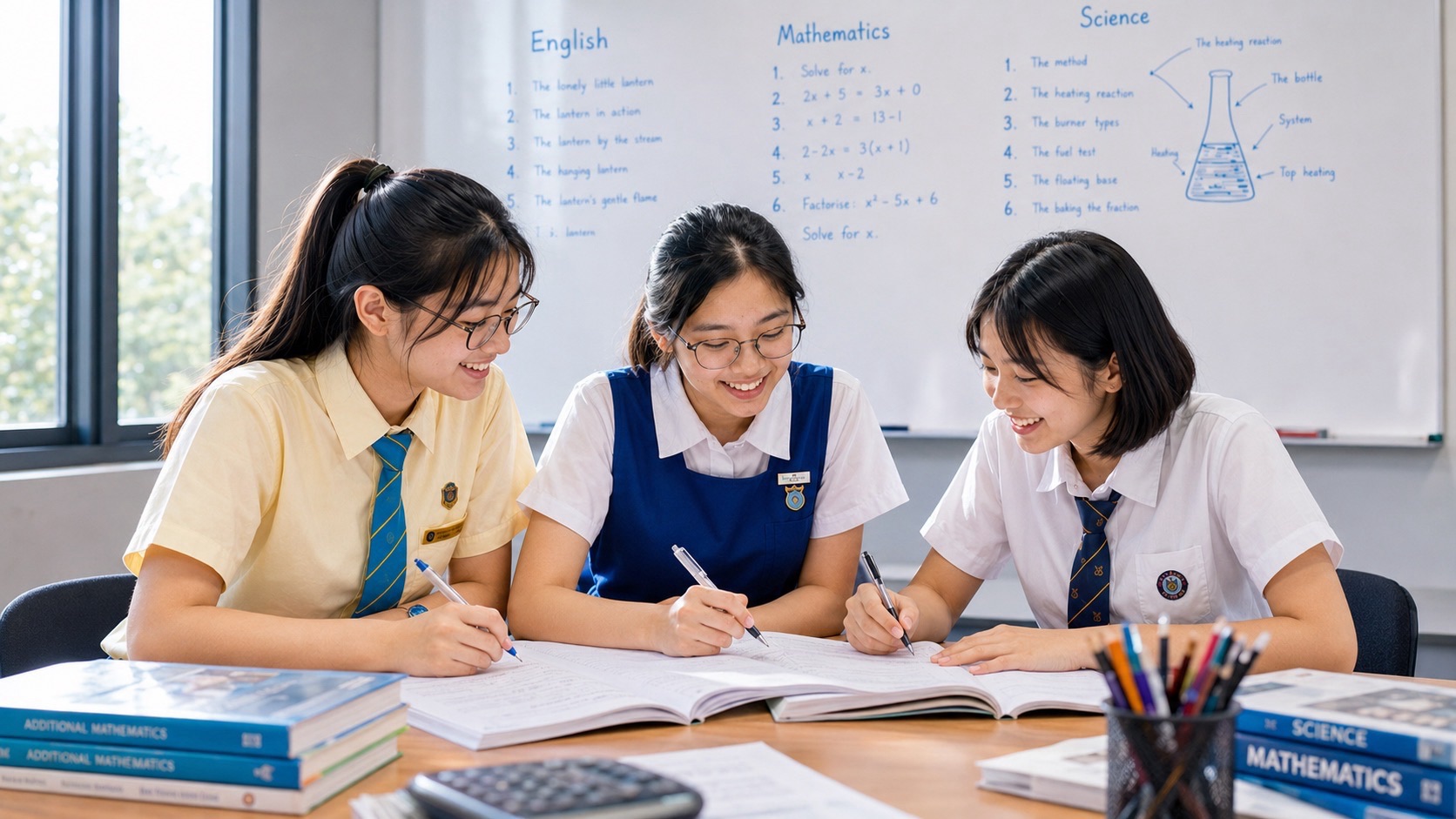
A Primary 5 pupil can name every grammar rule on a revision sheet and still make grammar errors while composing an original story. Another can retell a passage perfectly yet miss the point of a question. A third writes a lovely message that leaves its recipient uncertain what to do next. These are the hidden problems that good Primary 5 English tuition in Bukit Batok should address: not just what a child knows, but whether that knowledge can be selected and used appropriately in a new situation.
Families looking for Primary 5 English comprehension, situational writing, composition, grammar, cloze, vocabulary or PSLE foundation lessons in Bukit Batok are often trying to solve a practical question: how do we prepare for Primary 6 without turning every evening into another full examination paper? The answer begins with diagnosis, purposeful teaching and opportunities to transfer learning between reading, writing, listening and speaking.
This guide takes a first-principles approach. We will examine how questions determine relevance, how evidence limits inference, how a functional message serves its audience, and how a composition earns its ending through choices and consequences. We will also work through grammar transformations, cloze reasoning, vocabulary, oral and listening, and a six-week learning cycle for three-student English tutorials. All practice passages and messages here are original examples, not official questions or promised examination content.
Bukit Batok families have useful local contexts for teaching source accuracy. NLB states that Bukit Batok Library at West Mall reopened on 27 March 2026, with new sound-related spaces, after closing for renovation in late 2023. Nearby Bukit Batok Nature Park includes the former quarry and a memorial reflecting the area’s history. Both make interesting subjects for comparing past and current claims. Neither is represented as an SETC classroom: families should confirm the actual tuition venue, fees and timetable directly.
Primary 5 is the bridge between learning a skill and choosing it
Earlier primary lessons frequently isolate one kind of work. A pupil practises subject–verb agreement under a clearly marked heading, then practises story endings in another exercise. In upper primary, the heading disappears. Reading questions may demand several related decisions; writing requires the pupil to think about content, audience, sequence and correctness at once. It is a shift from recognition to deliberate use.
A child who writes fluent sentences may still miss an instruction in situational writing. A child with strong vocabulary may overstate what a passage suggests. These are selection problems. Teaching should make the decision visible: what exactly is the task asking, and which skill serves it?
The MOE Primary English Language syllabus emphasises purposeful language use across reading, writing, oral communication and listening. A useful tutor will connect those modes, rather than assume that mastering isolated workbook chapters automatically guarantees confidence with unfamiliar tasks.
First principle one: every comprehension question assigns a job
One passage may contain ten interesting details. Only one or two may answer a particular question. The first step is to name the required response: reason, method, comparison, consequence, direct fact or inference. A sentence can be entirely true and still be irrelevant. This is particularly important when a child has read enthusiastically and wants to show everything they remember.
Original practice passage: the revised exhibition information
Passage: “A class prepared a display about Bukit Batok’s history. One pupil found a description of the local library written during its renovation closure. Before printing the exhibit, the class checked a newer NLB document explaining that the library had reopened in March 2026. They updated the panel and included the source date.”
Question: Why did the class update its display? Good answer: The earlier description was from the renovation closure period and no longer reflected the library’s reopened status. Weak answer: “The class prepared a display about history.” That is a correct summary of the activity but not the reason for the change.
Question: How did the class improve the reliability of the information? Good answer: They checked a newer NLB document, corrected the panel and included the source date. The response names a method. Unsupported addition: “The teacher discovered that the earlier writer was deliberately dishonest.” No such intention is supplied.
The question–clue–answer test
- Underline the exact request, including words such as two, compare or based on paragraph four.
- Locate evidence for every required part, without borrowing details from unrelated sentences.
- Decide whether the evidence directly states a fact or supports an inference.
- Write the shortest complete answer that fulfils the request.
- Read the question and answer together to find any missing or irrelevant information.
After modelling, give a new passage and do not announce the type of question in advance. The pupil should identify the demand without a prompt. A corrected answer copied onto a worksheet is not the same as a transferrable method.
First principle two: state only what the evidence can carry
A strong inference is neither a wild guess nor a literal copy. It is a conclusion justified by particular clues. If a character checks a time repeatedly and takes a breath before speaking, nervousness may be one plausible inference. It is not established that the character once failed a similar event or fears a specific person’s reaction.
Worked inference correction
Original text: “Nadia rearranged the cards for her talk, tested the microphone once and glanced at the audience waiting outside.” Overconfident: “Nadia was terrified because she had never spoken to a crowd.” Repaired: “Nadia appeared to be preparing carefully for her talk, as she checked her cards and tested the microphone.”
The repaired response keeps its conclusion close to observable actions. It also avoids claiming a feeling unless the question requires one. Teach pupils to calibrate their language: suggests is not proves.
For a further challenge, ask what additional information would make the stronger claim justified. If the passage later stated that Nadia remembered a failed talk and dreaded another, the evidence would change. Reading responsibly means being willing to revise a conclusion when the text changes.
First principle three: situational writing is communication that gets something done
Situational writing is not a contest for the most elaborate salutation. A writer must convey necessary information to a particular recipient with a suitable tone. Before drafting, identify sender, audience, purpose, all required content points and the intended next action. A message that sounds polished but omits its central request remains incomplete.
Original scenario: a change of school reading session
Practice prompt: A school reading discussion planned for Wednesday will instead take place on Friday at 3.30 pm in the learning room. Each participant must bring the selected book and a pencil. Write to a classmate who was absent, explaining the change and requirements. This is a fictional school scenario, not a published Bukit Batok Library event.
Incomplete message: “Dear Ellie, I hope your week is going well. Our reading discussion will be wonderful. It is very important to read many books. I hope to see you. Your friend, Sara.” The warmth is pleasant, but Ellie cannot tell when, where or what to bring.
Purposeful message: “Hi Ellie, our reading discussion has moved from Wednesday to Friday. Please meet in the learning room at 3.30 pm and bring your chosen book and a pencil. I hope you can still join us. See you, Sara.” It contains the information the reader needs.
A three-pass revision process
- Content: underline each requirement in the task and locate the matching detail in the draft.
- Audience: check whether greeting, tone and degree of explanation suit a friend, teacher or organiser.
- Accuracy: check dates, times, pronouns, conditions, punctuation and anything that may have been invented.
Once the child can write to a classmate, change the recipient to a teacher and the purpose to asking for permission. A true test of learning changes the audience and task, not just a character’s name. A copied model may hide whether the child understands what the message needs to accomplish.
A second functional-writing clinic: politeness cannot substitute for purpose
Scenario: A pupil cannot attend a group rehearsal because of an appointment. The pupil must tell the teacher about the absence and ask what to prepare before the next meeting. Weak draft: “Dear Teacher, you are very kind. Thank you for all your efforts. Please understand. Yours sincerely, Mira.”
Improved draft: “Dear Mr Chen, I will be unable to attend Thursday’s group rehearsal because I have an appointment. Could you please let me know which part of the presentation I should practise before our next meeting? Thank you for your help. Yours sincerely, Mira.”
The improvement is functional. The teacher knows what is happening and what response the pupil requests. In real assigned tasks, all details must be grounded in the instructions; do not add an appointment or a name unless the prompt provides or permits it. The exercise here is a demonstration, not a universal template.
First principle four: a composition should belong to the topic
Memorised stories can become a trap. A pupil who knows a vivid adventure about a storm might try to force it into a topic about responsibility or honesty. The sentences may be excellent while the narrative fails its assigned purpose. Start planning by identifying a central decision that genuinely demonstrates the theme.
Original theme: correcting information even when it is inconvenient
Imagine a practice topic about making a responsible choice. A pupil helps prepare an exhibition and discovers that a panel uses an outdated statement. The group is almost finished and would rather leave it unchanged. The pupil must decide whether to speak up and help verify the information, knowing the correction will take time.
The interesting part is not simply “I was nervous.” It is the competing pressure. The child examines a dated source, asks a teacher or classmate to check it, and helps revise the panel before visitors arrive. The result follows from a decision and has a realistic cost: time that could otherwise have been used for rehearsal.
This is an original planning example, not a story to memorise. Change the problem to a sports team, a borrowed item or an instruction that was misunderstood. If the student can create a different plot around a difficult choice, the underlying method is developing.
Build the middle around a problem that requires action
- Situation: establish the character, setting and original plan without overlong exposition.
- Disruption: introduce a specific conflict or fact that changes the plan.
- Pressure: explain why the easy response is tempting but inadequate.
- Choice: show what the character actually does, perhaps after one unsuccessful attempt.
- Consequence: let the next event follow from that action.
- Reflection: describe a credible change in understanding, if the story earns it.
A composition does not require six equal paragraphs. Some stages need more room, while a strong short sentence may mark the moment of discovery. A polished opening should not consume time and attention that the central choice requires.
A composition repair: when the ending arrives before the solution
Thin paragraph: “Our project had a mistake. I was shocked. I told my friend. Soon everything was fixed and we were happy.” The reader cannot tell what the mistake was or how the fix occurred.
Improved paragraph: “Just before printing, I noticed that our poster described the library as closed. The article we had used was from the renovation period. I showed Farhan the publication date and found a newer NLB document. We compared the information, then replaced the outdated sentence and added the new source beneath the picture.”
The improved version contains the clue, verification, action and revised result. It also shows why the time reference matters. The sentence need not be adorned with exaggerated emotions; a reader can understand the pressure through the specific problem and decision.
Dialogue should introduce information or change the plan
Unhelpful: “This is a serious problem,” I said. “Yes, a serious problem,” he replied. Useful: “What date was that article published?” Farhan asked. The second line initiates an action that matters. Ask whether each line of dialogue changes the story, reveals a character or provides necessary information.
Good writing often becomes stronger when unnecessary lines are removed. Tell a pupil to revise for meaning before adding adjectives. Every paragraph should serve the central event, not merely increase the word count.
First principle five: grammar must preserve the facts
Sentence transformation requires more than a valid construction. The transformed sentence must preserve who acted, what happened, when and under which conditions. “The pupils were tired. They continued preparing the exhibition.” becomes “Although the pupils were tired, they continued preparing the exhibition.”
It does not become “Because the pupils were tired, they stopped preparing the exhibition.” That changes the outcome. The student may have chosen a grammatically sound pattern but produced a false version of the source.
Find the controlling subject rather than the nearest noun
“The collection of recordings is interesting.” The subject is collection, singular. “The recordings in the collection are interesting.” The subject is recordings, plural. Teach pupils to identify the head noun before deciding on the verb. Guessing from the nearest noun is a fragile shortcut.
A tense comparison that changes the timeline
“When the visitors arrived, the programme began.” This can mean the events began together. “When the visitors arrived, the programme had already begun.” In the second sentence, the programme started earlier. Ask pupils to draw two events on a timeline. If they can explain the sequence, the grammar choice becomes meaningful.
Transformations should be checked against the original statement, not only against a remembered formula. This creates a habit of preserving truth that also helps factual writing and oral explanations.
Cloze: a word must fit its neighbours and the paragraph
The blank is not an island. A possible word needs to match grammar, meaning, normal usage and the surrounding sentences. A child who chooses a familiar connector without reading the whole paragraph can create a contradiction.
Original cloze repair
Paragraph: “The group had prepared carefully for the outdoor exhibition. ______, a sudden downpour meant the event had to move indoors.” However expresses an unexpected contrast. Therefore would wrongly imply that the preparation caused the rain or venue change.
Have the pupil explain why the chosen word makes the paragraph coherent. Then write a new passage with a genuine cause-and-effect relationship in which therefore would be suitable. Contrasting both is more valuable than memorising the answer to one blank.
Vocabulary: strength and certainty must match the evidence
The words claim, suggest and demonstrate express different degrees of certainty. Annoyed, disappointed and furious express different reactions. An advanced vocabulary list is useful only if the student knows which word is true to the intended context.
Try a small word family: decide, decision, decisive, indecisive. Ask what grammatical role each can take. Then apply two of them to new sentences. A word that works in one memorised example may still be uncertain in a different construction.
A child should be able to explain a deliberately wrong example: “He was furious because his book had a slightly different cover.” Is furious appropriate, or does it exaggerate the situation? The context determines the answer. Correct word choice is a form of judgement.
Bukit Batok Library and the surprising value of dated sources
NLB’s library fact sheet states that Bukit Batok Library originally opened in 1998, closed for a full revamp at the end of 2023 and reopened on 27 March 2026. A page published during the closure could accurately describe the library as unavailable then, yet become misleading if repeated as a present-tense claim after reopening.
A useful Primary 5 exercise uses three columns: statement, date and what the statement permits us to say today. “The library was closed during renovations” and “the library reopened in March 2026” are compatible descriptions of different moments. Do not treat the newest known source as a guarantee that every service remains permanently unchanged; check current official information when planning a visit.
The new Sound Library and Time Caverns also invite the distinction between a historical recording, the present-day context in which it is heard and the conclusions a listener draws. A primary pupil can learn that a voice recording may preserve the words of a speaker at one moment without proving every interpretation of that speaker’s experience.
Bukit Batok Nature Park: describing a place without inventing history
NParks explains that Bukit Batok Nature Park was developed on a former quarry site in 1988 and includes a memorial plaque relating to World War II. A student can use this to practise choosing between historical fact, present observation and imaginative description. A photograph of the quarry pool cannot by itself establish every event in its past.
Ask what a source establishes directly: the location and identified features. Then ask what would need a historical record: dates, people or causes of events. The pupil learns that a vivid description is not automatically a reliable historical explanation. This is the same discipline that prevents unsupported comprehension answers.
Oral communication: make the reason audible
A Primary 5 child may answer “Yes, I like libraries” and stop. A fuller response might be, “I enjoy libraries because I can explore topics that I would not normally choose in school. For example, I once became interested in animal sounds after browsing an information book.” The answer gives a view, a reason and a specific example.
A follow-up could ask whether listening to recordings and reading printed explanations suit different learners. The child may recognise benefits and limits of both without declaring one universally superior. Natural conversation develops through listening and adapting, not delivering one prepared speech.
Listening: updated information defeats an old plan
Original script: “The workshop was planned for Tuesday afternoon, but it will now take place on Thursday at four. Please bring a pencil, and you no longer need to bring a notebook.” The correct date is Thursday and the required item is a pencil. An answer that repeats Tuesday or includes the notebook ignores the change.
Train attention to but, instead, now and no longer. Then vary the context: a changed meeting point, a revised deadline or an item made optional. The goal is a pupil who updates understanding as speech unfolds.
The three-student tutorial: an individual diagnosis inside a shared conversation
Imagine three Primary 5 pupils. One reads accurately but omits required information in functional writing. Another writes fluent paragraphs but overstates inferences. A third understands the rules but cannot retrieve them under timed conditions. A small-group lesson should not treat these different problems as one uniform weakness.
- Begin with retrieval from previous lessons without announcing exactly which skill applies.
- Use a fresh task to identify each learner’s earliest unreliable decision.
- Model an underlying principle through a correct answer and a plausible near-miss.
- Give independent practice matched to the individual need.
- Discuss why answers work, not merely which answer is correct.
- Check transfer in an unfamiliar task and agree a realistic home priority.
A 90-minute weekly tutorial can give those activities room. The important feature is careful observation, not a rigid timetable. Ask whether the tutor can name what each child should practise next and show evidence that the earlier weakness is improving.
A six-week bridge from Primary 5 towards PSLE readiness
Weeks 1–2: identify weaknesses and stabilise foundations
Collect recent comprehension, grammar and independently written work. Identify patterns such as missed question demands, unsupported inference, missing functional-writing details or weak narrative causation. Choose two priorities and practise them in short sets before returning to longer tasks. Record the child’s existing strengths.
Weeks 3–4: connect skills across contexts
Use evidence evaluation in both comprehension and source-aware factual writing. Use cause and consequence in story planning and grammar transformation. Practise audience awareness in functional messages and oral explanation. Mix categories so the child learns to choose a method without the worksheet naming it first.
Weeks 5–6: verify independent application
Use new passages, fresh writing prompts and reasonable timed practice. Compare work with the baseline. If the concept fails, return to direct teaching; if the skill is stable but slow, practise efficient retrieval and checking. A full practice paper is useful for diagnosis and integration, but should not replace lessons addressing the discovered cause.
An upper-primary home plan that will fit a real week
- Read something enjoyable and discuss one evidence-based claim.
- Answer two comprehension questions and underline their supporting details.
- Write one functional message, checking every required point.
- Plan an original story around a difficult decision and its consequence.
- Correct three grammar or cloze items and explain what meaning the correction preserves.
- Use two vocabulary words in new situations after a delay.
- Give one spoken point with a reason and a specific example.
- Protect sleep, leisure and voluntary reading rather than turning all free time into assessed work.
The routine is a menu, not a demand to complete every activity in one sitting. Parents can support a child by asking what the reader needs to know and which evidence supports the answer. They should avoid rewriting an entire paragraph in adult prose, because that hides the child’s independent ability.
An integrated mini-assessment: one scenario, five skills
Original scenario: “A class prepared labels for a sound exhibition. One description used an outdated date. The pupils checked a newer source, corrected the label and informed the teacher before visitors arrived.”
Reading: Why was the label corrected? Because it contained an outdated date. Inference: What can be cautiously said about the pupils? They appeared careful about accuracy because they verified the information. Grammar: Combine “The pupils were busy. They checked the facts” using contrast, without changing what happened.
Functional writing: Tell the teacher that the error was discovered, the facts checked and the label corrected. Composition: Imagine a pupil hesitating to speak up about the error because the group is nearly finished. Show the decision and its consequence.
These tasks share a setting but have different purposes. The pupil must choose what each asks. That is the heart of upper-primary English. Knowing words is a foundation; selecting and using them appropriately is the next stage.
Frequently asked questions from Bukit Batok Primary 5 families
Should Primary 5 focus entirely on PSLE papers?
Primary 5 should strengthen the transferable skills needed for Primary 6. Familiarity with examination tasks is useful, but repeated full papers cannot repair a concept that has never been taught clearly. Balance deliberate practice with sustained reading, authentic writing and appropriate rest.
My child knows grammar in worksheets. Why do original paragraphs contain errors?
The worksheet announces the rule category. Original writing requires the child to retrieve and apply rules while planning meaning and structure. Practise self-editing genuine paragraphs, not only isolated questions, and check the same skill later in a new piece.
Is memorising polished compositions effective?
Good examples can teach craft, but a memorised story may be irrelevant to an unfamiliar topic. A pupil should be able to create a new plot with a meaningful decision and a believable middle. Relevance and coherence cannot be replaced by a rehearsed introduction.
Can vocabulary enrichment alone improve all English marks?
Vocabulary supports comprehension, writing and conversation, but it does not independently fix evidence selection, structure or functional completeness. Study words in context and teach the relevant reasoning skills alongside them.
Can three pupils have separate progress goals?
Yes, if the tutor diagnoses each learner and provides differentiated practice within a shared discussion. Ask for evidence of independent progress rather than relying solely on class size as a quality measure.
Is there an SETC classroom at Bukit Batok Library?
This page makes no such claim. The reopened West Mall library and nature park are public reading and observation references, not described as SETC premises. Verify the actual class address, fees, schedule and availability directly.
How should we tell whether tutoring is working?
Look for fewer recurring mistakes in new work: more relevant comprehension, complete functional messages, better-controlled grammar and story endings that follow from the middle. Ask for a diagnosis, a correction and a fresh independent verification, not just a higher worksheet count.
The Primary 5 goal is better judgement
Strong Primary 5 English means knowing how to decide what a question wants, what evidence can support, what information a recipient needs, and how a story’s choices create its outcome. A pupil who can make those decisions on unfamiliar material is better prepared for Primary 6—and for the communication demands of the wider world.
Learn about SETC Primary 5 English Tuition, our three-student tutorial approach and the earlier Primary 4 Bukit Batok first-principles guide. A recent independent writing sample gives a much better basis for the next step than an untested promise of grade improvement.
Continue through the Bukit Batok Primary English series
Each year asks children to use familiar English skills in new ways. Choose the guide for your child’s current learning stage, and revisit earlier foundations whenever unfamiliar tasks reveal a gap.
- Primary 3 English Tuition Bukit Batok — Clear sentences, evidence and the first coherent stories
- Primary 4 English Tuition Bukit Batok — Comparison, inference, grammar relationships and story causation
- Primary 5: this guide — Situational writing, upper-primary reasoning and PSLE foundations
- Primary 6 PSLE English Tuition Bukit Batok — Evidence-led preparation across English Papers 1–4