
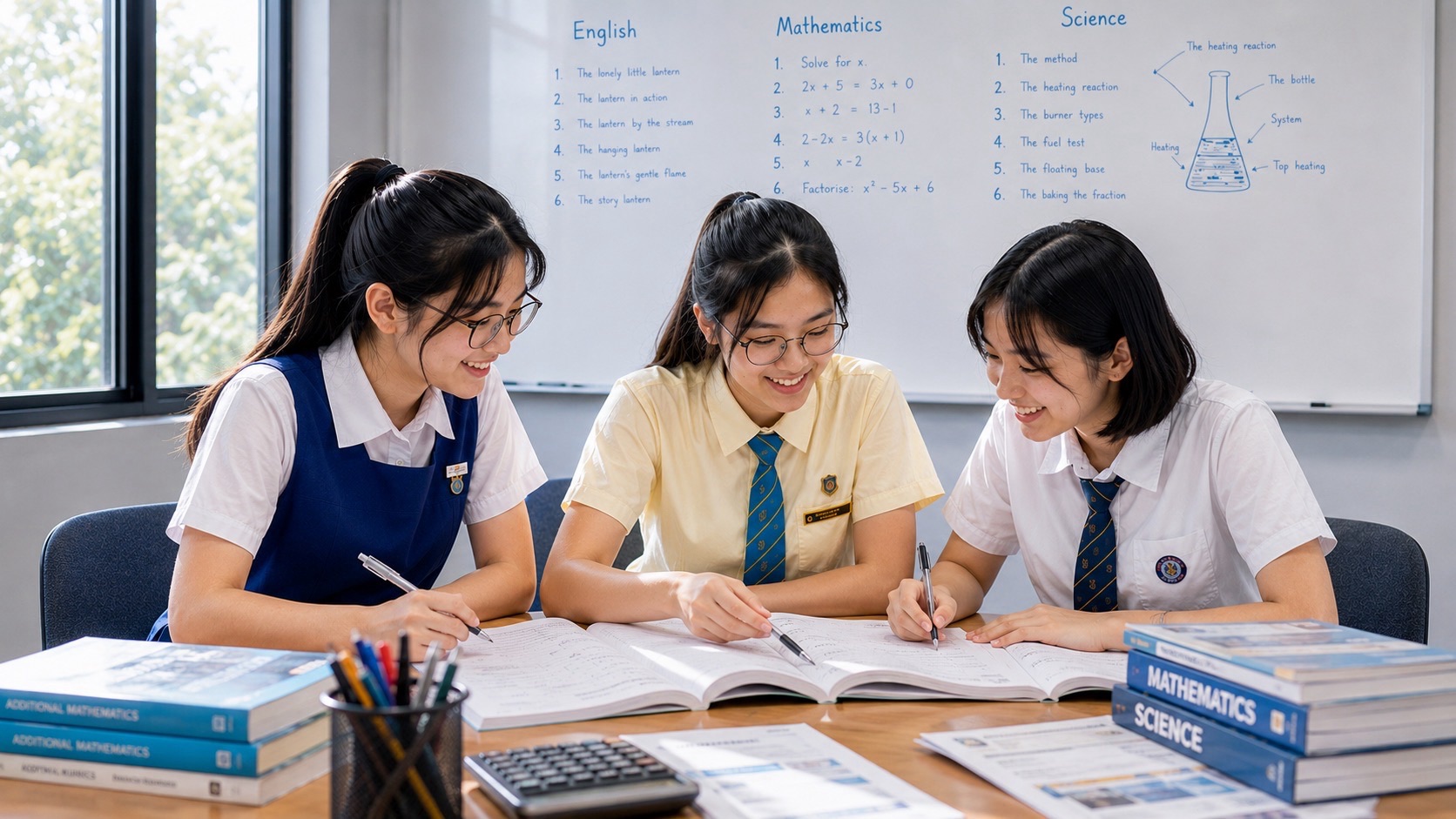

Secondary 3 G1 English tuition in Bukit Ho Swee can teach one of the most important habits a student will ever learn: the ability to tell a reader what is known, how it is known and what remains uncertain. That habit is the foundation of reading comprehension, functional writing, reports, oral explanation and responsible argument. It matters especially when the subject is a real event in Singapore’s history.
For families looking at Secondary 3 G1 English tutorials for Bukit Ho Swee, the task is no longer simply to write longer answers. A student needs to distinguish fact from inference, sequence from cause, evidence from opinion and a useful recommendation from a promise that cannot be supported. The same skills make school English clearer and daily communication more trustworthy.
This first-principles guide to Bukit Ho Swee Secondary 3 G1 English tuition respectfully uses publicly documented local history to demonstrate accurate language. The Bukit Ho Swee fire of 25 May 1961 had serious human consequences and should never become a sensational classroom gimmick. We use only a small number of verified facts for analysis; all invented dialogues, notices and report scenarios are explicitly hypothetical exercises, not accounts of real residents or events.
The quick parent answer: what does Secondary 3 G1 English need to build?
By Secondary 3, students should be moving towards independent control of information. They need to recognise the task, find relevant source evidence, decide what a claim permits, and express an answer in a form suited to its reader. A learner who can perform these moves on a familiar worksheet may still struggle with an unfamiliar historical account, public notice or narrative. The tutorial must therefore test transfer, not only repetition.
The central goals are evidence-based comprehension, concise summary, accurate tense and verb choice, connected paragraphs, functional messages, purposeful oral responses and a habit of checking what a passage actually establishes. Each area reinforces the others. If a learner misreads a source in comprehension, the same misreading may reappear in a report or speech.
G1 is a subject level within Full Subject-Based Banding. It should not be confused with Posting Group 1 or treated as a permanent description of a learner’s potential. The school makes subject-level decisions according to the relevant policy and evidence. A tutor helps the child develop skills that remain useful regardless of the level offered in another subject.
Bukit Ho Swee history makes the difference between fact and speculation impossible to ignore
On 25 May 1961, a devastating fire affected Bukit Ho Swee. The National Library Board’s Singapore Infopedia records that around 16,000 people were left without homes and that four people died. Accounts also describe the significant impact on Singapore’s public housing development. Most importantly for our language lesson, the precise cause of the fire remains unknown in the Infopedia account.
Those last words matter. A student might read about strong winds, structures made from vulnerable materials and a fire spreading through the area. These are important details about conditions and consequences, but they do not automatically prove the original cause. A claim that confidently identifies the cause goes beyond the cited account. Historical English must be honest about the boundary.
We can read NLB’s account of the Bukit Ho Swee fire and the National Heritage Board’s Roots overview for documented context. These sources are part of a nation’s memory, not simply convenient question banks.
A respectful lesson invites students to write clearly without inventing the feelings, names or exact experiences of particular people. English becomes more valuable when it gives a complicated event the accuracy and care it deserves.
First principle: the verbs in a report tell readers what they may believe
Read five verbs: reported, observed, confirmed, estimated, concluded. They are not interchangeable. A witness may report something. An investigator may observe a condition. An authority may confirm a verified detail. An estimate may express an approximate number. A conclusion may result from an argument or enquiry. Changing the verb can change the strength of a claim.
Suppose a fictional report says, “Residents reported hearing a loud sound.” A careless paraphrase becomes, “Investigators confirmed the source of the sound.” The first states what people said; the second claims verification by investigators. No amount of polished grammar makes the new claim faithful.
Teach students to ask three questions about each reporting verb: Who performed the action? What exactly was asserted? How certain is the assertion? Put the answers in a simple table and compare two possible rewrites. The learner learns the language of responsible reporting, not just dictionary definitions.
In an ordinary school context, the same principle matters. “The class requested a new timetable” is different from “The school approved a new timetable.” “The teacher suggested a revision” is different from “The teacher required a revision.” These distinctions protect the reader from misunderstanding and the writer from making unsupported promises.
A historical account needs a timeline, but a timeline is not the explanation
A chronological account puts events into sequence. It may begin by describing circumstances, proceed to the event and then discuss response and longer-term effects. An explanatory account also needs causal relationships backed by evidence. Students must learn that moving from one paragraph to the next does not automatically prove that the first event caused the second.
A familiar school-level error illustrates the point. A passage says, “Heavy rain began. Shortly afterwards the sports activity ended.” The student writes, “The activity ended because of rain.” That might be true, but the source given did not explicitly provide the reason. The student has moved from sequence to causation without checking.
In the historical context of Bukit Ho Swee, a responsible writer can discuss the fire and its consequences for housing policy while being careful about the boundary between what sources document and what a modern writer infers. The event’s importance does not give permission to invent details that the record does not supply.
For practice, provide a short dated sequence about a fictional school renovation: planning, approval, construction, opening. Ask students to summarise it in one sentence, then explain which causal claims would require additional sources. If the learner can make that distinction, the skill has moved beyond the history lesson.
What a source states, suggests and cannot answer
A tutor can use three columns: stated, supported inference and not established. Put a phrase from the source in the first column. In the second, write a cautious inference with a reason. In the third, write a plausible-sounding claim that would require new evidence.
For example, in a hypothetical school report, “Thirty learners attended a briefing” is stated. “The briefing likely reached more learners than the previous session of twenty” is a supported comparison if both counts are present. “All learners were satisfied” is not established unless the report includes information about satisfaction.
Students often believe that a more confident answer will impress a marker. In evidence-based English, confidence must be earned. Words such as all, never, certainly, caused, proved carry heavy commitments. A single overstrong word can change the truth of an otherwise reasonable sentence.
Ask the child to defend each important claim by pointing to a phrase in the passage. If the defence is “That sounds right,” work backwards. What evidence would make it right? This question turns an error into a lesson in inquiry.
The language of uncertainty is a strength, not a weakness
A careful writer can express different degrees of confidence. “The text states” signals direct reporting. “This may suggest” introduces a possibility. “The evidence supports the view that” presents a reasoned interpretation. “The account does not establish” marks a limit. These expressions are not elaborate padding; they tell the reader what kind of claim is being offered.
Compare: “The event caused every later change.” “The event contributed to broader changes.” “The event was followed by broader changes.” Each sentence makes a different causal claim. A source may support one while not supporting the others. The writer must choose the statement that can be defended.
In functional writing, the same skill helps when a student communicates a concern. “The venue may be difficult for some visitors to access” is different from “The venue is inaccessible to everyone.” The first allows for a concern that might need checking; the second is a categorical statement that requires strong evidence.
Practise rewriting overconfident sentences into proportionate claims. Then challenge the learner not to become vague by default. The aim is exact confidence, not constant hesitation.
Second principle: answer the instruction, not the subject that interests you
Students may know several facts about an event and still lose relevance. If the question asks “What was the consequence?”, a paragraph describing only the date and location does not answer it. If it asks “Why might the writer have included a quotation?”, repeating the quotation is not a full explanation.
Teach task verbs by their work. Identify calls for naming a relevant detail. Explain calls for a meaningful relationship. Compare calls for a shared measure. Evaluate calls for a judgement and reasons. Suggest calls for a reasonable proposal. The student should be able to state the task in ordinary language before starting.
A useful classroom routine is to cover the passage briefly and discuss only the question. What kind of answer would satisfy it? How much evidence might be needed? Then reveal the passage and locate the evidence. This prevents the common approach of copying whatever nearby sentence happens to contain a familiar keyword.
After writing, place the question and answer beside each other. Does every sentence serve the requested purpose? If not, shorten or redirect the response. Precision in Secondary 3 often looks like confident restraint.
Inference: use a clue, explain its meaning and stop where the clue stops
Suppose a fictional story says, “When the announcement was read, Mei folded the letter and kept it in her bag without speaking.” A student might infer that Mei was thoughtful, disappointed, worried or simply waiting to speak privately. The text supports an observation of silence and a deliberate action, but it may not settle one emotion.
If other lines say Mei had been hoping for different news, disappointment becomes better supported. The answer should connect the clue to the conclusion: “Mei may have felt disappointed because she had expected different news and did not respond immediately.” The inference is specific without pretending to know everything.
The strongest inference routine is evidence, possible meaning, competing explanation and calibrated conclusion. The third step is often overlooked. Asking whether another interpretation fits encourages genuine reading rather than automatic guesswork.
Not every examination answer needs to display every step in full, but the underlying thinking should be there. A tutor can model it aloud and then ask the student to produce a brief answer independently. As confidence rises, the reasoning becomes faster because the student recognises what an inference is allowed to do.
Summary writing: what should remain after the details have been compressed?
A good summary is not a list of striking phrases. It preserves the source’s main actors, actions and relationships while removing examples that are not needed for the requested purpose. If a passage explains the stages of responding to an emergency, the summary should retain the stages and their functions rather than the colour of the vehicles or the order in which quotations appear.
Try a fictional case: “The committee gathered feedback, reviewed safety concerns, consulted the school and revised the activity plan.” A useful summary is, “The committee used feedback and safety review to revise the activity plan with the school.” The central process remains intact.
A defective summary might say, “The committee ignored safety concerns and changed the plan,” because it introduces a conclusion opposite to the source. Another weak version says, “The committee did many things,” because it compresses away the important relationships. Shortness alone is not success.
Teach students to highlight verbs before nouns when summarising a process. Then ask for one sentence that explains what changed. The SETC paraphrase guide is useful when the learner understands the information but struggles to reword it without altering the claim.
Third principle: a functional report is a sequence of answerable claims
Reports often fail because the student is unsure whether to describe, analyse or recommend. A useful simple report answers: What happened? What evidence supports that description? What problem follows? What next action is reasonable? These are different jobs, and a paragraph can be organised around each.
Consider a fictional school library report. The writer might state, “A class survey found that some students could not locate the books they needed.” That is an observation of a reported result. The writer might then explain the limitation: “The survey involved one class, so it does not describe every student in the school.” Finally, the writer may recommend clearer shelf labels or further feedback from other classes.
The recommendation does not require pretending that the improvement is already approved. “The school should consider” is different from “The school will install.” Students need to control the difference between a proposal and a decision.
A precise report can be brief. A long report can be unreliable. Tutors should train students to use headings or paragraph focus where appropriate, keep dates and quantities accurate and write recommendations that logically follow the evidence.
A comparison must use the same question on both sides
Imagine a task comparing two accounts of a community activity. One account gives the number of participants; the other describes the organisers’ intentions. A student cannot simply conclude that the first event was more popular unless comparable participant data is available for both. Apples and oranges are not made comparable by placing them in adjacent sentences.
A good comparison chooses a shared dimension: audience, purpose, timing, evidence, limitation or result. “Both notices tell residents where to attend, but only the second gives a registration deadline” is a meaningful comparison because the dimension is information supplied. “The second is better” is not enough unless the writer explains better for what reader need.
Teach students to write a comparison sentence using “both”, “whereas” or “in contrast” only when the logic fits. Then ask them to write a paragraph without overusing these phrases. Connectives should carry real relationships, not decorate an answer.
When a learner makes a judgement, invite one qualification. A notice can be more detailed yet less readable. A report can be concise yet omit an important condition. Mature English is able to notice a trade-off rather than reduce everything to good or bad.
The claim–reason–example paragraph for Secondary 3 G1 writing
A student preparing an opinion paragraph can begin with a clear claim, explain the reason, give a relevant example and close by connecting the example to the claim. The structure is simple but powerful because it keeps the paragraph accountable to its reader.
Prompt: “Why should schools teach students to check information before sharing it?” A possible paragraph is: “Students should learn to check information because an inaccurate message can spread confusion quickly. For example, a mistaken announcement about an activity date may cause classmates to arrive at the wrong time. Checking the original notice and its date before forwarding it can prevent this problem. The habit therefore protects both the writer and the people who rely on the message.”
Ask what each sentence is doing. Then remove the example and observe what becomes weaker. Replace it with a different example from health, public transport or school study. The goal is to preserve the logical shape while changing the content.
A tutor should avoid teaching one impressive opening that students paste into every essay. The strongest paragraph is the one that is responsive to the actual question, not the one that sounds most similar to a memorised sample.
Counterarguments: disagreement can improve clarity
Students sometimes think an argument becomes stronger by ignoring every possible objection. In practice, a fair counterpoint can show that the writer understands the issue. Suppose the essay asks whether every school notice should be very detailed. A student might argue that detail reduces confusion, while acknowledging that excessively long notices can be difficult to scan.
A balanced answer could say: “Although detailed notices can reduce uncertainty, the essential instructions should remain easy to find. Headings and short paragraphs can help readers locate the information they need.” The writer has not abandoned the original view. The qualification makes the recommendation more useful.
Do not ask learners to invent straw-man positions that nobody believes. A genuine counterargument should address a reasonable competing concern. The tutor can use a two-column exercise: benefit and possible limitation. Then the student writes a recommendation that responds to both.
This skill also supports respectful oral English. A learner can say, “I understand that another student might prefer a different approach, but I would choose this one because…” That is more persuasive than simply repeating a louder version of the first claim.
Grammar: tense, reference and reporting must agree
An account of a past event ordinarily needs reliable past-time forms. “The committee meet yesterday and discuss changes” should usually become “The committee met yesterday and discussed changes.” But correction must go beyond replacing two verbs; the tutor should ask which time reference governs the paragraph.
Reported information needs care too. “The teacher said the visit is confirmed” and “The teacher said the visit was confirmed” can be appropriate in different contexts depending on whether confirmation remains current and how the report is framed. Students should consider meaning rather than apply tense backshifting blindly.
Pronoun ambiguity is another common problem. “The students thanked the volunteers after they completed the project” could make the agent of completion unclear. Sometimes a repeated noun is the right choice: “After the volunteers completed the project, the students thanked them.”
When editing, prioritise meaning-bearing errors: wrong action, wrong time, wrong person, wrong negation, unsupported certainty. Correct punctuation and style too, but do not allow surface polish to conceal a false or confusing claim.
Vocabulary for truthful explanation and precise evaluation
Secondary 3 learners benefit from verbs and nouns that express the strength of evidence: document, verify, estimate, attribute, indicate, infer, suggest, demonstrate, distinguish, qualify. Each word needs use in context. “The source documents the date” is different from “The source suggests a possible explanation.” “The number was estimated” is different from “The number was confirmed.”
Teach contrasts rather than ornate synonyms. Ask students to choose between “caused” and “contributed to”; “proved” and “supported”; “claimed” and “reported”; “impossible” and “unlikely.” Explain what each choice commits the writer to. A wrong strong verb can damage the accuracy of a whole paragraph.
Move from recognition to retrieval. The child first sorts sample sentences into accurate and inaccurate claims, then writes a new sentence using a suitable word, then explains the same distinction orally. If a word is used only in memorised definitions, it has not yet become part of usable English.
Avoid treating historically difficult topics as a chance to collect dramatic adjectives. In writing about suffering, precise and respectful language is preferable to exaggerated vocabulary intended to impress.
Listening and spoken response: notice when a speaker corrects the record
A spoken announcement may contain an initial plan, a revision and a final instruction. Students who record only the first date or first figure will misunderstand the current situation. A listening exercise can explicitly teach the signals however, instead, revised, no longer, now.
Consider this fictional message: “The presentation was initially scheduled for Thursday. It has now been moved to Friday, and participants must confirm attendance by Wednesday.” The current presentation day is Friday; the confirmation deadline is Wednesday. These are two different dates performing different jobs. The learner should identify both.
Oral English requires equally careful claims. If a student discusses a photograph, begin with what can be observed, then introduce a cautiously supported interpretation. “The people are standing beside a display” is observation; “They may be explaining their work to visitors” is inference. Let the child say why the interpretation is plausible.
A three-person discussion can rotate speaker, questioner and summariser roles. The summariser must reproduce the speaker’s meaning faithfully. This activity makes listening active and shows why precise English serves cooperation, not only formal examinations.
What parents can learn from the first wrong move
A wrong answer is the visible result of an earlier problem. A learner may have misread the question, selected the wrong passage line, confused a pronoun, inferred too strongly, omitted a condition or written a sentence that obscures an otherwise sound idea. Each possibility requires different teaching.
In a diagnostic tutorial, ask the student to read a short unfamiliar passage, answer a fact question, justify an inference and write a brief report or opinion paragraph. Then ask one question: “Which sentence in the source made you write that?” The reply often reveals the earliest point where meaning was lost.
Parents can use this method gently at home. Rather than calling an error careless, ask the student to show the evidence. If the student cannot, revisit reading. If they can but the answer is unclear, work on expression. If the sentence is factually sound but irrelevant, return to the task instruction.
A useful progress record contains the original error, the reason it occurred, the corrected principle and a later unfamiliar example. The child should be able to explain the principle without the teacher supplying every clue. Less prompting is a meaningful sign of progress.
Why a three-student maximum can support independent English
A lesson with at most three students can reveal different interpretations of the same text. One learner may overclaim, another may omit essential evidence and a third may be unable to turn a good oral explanation into writing. A skilled tutor should respond differently to each. Simply giving all three students another identical worksheet would miss the diagnostic opportunity.
The structure also allows the teacher to ask students to challenge an overconfident claim respectfully: “Which line supports that?” “Is that definitely stated?” “Could another interpretation fit?” These are useful academic and civic habits. The peer discussion remains calm because the group is small enough for each voice to be heard.
A 1.5-hour tutorial might include a short retrieval test, a reading demonstration, independent comprehension, a focused report task, oral explanation and targeted correction. It should produce some evidence of what the learner can do without help.
Ask any tuition provider about how written work is assessed, how learning gaps are found, how the class is paced and whether the setting suits the child. Three students is a design choice, not a guarantee; the quality of teaching and feedback still matters.
A six-week example for Secondary 3 G1 learners
Week 1 — Diagnose. Read a fresh passage and ask for factual, inferential and evaluative responses. Capture one original writing sample. Identify the first failure in task reading, evidence, inference or expression.
Week 2 — Stabilise reporting verbs and source boundaries. Distinguish reported, observed, confirmed, estimated and recommended. Practise on fictional notices and school reports before applying the habit to more complex material.
Week 3 — Build inference and summary control. Require a clue for every inference; practise compressing a passage without changing its subjects, actions, conditions or chronology.
Week 4 — Improve paragraph reasoning. Write claim–reason–example paragraphs and one fair counterargument. Teach students to revise for relevance before polishing adjectives.
Week 5 — Transfer to functional writing and oral communication. Produce a short report for a defined audience, explain a proposal and listen to a peer’s response. Check the difference between a recommendation and an approved plan.
Week 6 — Test on genuinely new texts. Compare answer accuracy, writing independence and clarity of explanations. Use the remaining errors to determine the next focus. A six-week model is a planning example, not a promise about any child’s progress rate.
The home routine: a small number of careful questions
A parent does not need to turn the living room into a second classroom. Use a short nonfiction paragraph or school notice and ask three questions: What is stated? What might reasonably be inferred? What does the text not tell us? These questions can take less than fifteen minutes yet train several valuable abilities.
On another day, choose one sentence and replace a verb. Ask whether the new verb changes the confidence or timing of the claim. On a third day, write a two-sentence summary. Later, ask the child to produce the same kind of answer with a new topic and no visible model.
To support oral confidence, ask for an opinion and one reason, then offer a respectful counterpoint. The goal is not to win the discussion but to help the learner explain and revise a thought. If a historical subject is involved, keep the tone respectful and refer to reliable sources.
Praise the exact behaviour that improved: “You noticed that the article did not identify the cause,” or “You distinguished the date of the event from its later consequence.” Specific feedback teaches the learner what to repeat.
Original practice bank: twelve evidence-and-writing challenges
The mini-passages below are invented for practice unless explicitly labelled as public historical facts. They are not excerpts from a live examination or a local community notice.
1. A reported claim is not a confirmed fact
Fictional text: “Two residents reported hearing a loud sound; the organiser had not yet established its source.” Task: Summarise accurately.
Model: “Two residents reported a loud sound, but its source had not been established.” Do not write that investigators confirmed the cause.
2. Historical evidence has limits
Public source point: NLB records the Bukit Ho Swee fire on 25 May 1961 and states that the cause remains unknown. Task: Identify one claim that would exceed this evidence.
Model: A definitive claim naming the cause would exceed it. The correct habit is to separate conditions that intensified an event from the cause of its initial outbreak.
3. Scope matters
Fictional text: “Several families requested additional information.” Student answer: “Every family objected.” What is wrong?
Model: “Several” was changed to “every,” and a request was changed into an objection. Both the number and the action were overstated.
4. A timeline is not a cause
Fictional note: “A notice was sent on Monday. Attendance increased on Tuesday.” Task: Can the writer claim the notice caused the increase?
Model: Not from the two statements alone. Another factor may explain the increase, and the note provides sequence rather than causal proof.
5. A recommendation is not an approval
Fictional report: “The committee recommended new signs.” Student summary: “New signs will be installed.” What needs repair?
Model: “The committee recommended installing new signs.” A recommendation records a proposal, not a confirmed decision.
6. A comparison needs a common measure
Fictional figures: Group A submitted twelve comments; Group B submitted seven. Task: Write one supported comparison.
Model: “Group A submitted five more comments than Group B.” Do not infer that either group’s comments were of higher quality.
7. Preserve the question’s job
Question: “Why did the team revise the plan?” Source: “The team revised the plan after receiving safety feedback.”
Model: “The team revised it in response to safety feedback.” Simply restating that the plan changed fails to answer why.
8. Replace an overconfident verb
Sentence: “The survey proved that every student wanted a longer break.” Fictional survey: twenty students responded; fifteen preferred the change.
Model: “In the small survey, fifteen of twenty respondents preferred a longer break.” The revision respects both sample size and scope.
9. Write a fair counterpoint
Claim: “Long notices are always better.” Task: Write a one-sentence qualification.
Model: “Detailed notices can answer important questions, but essential instructions should still be easy to scan.” It acknowledges benefits and limits.
10. Choose an appropriate email request
Scenario: A school form lists a submission date but not whether email submissions are accepted. Task: Draft one polite question.
Model: “Could you please confirm whether this form may be submitted by email before the stated deadline?” The writer requests missing information instead of assuming.
11. Repair an ambiguous pronoun
Fictional sentence: “The volunteers informed the residents that they should arrive by noon.” Who should arrive?
Model: The sentence may be ambiguous in isolation. If residents are intended, write: “The volunteers told the residents to arrive by noon.”
12. Build a two-sentence inference
Fictional narrative: “Nora checked the clock twice and kept her bag beside the door.” Task: Infer a possible intention and name the evidence.
Model: “Nora may have been preparing to leave soon. Her repeated checks of the clock and the bag near the door support this possibility.” Do not claim certainty about her destination.
Preparing for the 2027 SEC without confusing today’s priorities
Singapore’s new Singapore-Cambridge Secondary Education Certificate (SEC) begins in 2027, with subjects sat at their respective G1, G2 and G3 levels. The Singapore Examinations and Assessment Board’s official G1 list identifies English Language as K100. This provides a real destination for the relevant cohorts, but it does not mean every Secondary 3 lesson should become an endless collection of last-year-paper routines.
The best preparation strengthens transferable control: reading unfamiliar texts without inventing information, writing coherent answers, handling precise task words and communicating a reason orally. Teachers should also review the syllabus and assessment guidance relevant to the school and year, rather than repeating assumptions from the previous N(T), N(A) and O-Level structure.
Families can consult the SEAB SEC overview and the 2027 G1 syllabus list. A tutor can support performance and independent ability; a tutor cannot guarantee grades, subject-level movement or examination outcomes.
Frequently asked questions about Bukit Ho Swee Secondary 3 G1 English
My child writes long answers but still misses marks. What should we check? Look for irrelevant sentences, missing evidence, overstrong conclusions and failure to address the task verb. More words are not the same as more reasoning.
Is it appropriate to use local history when learning English? Yes, if the sources are reliable, events are represented respectfully and invented classroom scenarios are not confused with real accounts. Historical material can teach chronology, evidence, inference and explanation.
Should students memorise newspaper phrases? Learn useful expressions in context, but prioritise accurate reporting verbs, paragraph logic and the ability to revise independently. An impressive phrase is not a substitute for a defensible claim.
What if my child can explain an idea but cannot write it? Record the spoken point, identify its reason and help the student convert it into a sentence. Gradually remove prompts until the child can perform the move independently.
Can tuition guarantee that my child changes subject levels? No. Schools manage subject-level pathways and the relevant criteria. Tuition should focus on genuine skill development and honest progress evidence.
Are there lessons at a Bukit Ho Swee centre? This local guide does not claim a physical branch in Bukit Ho Swee. eduKateSG’s small-group tuition is based near Sixth Avenue MRT, so consider travel and scheduling before enquiring.
How do we judge whether progress is happening? Compare unfamiliar reading and writing tasks over time. Look for fewer unsupported claims, clearer reasoning, stronger revisions and less tutor prompting.
Your next useful step
Ask your child to read a short report and underline every word that signals certainty, uncertainty, chronology or recommendation. Then ask for a two-sentence summary that changes none of those meanings. It is a small exercise, but it reveals exactly the kind of English control that matters in Secondary 3.
More guidance is available through the Secondary 3 English Tuition hub, the reading evidence guide and our parent–student–tutor review framework. You can also read about the eduKate small-group teaching approach or contact eduKate Singapore about suitability and travel from Bukit Ho Swee.
The purpose of English learning is not to sound certain about everything. It is to help a reader understand exactly what we know, what we have good reason to think and what we should still ask. That is a foundation worth carrying into examinations and beyond.
Continue reading: Secondary G1 English First Principles. Families comparing learning needs across year levels may also explore Secondary 1 G1 English in Fernvale; Secondary 2 G1 English in Bedok Reservoir; Secondary 4 G1 English in Taman Jurong. Each guide explains the year-specific reading, writing and communication skills rather than simply repeating a location profile.