

A Secondary 3 student can write an English argument that sounds utterly convincing—until someone asks, ‘Which part of the evidence proves that?’ Suddenly the beautiful vocabulary and confident conclusion are not quite enough.
For Pasir Panjang families considering G2 English tuition, this is a useful way to understand the upper-secondary transition. At this stage, writing well means more than producing fluent sentences. It means selecting the right information, making a defensible claim, explaining how that claim works and adjusting the message for the person who will receive it.
The first principle is that clear English makes reasoning visible. Reading is the work of following a writer’s evidence. Writing is the work of giving your own reader enough evidence and structure to follow you. Oral communication adds one more challenge: you have to make those choices while another person is responding in real time.
What changes in Secondary 3 G2 English?
By Secondary 3, students often know the names of many techniques. They recognise topic sentences, connectives, imagery, formal email conventions and the idea of supporting an argument. The difficult part is deciding which tools belong in an unfamiliar task.
A learner might use an attractive formal opening in a message that is meant for a close friend. Another might include three reasons in a composition but never explain how any of them leads to the claimed benefit. A third might infer that a character is furious from an action that merely suggests hesitation.
These are separate weaknesses which can produce similar marks. A tutor should identify the decision that goes wrong instead of assigning an undifferentiated stack of upper-secondary worksheets.
For a Secondary 3 learner in 2026 preparing for the 2027 G2 SEC route, SEAB’s 2027 G2 English Language K200 listing provides a later examination reference. The school’s current syllabus and assigned work remain the immediate guide for lessons.
A fictional Pasir Panjang exercise: a proposal that needs a reason
Imagine a school discussing a student-led afternoon of observation and writing near Pasir Panjang’s waterfront. This is a hypothetical learning activity, not an announcement of a real excursion. The prompt asks: ‘Should schools use more neighbourhood experiences as material for English lessons?’
A first response says: ‘Yes, because it is interesting, fun and much better for students to go outside. Everyone will enjoy it.’ The statement has enthusiasm. What it does not yet have is a clear explanation of how the learning would work.
A more developed response could say: ‘A carefully planned neighbourhood visit gives students shared details that they can observe, describe and compare. One student may notice changes in the surroundings, while another may focus on the way people use a public space. Discussing why their descriptions differ can teach students how selection shapes meaning.’
The improvement is not a rare word. It is the chain from activity to mechanism to possible benefit. A reader can now understand why the proposal might be valuable.
But suppose another student objects that outdoor activity time might displace a scheduled lesson. A thoughtful writer should recognise the condition: the activity would need clear objectives and a manageable duration. This does not destroy the original argument. It gives that argument a realistic boundary.
First principle one: a claim needs a mechanism
- Position: what is the conclusion you want the reader to consider?
- Reason: what makes the conclusion plausible?
- Mechanism: what process connects the proposed action to its result?
- Example: what concrete situation makes the explanation understandable?
- Qualification: which limitation deserves recognition?
- Judgement: how should the reader weigh the reason against the limitation?
These are thinking prompts, not compulsory sentence starters. A short answer may use only two or three. A substantial argument may need most of them. What matters is that the writing progresses rather than repeating its first point.
For instance, ‘Teamwork builds confidence because it is good for students’ is circular. ‘Students working in a team may need to explain an idea, ask questions and repair a misunderstanding in front of others; repeated practice can make those interactions less intimidating’ gives a mechanism.
A good tutorial can take one weak paragraph, identify the missing mechanism and invite a revised version. Then the tutor must change the topic. If the student can create a supported paragraph on unfamiliar material, the skill has begun to transfer.
First principle two: comprehension should never outrun the passage
Now imagine an invented passage about a small school project: ‘The volunteers were pleased by the turnout on the first day, although several said they wanted to understand the workload before agreeing to return.’
Question: How did the volunteers feel about continuing?
An inaccurate answer might say, ‘They were enthusiastic and had all committed to returning.’ The opening phrase pleased by the turnout is positive, but the rest of the sentence introduces a condition and uncertainty.
A more precise answer says the volunteers were encouraged by the first session but some were not yet ready to commit without knowing the work involved. The response preserves both halves of the evidence.
A useful tutor does not simply mark the first answer wrong. They ask why the word although changes the relationship between the clauses, then present another sentence in which unless, only or might limits the claim.
The skill is not noticing keywords for their own sake. It is matching the certainty and scope of the answer to the certainty and scope of the text. Read the reading evidence and answer-scope guide for a connected explanation.
First principle three: situational writing should begin with its recipient
Return to the hypothetical Pasir Panjang writing project. One task asks the student to write to a teacher requesting permission. Another asks for a friendly message inviting classmates. A third asks for a brief report explaining what participants would learn.
The facts may be similar, but the reader’s needs change. A teacher may want an educational reason and practical arrangements. Classmates may want to know what they will do, what they should bring and how long it will take. A report reader needs clear distinctions between planned activities and observations that actually occurred.
A model letter format can be useful, but it is not the first decision. Students should identify purpose, audience, context and required points before deciding how to open and how formal the voice should be.
Compare: ‘Would you like to help us write short descriptions of the waterfront?’ and ‘I would like to seek your advice on a supervised observation-and-writing activity for our class.’ Both are appropriate in different situations.
That is the point: there is no single impressive sentence that automatically fits every reader. Good situational writing responds to the person and the task, not only to the format.
First principle four: oral English is thinking aloud with somebody else
Students sometimes rehearse a thoughtful oral response and then fall silent when the examiner asks an unexpected follow-up. They know how to deliver their opening; they have not practised revising an answer in a conversation.
An effective tutorial might begin with the Pasir Panjang question about neighbourhood learning. A student supports the idea with a reason and an example. The tutor then asks: ‘What if some students are uncomfortable walking for long periods?’
A thoughtful answer might suggest an accessible location, a shorter route or equivalent materials for students who cannot participate in the same way. The learner has recognised a constraint, adapted the original proposal and communicated a considered judgement.
The goal is not to perform endless debate. It is to become capable of listening to another person’s question and responding to the new information, rather than automatically returning to a memorised speech.
The speaking beyond a memorised script guide examines this kind of independence.
First principle five: the paragraph should change the reader’s understanding
A weak narrative can contain lovely scenery while the central event remains delayed. Imagine a prompt about a misunderstanding between classmates. A student spends two paragraphs describing a bus ride and a sunset, and then solves the misunderstanding in one rushed final sentence.
Description has a place, but it must serve the story. The reader needs to understand what one person believed, what evidence challenged that belief, the decision that followed and the resulting change.
The writer can use those questions as the story’s spine, then choose details and dialogue that make the scene worth reading. The structure supports creativity rather than replacing it.
In an argumentative response, an equivalent spine moves from position to explanation, evidence, qualification and reasoned conclusion. Each paragraph should contribute something the others have not already supplied.
What a three-student English tutorial adds
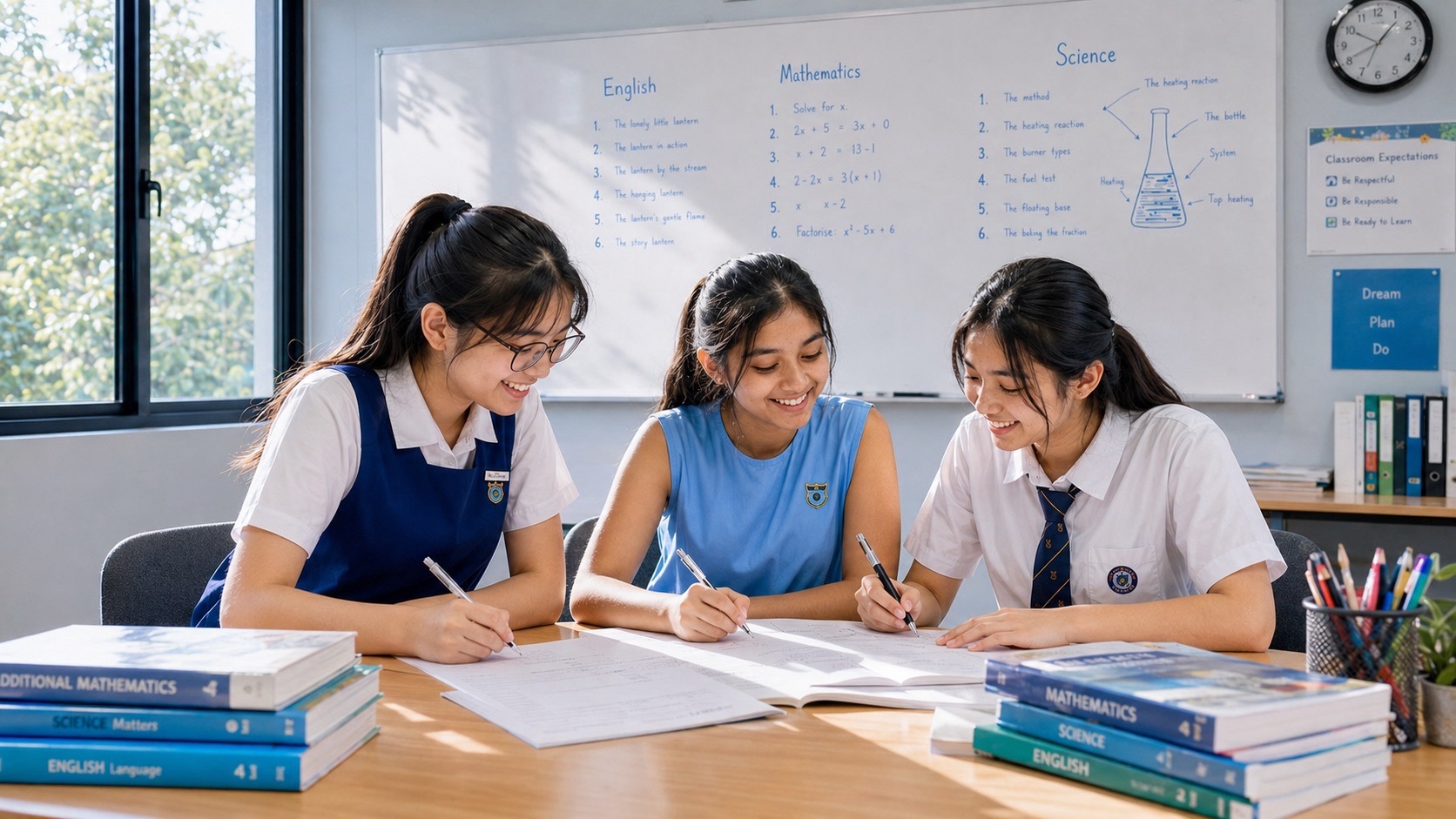
A group of three creates opportunities for each learner’s reasoning to become visible. One child may offer a plausible but unsupported inference. Another may have relevant ideas but write them in a confusing order. The third may speak fluently yet avoid the particular question they were asked.
Those problems should not receive identical corrective worksheets. The tutor can diagnose each one, demonstrate the appropriate first principle and ask for a fresh attempt.
A good discussion also exposes alternative approaches. But after the shared explanation, every student needs an independent task to prove that the method can work without the strongest voice in the group.
That is why three-student English tutorials are designed around close observation, immediate feedback and a return to independent performance.
A practical Secondary 3 G2 learning sequence
- Begin with schoolwork: inspect one marked writing piece and a comprehension response.
- Find the earliest weak link: choose between task misunderstanding, evidence selection, paragraph development, language accuracy and time use.
- Explain the mechanism: demonstrate why the original approach failed in a short example.
- Change one condition: vary the audience, text, topic or question.
- Test independence: require a new response without hints or model sentences.
- Return later: revisit the skill after a gap and decide whether it remains reliable.
Not every Secondary 3 student needs every component equally. A confident speaker may need more writing structure. A strong writer may need help with inference and answer scope. A tutor who sees those distinctions is better placed to make the extra lesson worth the time.
A question for Pasir Panjang parents
Before committing to tuition, ask the tutor to examine a real marked answer and explain what precisely must change. ‘Improve argument’ is a broad goal. ‘Explain the missing connection between the claim and its proposed consequence’ is a target that can be taught and checked.
Confirm the three-student group, actual venue, current schedule and travel. A Pasir Panjang tuition guide does not imply that a physical classroom is located within Pasir Panjang.
Explore Secondary 3 English tuition for the wider progression, or contact eduKate Singapore to discuss a starting point using the student’s real schoolwork.
The most satisfying improvement is not simply that a student sounds more grown-up. It is that their ideas have become easier to follow. When they can show how a conclusion grows from evidence, English becomes a tool they can use, not a puzzle they are hoping to survive.