

A six-year-old is asked to put a red card beneath the book and then close the box. The child closes the box beautifully. The card is still on the table. A parent might sigh, “You weren’t listening.” But the child did listen to some of the words. The more interesting question is which part of the instruction disappeared.
This is an excellent place to begin pre-primary English tuition in Bishan. Families preparing for Primary 1 often focus on phonics, reading, writing, vocabulary and English worksheets. Yet much of school readiness depends on an earlier skill: understanding exactly what an instruction asks, holding its steps in mind and knowing how to recover when part of the message is unclear.
Pre-primary is a convenient parental term for the transition out of kindergarten, especially the final K2 months. It is not a separate official examination grade in Singapore. A good programme prepares the child for independent learning while preserving curiosity, stories and play.
First principle: understanding an instruction is a sequence of decisions
The direction “Put the red card beneath the book, then close the box” seems easy to an adult. A child must identify the right card, recognise beneath, act on the first part, remember then and carry out the final action.
If the card is put on the book instead of under it, perhaps the spatial word is unfamiliar. If the learner closes the box first, the order may be unstable. If both objects are placed correctly after an adult points, we still don’t know whether the child understood the words independently.
A tutor can isolate each relationship. Put one toy beneath a book. Invite the child to give the same direction in their own words. Then replace the toy with another object, move the book and let the child try without gestures. The task is complete only when the new arrangement makes sense.
The method matters because children rarely receive identical instructions twice at school. Learning the specific position of a red card is a memory exercise; learning what beneath means is a transferable language skill.
Bishan offers a beautiful setting for noticing sequence
Bishan–Ang Mo Kio Park is one of Singapore’s large urban parks, with green open areas and a naturalised meandering river. NParks describes the river as a transformed former canal and identifies opportunities to observe plants and wildlife in a family-friendly setting.
A child can learn about sequencing from something as ordinary as a safe park walk. First the family reaches the entrance, next they follow a path and afterwards they return home. A child might tell the story as a jumble of places. An adult can help reconstruct the order with three drawings.
This is not a reason to turn a family outing into a formal lesson. The park simply gives the child something worth telling. The actual practice may happen back at home, using a photograph and three picture cards. Parents should follow current park notices and avoid closed or unsafe areas near water.
Ask the child to explain the sequence to someone who didn’t come along. If they say “We went there and then there,” the listener may need names or landmarks. The child begins to see why precise words carry information that gestures cannot.
Once the sequence is meaningful, a printed instruction such as Draw the tree before colouring the bird is less abstract. The relationship between first and next has already been practised in life.
Listening is not simply sitting still
Some children can sit quietly through a story without following its meaning. Others are physically restless but can retell every important event. Behaviour and comprehension overlap, but they are not identical.
A useful listening check starts with a brief story. Ask the child what the main character wanted, what happened and how the story ended. If a part is missing, invite them back to the relevant sentence rather than immediately giving the answer.
Now change the question. “Where did the character go?” asks for a place. “Why did they go?” asks for a reason. A child may know the passage and still reply with the first interesting detail that comes to mind. The tutor’s job is to make the information requested by the question clear.
These small distinctions matter for Primary 1. A school worksheet may ask the child to circle a word, colour a picture or underline a sentence. Knowing the story isn’t quite enough if the learner has not recognised what the question wants them to do.
The five things a readiness check should actually reveal
- Spoken understanding: Can the child follow an age-appropriate instruction with a short sequence?
- Question meaning: Does the child know that who, where and why ask for different information?
- Sound and print: Can the learner hear familiar speech sounds and use taught letter–sound patterns in first words?
- Early expression: Can the child describe an event, ask for a repeat and attempt a meaningful written message?
- Independence: After a tutor’s demonstration, can the child try an unfamiliar version of the task with fewer cues?
These are learning observations, not a pass-or-fail admissions test. One child may be a confident storyteller while struggling with unfamiliar print. Another may decode short words accurately yet need support understanding two-step instructions. They should not automatically receive the same worksheet.
Singapore’s MOE Nurturing Early Learners language and literacy guidance emphasises connected listening, speaking, reading and emergent writing goals. The framework supports developmentally appropriate teaching rather than racing children through a full Primary 1 syllabus in advance.
Why phonics and comprehension must meet
A child may know the spoken word ship and understand what a ship does, but still be unable to read the word on a new page. The missing part is the connection between speech and print. Phonics instruction helps children understand how letters and letter groups represent sounds.
A useful tutor teaches a manageable sound pattern, lets the child blend it and then offers another word using already taught patterns. If a child has memorised mat, they might attempt map. Does the learner notice the final letter change, or repeat the old word quickly?
A careful attempt is not a failure because it takes a few moments. The child is learning a method for words they haven’t seen before. Repeated success can eventually make decoding more automatic.
But word recognition must lead back to meaning. A child who sounds out cap should also be able to distinguish a cap from a cup in a picture or sentence. If the child can pronounce the word but not understand it, the reading bridge is only partly complete.
The Phonics at Home guide explains sound–print practice, while How to Teach a Child to Read connects decoding with fluency and comprehension.
The difference between repeating a sentence and acting on it
A learner can repeat “The ball is behind the box” exactly and still put the ball beside it. Repetition shows that the words were remembered; the action reveals whether the relationship is understood.
Instead of asking for another verbal repetition, show two objects and let the child demonstrate behind. Then change to a new pair of objects. Finally, return to the printed sentence and ask the learner to match it to a picture.
The reverse task is just as useful. Give the child a toy arrangement and ask them to write or dictate a sentence that would help someone else reproduce it. The child discovers that the same idea can travel from an action into speech and from speech into print.
When those representations connect, a small word becomes more dependable. A pupil who understands between with blocks can begin recognising it in a story about two trees or in an instruction about a pair of books.
A written note can become a tiny independence test
Invite the child to make a reminder for tomorrow: Bring the blue folder. The message has a real purpose and an intended reader, unlike an arbitrary sentence copied for neatness.
The adult can model the wording. Depending on readiness, the child may draw the folder, attempt the word blue or write the short sentence themselves. Do not demand more print than the child is ready to produce.
The next morning, show the note without immediately supplying the spoken instruction. Can the learner identify the folder? If they choose the wrong colour, return to the word that makes the difference. The next day, change the note to a green folder and see whether the child notices.
The goal is that print becomes a useful guide to action, not just a page filled with carefully copied letters.
The confidence to say ‘Please repeat the second part’
Some of the most useful school-readiness language is surprisingly short. “Which book?” “Do you mean the red card?” “Can you say the last part again?” These questions show a child who recognises that meaning is missing.
A tutor can occasionally give a deliberately incomplete instruction, then welcome the child’s request for clarification. If there are two identical-looking boxes, “Put it in the box” may require another detail. Asking which box is the sensible response.
This is not a trick. It teaches children that successful communication involves the listener and speaker working together. A child who asks a clear question may be demonstrating more independence than one who guesses and hopes to be praised.
How three students can learn from three different instructions
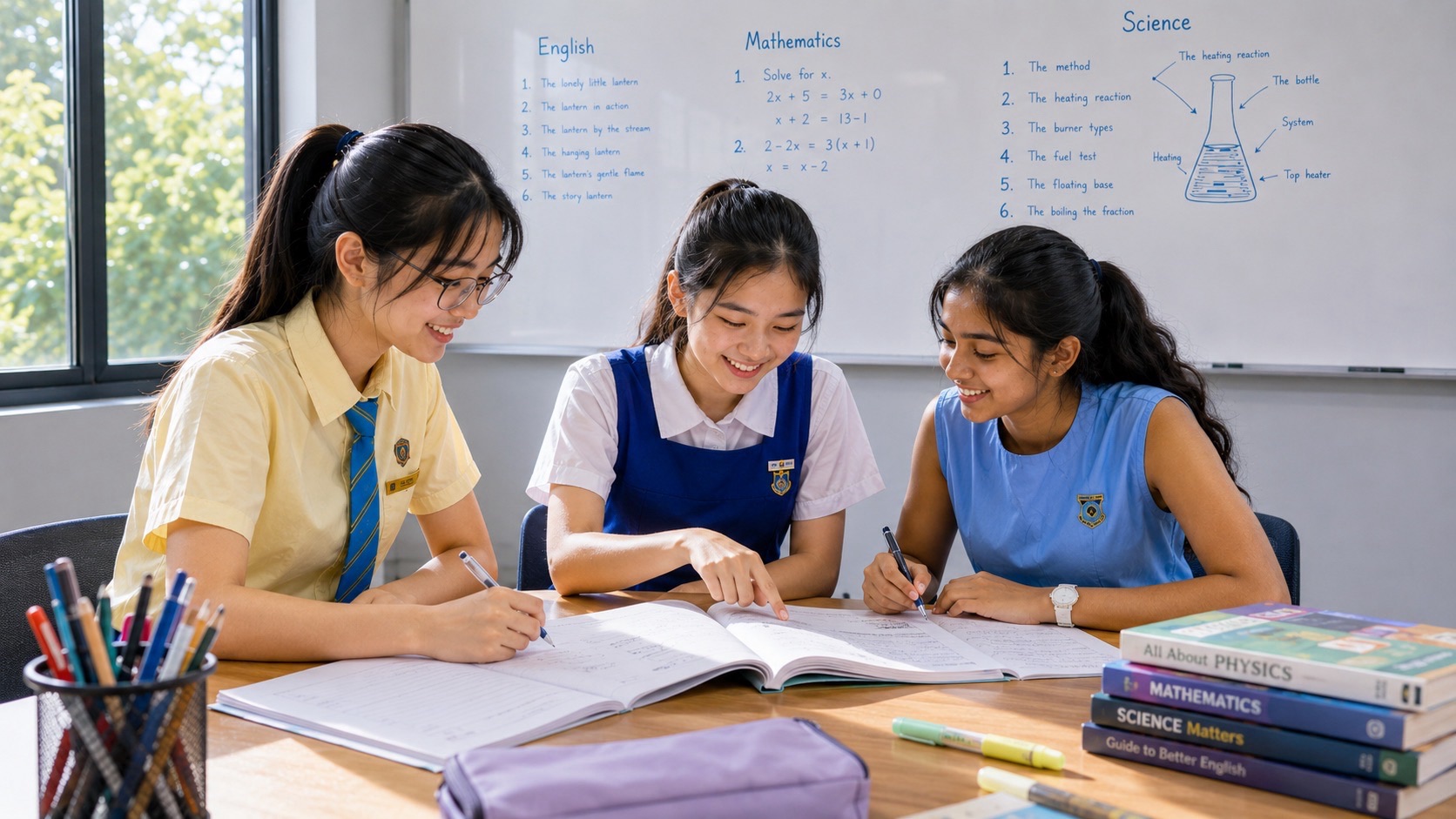
The eduKate premium tutorial approach uses three learners in a small group. For children nearing Primary 1, a suitable session might rotate three roles: one child gives a short instruction, another follows it and the third checks whether the words were precise.
The tutor can observe whether a child understands the relation but loses the sequence, remembers the sequence but misreads a label, or needs help asking for clarification. One shared activity can reveal different teaching needs.
A three-student format is only valuable if each learner receives close attention and individual practice. The group task should be followed by a new example for each child. Children shouldn’t be expected to rely on the most confident classmate for every answer.
Parents should confirm whether an age-appropriate class is available, what teaching format suits their child and whether travel is practical. An article addressing Bishan families is not a claim that a physical tuition branch operates inside Bishan.
A gentle four-evening routine
One evening, read a picture book and ask the child to retell its beginning and ending. On another, play a two-step instruction game with household objects. On a third, make a simple written reminder. On the fourth, revisit a previously taught relationship using different objects or pictures.
Keep the sessions short enough to preserve attention and enjoyment. The aim isn’t to transform the home into a second school. It is to give the child repeated opportunities to listen carefully, express meaning and try a fresh task with less prompting.
Notice progress in the child’s actions: a direction followed without pointing, a question asked when wording is unclear, a new short word decoded carefully, or a written reminder used for its intended purpose.
Primary 1 readiness is a growing ability to recover
A child doesn’t need to arrive at Primary 1 knowing everything in advance. They need a growing ability to understand a message, start a manageable task and recognise when more information is needed.
Families can follow the Primary 1 English learning guide, the existing Primary 1 Bishan guide, and the three-student tutorial approach for the next stage.
The child who remembered to close the box but forgot the red card has not failed a test of intelligence. The learner has shown us which part of a message still needs teaching. When that connection becomes dependable, English begins to guide the child’s own next step.