
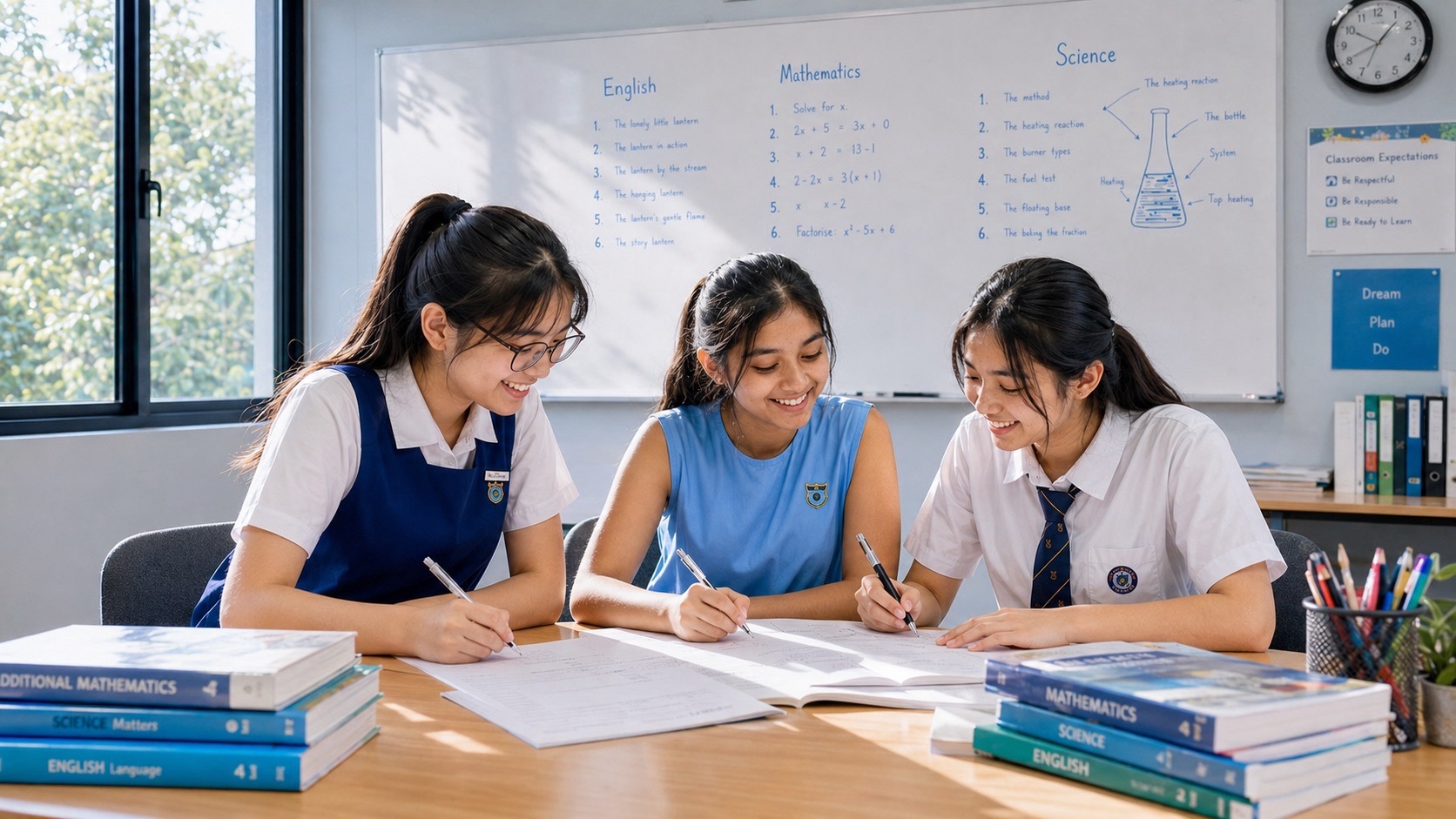
Imagine arriving at a Singapore neighbourhood gathering. Someone explains a plan in clear formal English. Later, among friends, the same person slips into a more intimate style, with familiar local expressions and little particles that carry exactly the right feeling. Nothing about the switch means the person has forgotten English. It means the audience, relationship and purpose have changed.
The history of English in Singapore from 1819 to 2026 is the story of a colonial administrative language becoming an important language of education, work and communication in an independent multilingual society. English gained institutional roles after the British trading post was established in 1819, although Malay and other languages already supported a thriving regional world. Following independence in 1965, English was one of four official languages, alongside Malay, Mandarin and Tamil, with Malay designated the national language. Education policy developed around bilingual learning, and Singaporeans increasingly shaped distinctive local forms of English.
How did Singapore English develop? Is Singlish broken English? Why are English and mother-tongue languages taught together, and what should students use in school examinations? The answer is not that one language replaced every other language in Singapore. It is that different communities made English part of their own lives through schools, work, families, media and local conversation. The result includes both Standard Singapore English, useful in many formal settings, and Colloquial Singapore English, popularly called Singlish, used in varied social contexts.
Before 1819, Singapore already had languages
We should begin with a fact often lost in simplified histories.
Singapore did not begin with an English-speaking colonial settlement in 1819. The island and surrounding region had long histories of trade, settlement, political relationships and language use.
Malay was important in regional communication and commerce. Other languages travelled through networks connecting different parts of Southeast Asia and beyond.
These were not incomplete communication systems waiting to be supplied with English.
People already negotiated, shared knowledge, raised families and conducted trade.
The British East India Company’s establishment of a trading post introduced new political and economic conditions, but it did not invent language on the island.
The question is therefore not ‘When did Singapore start speaking?’ It is how English acquired new functions within a place that was already multilingual.
That distinction makes the later development of Singapore English far easier to understand.
Why is 1819 a turning point?
In 1819, arrangements with Malay rulers enabled the British East India Company to establish a trading post in Singapore.
The events are often associated with Stamford Raffles, Sultan Hussein Shah and Temenggong Abdul Rahman.
The agreements formed part of a contested colonial and regional political setting. They were not the arrival of a new language on an empty island.
The port subsequently expanded, drawing people through commercial routes connecting Southeast Asia, China, India, Europe and other regions.
A trading port creates many language demands.
People need to agree on prices, identify goods, settle obligations and understand officials.
Different communities may use different languages for different tasks.
English became increasingly useful in certain colonial commercial and administrative contexts, while Malay and other languages continued serving many important functions.
The history involves overlapping networks rather than a single linguistic takeover.
A port needs a bridge between strangers
Imagine three people at a nineteenth-century trading wharf.
One knows a local language used in regional commerce. Another has recently arrived from a Chinese-speaking community. A third works for a British trading firm.
They have a practical goal: move goods, confirm a price and arrange a delivery.
They do not necessarily share one first language.
Communication may depend on a lingua franca, partial multilingual competence or the help of interpreters and intermediaries.
English could become useful because of its association with particular firms and authorities.
But the presence of an official who writes English documents does not tell us what every trader spoke with friends or relatives.
A successful port can sustain multiple working languages at the same time.
This is a fundamental reason Singapore’s language history cannot be reduced to one colonial archive.
The public documents are only one part of the living linguistic world.
What is a lingua franca?
A lingua franca is a language used to communicate among people who do not necessarily share it as a first language.
It need not be the language spoken by the majority at home.
Malay held important regional lingua-franca roles in Southeast Asia over long periods.
English later acquired a common working role in Singapore across different linguistic communities, especially through education, administration and economic activity.
These roles depended on institutions and practical needs.
The linguistic structure of English did not magically make it better than every other language for communication.
Its usefulness grew because more people and organisations had reasons to use it.
A lingua franca is a social arrangement as well as a language.
The arrangement changes when schools, workplaces, migration patterns or government policies change.
That is why English’s role in Singapore evolved across generations rather than being decided completely in 1819.
The Straits Settlements change the institutional map
In 1826, Singapore was grouped with Penang and Malacca in the Straits Settlements.
The legal and administrative environment changed through colonial charters and institutions.
English acquired particular value within these structures.
But the fact that a court or government office used English did not mean that every resident could read English or had equal access to legal advice.
Institutional language can open opportunities for those who know it and create barriers for those who do not.
This tension becomes a recurring theme in the history of Singapore education.
Parents and students had to evaluate what language skills would be useful for employment and further study.
Community institutions also continued preserving knowledge through other languages.
Singapore’s educational landscape therefore developed through multiple streams and traditions.
English was one powerful element within a wider system.
Schools create a longer-term change
A language becomes widely established not only when a government uses it, but when children learn it across generations.
Singapore’s colonial history included government, missionary and community schools with different resources, audiences and languages of instruction.
Some families valued English for its connection with particular occupations and educational opportunities.
Others preferred education in languages used within their communities.
The National Museum of Singapore’s collection contains an English reading and comprehension textbook published in 1962, a useful reminder that educational materials reflect the needs and assumptions of their own era.
The museum’s record also describes how, in 1959, parents could choose among several language-medium streams, and how policy encouraged more integration among different streams.
This was a complicated educational environment.
There was no single moment when every child in Singapore entered one identical English-medium school.
The spread of English depended on access and repeated learning.
English did not belong equally to everyone under colonial rule
It is tempting to describe English simply as a passport to opportunity.
For some people, learning English did expand access to jobs and educational institutions.
But access to English schooling was influenced by money, location, family decisions and colonial social structures.
A student who could not enter a particular school did not lack the intelligence needed to learn its language.
The opportunity itself was unequally distributed.
This matters when evaluating historical English proficiency.
Official documents may show English gaining prestige, but that does not reveal the full conditions under which different communities lived and learned.
A language can be economically useful while the system distributing it remains unequal.
The important educational question is not merely whether English matters.
It is whether learners have practical, fair routes to mastering the forms of English needed for their goals.
Singapore becomes independent in 1965
Singapore gained independence on 9 August 1965.
The Republic of Singapore Independence Act 1965 states that Malay, Mandarin, Tamil and English are the four official languages.
It also identifies Malay as the national language.
These are different legal categories, and the distinction should not be lost.
The legislation also protects the use, teaching and learning of other languages in relevant provisions.
The independent state had to design institutions for a population with several linguistic and cultural traditions.
English developed a prominent common working role, but that did not mean the four official languages became interchangeable in every social setting.
Nor did everyone suddenly change their mother tongue.
The law established a framework within which language, schooling and social practices would continue developing.
Singapore’s English history became increasingly shaped by its own institutions rather than simply by the former colonial government.
Why English became useful for a multilingual society
Singapore needed ways for people from different communities to work and learn together.
English had historical connections with colonial institutions and international commerce, making it one practical option for a shared working language.
In a multilingual setting, a common language can help people collaborate without requiring them to adopt one another’s entire family-language identity.
But the choice is not socially neutral in every consequence.
It can influence which resources are easiest to access, which speakers feel more confident and how educational opportunity is distributed.
Singapore’s policies attempted to balance a common working language with the continued learning of languages associated with different communities.
That balance is neither automatic nor simple.
The history is best understood as a sequence of policy and social choices responding to national needs.
English was part of Singapore’s institution-building, while other languages remained part of its lived culture.
Bilingual education did not begin in 1965
The National Heritage Board traces the launch of bilingualism policy at the primary-school level to 1960 and at the secondary-school level to 1966.
This is worth remembering because the history began before independence and continued through later decades.
Education policy evolved in its implementation, subjects and social expectations.
The broad aim included building the capacity to use English for communication and learning while maintaining a designated mother-tongue language.
That required large investments in teachers, materials and school systems.
A policy written on paper does not immediately create fluent speakers.
Children need many years of meaningful exposure, practice and feedback.
English’s expanding role in Singapore was therefore a long educational transformation, not the result of one proclamation.
Each generation brought its own experiences into the language.
What is a mother-tongue language in Singapore schools?
In Singapore’s education system, Mother Tongue Language is an official subject-policy category, commonly covering Chinese Language, Malay Language and Tamil Language, with specific provisions for different learners.
The label is not necessarily a literal description of the language every individual child first heard at home.
Families may have complex linguistic histories, including use of English, several Chinese varieties, Malay, Tamil and other languages.
The Ministry of Education describes bilingualism as a cornerstone of Singapore schooling, with English as the main medium of instruction and Mother Tongue Language learning forming part of the curriculum.
This gives students two related but distinct learning responsibilities.
They need English to understand content in subjects and communicate in formal contexts.
They also learn a language connected with cultural, social and educational purposes under Singapore’s policy framework.
Understanding those roles helps avoid treating bilingualism as a simple competition between languages.
Singapore English begins to sound local
As English became more widely used across Singapore, it entered the speech networks of people already familiar with other languages.
Speakers adapted vocabulary, grammar, rhythm and conversational conventions to the local environment.
Over generations, recognisably Singaporean ways of speaking English developed.
This is not unusual in the world history of English.
Varieties associated with India, the Caribbean, Africa, North America and other places have also developed through local social histories.
A language adopted by a community does not remain permanently identical to one outside model.
Children learn it from local speakers, and those speakers create conventions suited to local relationships.
The result can be a variety that feels entirely natural within the community while containing expressions unfamiliar to outsiders.
Singapore English belongs to that larger story of World Englishes.
Standard Singapore English and Singlish
A useful distinction is often made between Standard Singapore English and Colloquial Singapore English, usually called Singlish.
Standard Singapore English is associated with many formal, educational and professional settings.
Singlish is associated with more colloquial use, local relationships and the expression of shared cultural context.
But the division is not two completely separate languages housed in two different populations.
Speakers may move among forms depending on the audience, topic, social relationship and desired effect.
The ability to adjust is often called style-shifting or register-shifting, although individuals’ repertoires and social practices vary.
A student might write a formal examination response in Standard English and later use colloquial expressions among friends.
Those uses perform different social jobs.
The practical question is whether the form suits the context.
Why Singlish is not simply random mistakes
The SG101 account of Singlish describes its development through sustained contact among languages used in Singapore.
Local varieties contain recurring vocabulary, grammatical and conversational patterns.
For example, speakers may use particles such as lah, lor and meh to express attitudes, expectations or interpersonal meanings.
These particles cannot always be translated accurately by substituting one fixed English word.
Their interpretation depends on context, intonation and the shared understanding of the participants.
That makes them interesting from the perspective of pragmatics, the study of how people use language in social situations.
A patterned colloquial variety is not accurately described as grammar-free.
At the same time, the fact that Singlish has structure does not remove the practical value of learning Standard English for formal writing and international communication.
Both claims can be true.
A tiny particle can carry a social relationship
Imagine a friend giving advice and adding lah.
The extra particle may contribute a feeling of reassurance, insistence, familiarity or another conversational nuance depending on context.
Its effect cannot be fully understood from spelling alone.
The speaker and listener share a relationship, and that relationship shapes the interpretation.
This is an example of how language carries meaning beyond dictionary definitions.
Grammar tells us how a sentence is organised. Vocabulary identifies concepts. Pragmatics helps explain why the speaker chose a particular form in a particular situation.
Colloquial Singapore English makes these distinctions visible.
A fluent local listener may understand the nuance immediately, while someone unfamiliar with the variety may need more contextual explanation.
That does not make either listener unintelligent.
It shows that communication depends on shared social knowledge.
Local vocabulary remembers contact
Singapore English includes expressions whose histories connect with Malay, various Chinese languages and other linguistic traditions.
Words such as shiok and kiasu have become familiar markers of local expression in many contexts.
The Oxford English Dictionary has recorded Singapore English vocabulary, including additions discussed in the SG101 account of its recognition in 2016.
A dictionary’s inclusion of a word records evidence of usage. It does not make the word legitimate for the first time.
The word existed through speakers before the dictionary recorded it.
Likewise, inclusion does not mean the word belongs in every formal sentence.
A locally expressive word may be useful in conversation and cultural writing while another form works better in an international report.
Understanding those differences is part of vocabulary knowledge.
A word’s historical origin and its appropriate modern register are separate questions.
Language can become a sign of belonging
Singlish can signal familiarity, humour and a shared understanding of Singaporean life.
A short expression may evoke experiences that local listeners recognise without needing a lengthy explanation.
The SG101 discussion also highlights the complexity of that relationship.
Not everyone in Singapore uses or identifies with Singlish in the same way.
Some people value it as a cultural marker; others emphasise the need for widely understood Standard English; still others move comfortably between both.
Local language can create solidarity, but it can also exclude people who do not know the relevant conventions.
Belonging should not be measured through one linguistic test.
A society is more complex than one accent or set of particles.
The history of Singapore English is richer when it includes different ways of participating in the language.
The Speak Good English Movement begins in 2000
In April 2000, Singapore launched the Speak Good English Movement.
The movement emphasised clear, internationally intelligible Standard English, especially in a country whose economy and institutions depended on communication across borders.
SG101 traces the social debate surrounding this policy and the tension between the practical value of formal English and the local identity associated with Singlish.
These positions need not be treated as logically incompatible.
A person may value local colloquial expression while recognising that formal communication requires different conventions.
But the debate is not merely technical. It involves education, opportunity, cultural identity and judgments about social status.
An effective learning system should not confuse a student’s ability to use colloquial speech with a lack of capacity to acquire formal English.
The important question is whether the student can select and produce the form required for the intended audience.
That is a teachable skill.
Why register matters more than a slogan
Imagine the same person in three situations.
At a family meal, familiar colloquial speech may communicate warmth and shared understanding.
In a school essay, the writer needs organised arguments, standard grammatical conventions and precise vocabulary.
In a professional meeting with international colleagues, the speaker may choose forms that are especially clear to people unfamiliar with local expressions.
The language needs are different.
A single instruction such as ‘always use proper English’ does not fully explain how the choices work.
Learners benefit from understanding what makes a message effective in each setting.
They need to know how tone, audience, purpose and context influence vocabulary and sentence structure.
Register competence is not merely the ability to imitate a prestige accent.
It is the ability to transfer meaning accurately and appropriately.
The school examination is a particular kind of audience
A Singapore English examination evaluates specific language and literacy capabilities according to the relevant syllabus and assessment requirements.
A student may be comfortable in everyday conversation yet find formal writing difficult.
Another may read accurately but struggle to infer a writer’s purpose.
Those difficulties are not always explained by the student’s use of Singlish.
A strong diagnosis asks which skill is missing: vocabulary in context, sentence control, comprehension, organisation, inference or audience awareness.
Formal Standard English remains important in examined writing, where a reader needs to understand the student’s meaning under explicit assessment conventions.
That does not require pretending informal local language has no structure.
It requires learning how to shift from one set of conventions to another.
The objective is competence and clarity.
English is the medium of many school subjects
The Ministry of Education identifies English as the main medium of instruction in Singapore schools, alongside the requirement to learn a Mother Tongue Language.
This gives English a special educational role.
A student must use it not only to pass English examinations, but to understand questions, explanations and textbooks in other subjects.
Consider a mathematics question containing a difficult conditional phrase.
The mathematical operation may be familiar, but the wording can still obstruct understanding.
In science, a student may know the relevant concept yet struggle to explain the relationship between evidence and conclusion.
Language competence therefore influences learning across the curriculum.
That is a practical reason to strengthen English reading and writing systematically.
The goal is not simply more vocabulary. It is the ability to reconstruct and communicate knowledge.
Singapore English on television and online
Broadcasting, entertainment and digital media have made local forms of English highly visible.
Characters in comedy and drama may use Singlish to signal identity, familiarity or humour.
Online conversations allow rapid movement among English, local expressions and other languages.
SG101 discusses popular culture and changing public attitudes towards Singlish, including debates in the late 1990s and later years.
But a television character is not a reliable census of how all Singaporeans speak.
Media representations can exaggerate features for comic effect.
A careful history distinguishes actual linguistic practice from the image of that practice presented for entertainment.
Still, media can influence which expressions become familiar beyond their original communities.
The relationship between language and local identity is partly shaped through repeated public exposure.
The internet makes more registers visible
In 2026, many Singaporeans use English across a wide range of digital contexts.
A school assignment, an office email, a group chat, a game and a social media post can all occur on the same device.
The user may switch from formal explanatory prose to playful colloquial language within minutes.
Technology makes the changes highly visible because the written record of casual communication has expanded.
That does not mean language switching began with smartphones.
Singapore’s multilingual communities had been moving among languages and social registers long before digital platforms existed.
What changed was the scale and speed of recorded interaction.
The same person can now produce more varieties of written and spoken English for more audiences during an ordinary day.
The skill of choosing the right form becomes increasingly important.
AI creates another English question
Generative AI systems can produce fluent English explanations, essays, summaries and messages.
But fluency is not the same as verified truth.
A student may receive a confident paragraph containing an incorrect date or a conclusion that the evidence does not support.
The human reader must still ask what the source says, whether the claim is justified and which parts need correction.
This new environment places additional demands on English literacy.
Understanding grammar and vocabulary remains important, but readers also need source evaluation and the ability to distinguish plausible language from reliable information.
In a multilingual society, AI may also be used for translation and language practice.
Such tools can be helpful, but their outputs need appropriate checks, especially where nuance, assessment rules or important decisions are involved.
English continues developing as a medium of human communication within a changing technological world.
The historical chain, not the linguistic stereotype
English in Singapore did not move through one simple sequence of ‘British English, then bad English, then correct English’.
It moved through colonial institutions, multilingual communities, education policy, local media, employment and generations of ordinary conversation.
Different varieties and registers developed for different social purposes.
Standard Singapore English belongs to an international written and spoken network, while also reflecting local institutional histories.
Colloquial Singapore English carries features shaped by contact and local communication.
Neither variety is adequately understood by treating Singaporean speakers as passive copies of some overseas model.
Singaporeans have been active participants in the development of their own English.
The history is one of adaptation, not merely imitation.
A timeline of English in Singapore
1819: a British trading post was established through agreements with Malay rulers; Singapore already had existing languages and regional trading networks.
1826: the Straits Settlements changed the colonial administrative setting.
Nineteenth and early twentieth centuries: English gained roles through certain schools, government institutions and commerce, alongside other language communities.
1960: bilingualism policy began at primary-school level.
1965: Singapore became independent, with four official languages—Malay, Mandarin, Tamil and English—and Malay designated the national language.
1966: bilingualism policy was extended at secondary-school level.
2000: the Speak Good English Movement was launched.
2016: the Oxford English Dictionary’s recorded Singapore English vocabulary gained further public attention.
2020–2026: digital communication, local media and AI created additional settings for English use and language learning.
None of these dates marks the day everybody spoke the same variety.
Each marks an institutional or cultural change within a continuing multilingual story.
Frequently asked questions
When did English first become important in Singapore?
English acquired increasing roles following British settlement in 1819, particularly through colonial administration, commerce and selected educational institutions. Its widespread use grew over generations.
What are Singapore’s official languages?
Malay, Mandarin, Tamil and English are the four official languages. Malay is the national language, a distinct designation established in Singapore law.
Is Singlish broken English?
Colloquial Singapore English has recurring vocabulary, grammar and pragmatic patterns shaped by multilingual contact. It should not be treated as grammar-free, although formal Standard English is important in settings such as assessed writing and international professional communication.
When did Singapore introduce bilingual education?
The National Heritage Board dates the launch of bilingualism policy to 1960 for primary schools and 1966 for secondary schools. The policy subsequently evolved.
When was the Speak Good English Movement launched?
In April 2000.
Why do students need formal Standard English?
They need to communicate clearly in examinations, academic learning, professional writing and many international contexts. Knowing informal local expressions does not remove the need to develop those formal skills.
Did Singapore invent a completely separate English language?
Singapore English developed distinctive local varieties within the wider historical English language, shaped by contact, schooling and social life. It remains connected with other World Englishes.
Continue the history and learning journey
For the detailed local chronology, follow History of English in Singapore: A Year-by-Year Timeline from 1819.
Explore 1800–1900 CE: Webster, the Oxford Dictionary and English in Singapore and 1900–2000 CE: Global English, Singapore and the Birth of the Web.
The World Englishes and Variation guide explains dialect, accent and register. The Complete History of English leads to the Master of English Language | 2026–2027.
Sources and further reading
- SG101: Singlish and Our National Identity — the historical development of Singapore English, policy debates and cultural identity.
- SG101: Singlish — colloquial grammar, the Speak Good English Movement and local vocabulary.
- Singapore Statutes Online: Republic of Singapore Independence Act 1965, Section 7 — official languages, national language and provisions on other languages.
- National Heritage Board: We Built a Nation — bilingualism policy in 1960 and 1966.
- National Museum of Singapore: Reading, Comprehension and Language Practice Textbook, 1962 — English schooling and multilingual educational history.
- Ministry of Education: What Education in Singapore Looks Like — English as medium of instruction and Mother Tongue Language learning.