
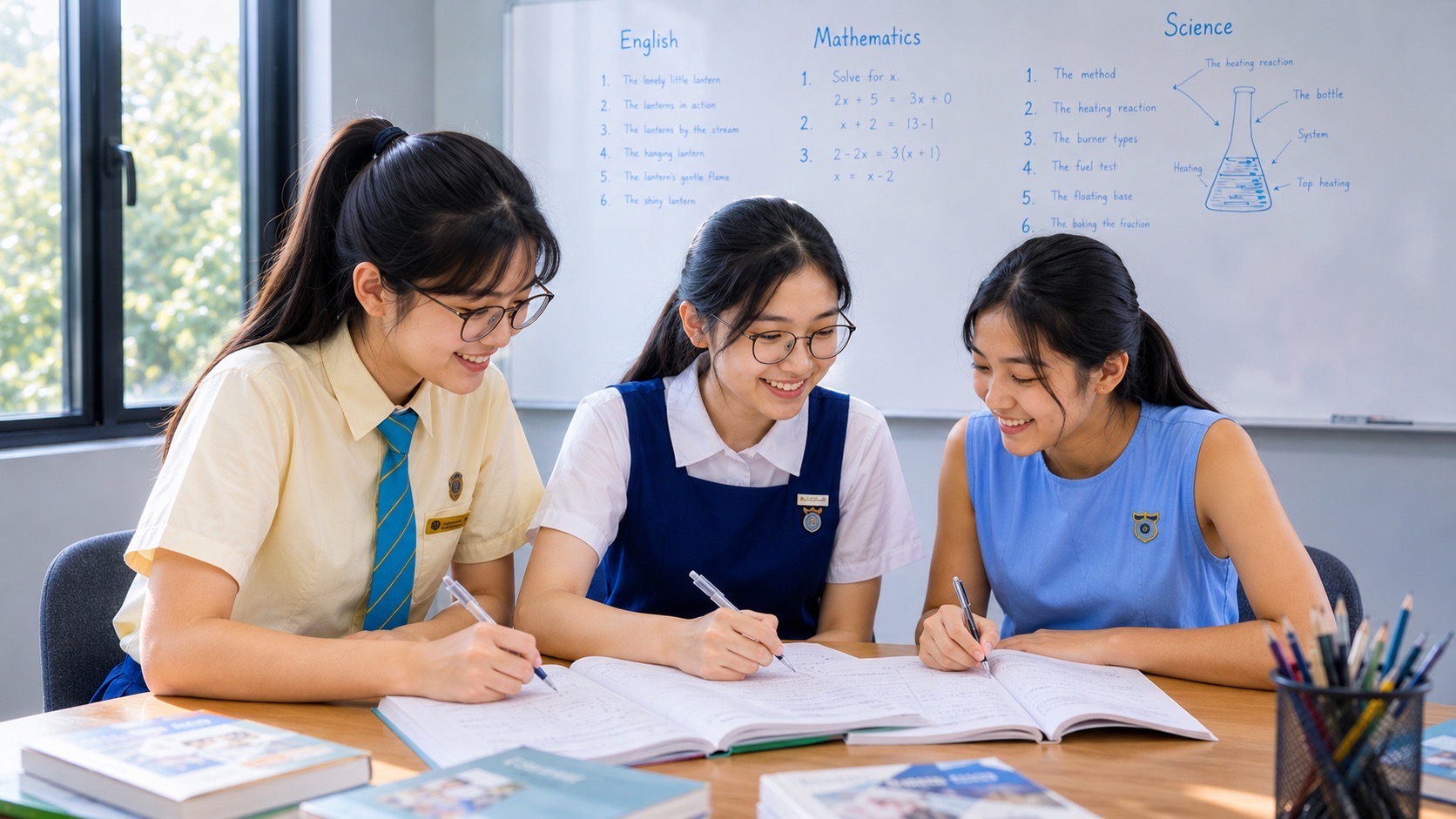
The first important decision in a Secondary English composition examination is made before the first sentence is written. A student looks at several prompts and chooses one. That choice can quietly determine how much of the student’s actual writing ability will become visible over the next hour. Choose well and the task gives the writer room to think, structure, develop and finish. Choose badly and even strong language may be spent rescuing an idea that never had enough material, never really answered the prompt, or demanded more knowledge, invention or time than the student could reliably supply.
This guide treats question choice as a trainable examination skill. It is written for Secondary English students across examination systems rather than for one national paper. Exact formats vary: some examinations offer narrative, descriptive, argumentative, discursive or reflective choices; others blend these forms or frame them differently. The transferable problem is the same. Faced with several possible tasks, how do you select the one you can actually finish well?
This article belongs to the SETC Secondary English Composition examination-performance lane. It follows How Secondary English Composition Works | From Prompt to Finished Script and sits beneath the wider English Writing Performance and English Examination Performance systems. Those pages explain the larger architecture. This one isolates the first decision: choosing the right composition question.
1. Question choice is part of writing performance
Students often think the examination starts when writing starts. It begins earlier. Reading, comparing and selecting prompts are already part of composition performance because they determine the conditions under which the rest of the writing will occur.
Imagine two students with similar language ability. One chooses a narrative prompt because a dramatic opening occurs immediately to her. She begins confidently, then discovers that the idea has no meaningful middle. The second chooses a quieter prompt after testing whether she can see a conflict, a consequence and an ending. Her opening may feel less exciting, but the story develops cleanly. By the end, the second script looks like stronger writing. Some of that difference came from language, but some came from selection.
A question is therefore not merely a topic. It is an operating environment. It imposes demands on knowledge, imagination, structure, tone, evidence, vocabulary, timing and genre control. Different prompts load those demands differently. Choosing is partly the art of matching the task to what you can control under pressure.
This does not mean always choosing the easiest-looking question. Easy-looking questions can be dangerous because their familiarity hides shallow material. Nor does it mean choosing the most original question. Originality can increase risk if the writer has not considered development. The objective is neither comfort nor novelty. It is executable quality.
Leonie calls this the finishability test. A prompt is attractive only if it can become a complete, controlled composition within the actual time and conditions of the examination. The word is awkward but useful. Students need to ask not merely, “Can I start this?” but “Can I finish this well?”
2. The first idea is not always the best evidence
One of the strongest biases in question choice is immediacy. The student reads a prompt and instantly thinks of an event, a person, an argument or a prepared essay. That immediate retrieval feels like evidence that the question is suitable. Sometimes it is. Sometimes it is merely evidence that the prompt resembles something already in memory.
Maren once saw a prompt about a difficult decision and immediately remembered a practised story about choosing whether to enter a competition. She felt relief: material was ready. But the actual prompt asked about a decision that first seemed insignificant and later changed something important. Her competition story involved a large decision from the beginning. Familiarity pulled her toward a script that answered the topic of decision-making without satisfying the relationship inside the prompt.
The lesson is not to distrust memory. Prepared knowledge is valuable. The lesson is to separate retrieval from fit. When an idea appears quickly, pause and test it. What exactly does the question require? Which part of the idea satisfies that requirement? What would need to be altered? If the changes are substantial, the idea is not really ready; it is only nearby.
This is especially important with memorised introductions, adaptable stories and prepared argument banks. They can create a false sense of momentum. The student begins adapting sentence by sentence, then spends the rest of the composition trying to make the prompt fit material chosen in advance. That reverses the correct relationship. The writing should serve the question.
A useful examination habit is to delay commitment for a short fixed window. Read all prompts once before choosing any. Mark the two or three that appear viable. Only then compare them. The small delay prevents the first familiar phrase from closing the decision too early.
3. Read each prompt as a contract
Iona treats every prompt as a contract. The question offers a field of possibility, but it also sets conditions. If the writer ignores those conditions, the piece may be fluent yet unsuccessful.
Most prompts contain at least three components: a subject, a relationship and an output expectation. The subject tells you what the writing is about. The relationship tells you what must happen among the ideas. The output expectation tells you what kind of piece the reader expects.
Take the prompt: “Write about a time when telling the truth made a situation more difficult before it made it better.” The subject is truth. The relationship is temporal and causal: honesty must initially worsen the situation and later contribute to improvement. The output expectation is narrative or reflective narrative. A story in which truth simply solves a problem immediately is relevant to honesty but does not honour the contract.
Now consider: “Young people are given too much freedom. Discuss.” The subject is freedom and young people. The relationship is evaluative: the writer must examine the claim rather than merely describe teenage freedom. The output expectation is discussion. A piece listing examples of freedom without testing whether the amount is excessive does not complete the task.
Before comparing questions, paraphrase each viable prompt in plain language. If you cannot explain what a successful answer must do, the prompt is not yet understood well enough to choose confidently.
4. The composition-choice matrix
A practical selection system can be built around six questions. For each candidate prompt, assess: understanding, material, structure, ending, language fit and risk.
- Understanding: Do I know exactly what this prompt requires?
- Material: Do I have enough specific ideas, events, examples or observations?
- Structure: Can I see a meaningful sequence rather than a list?
- Ending: Do I know where the piece is likely to arrive?
- Language fit: Can I express this material accurately and naturally?
- Risk: What could make this question collapse under time pressure?
You do not need to assign numerical scores in the examination. The matrix is a mental comparison tool. During training, however, scoring can make judgement visible. Rate each category from zero to two: zero means weak or unknown, one means workable, two means strong. A prompt with a dramatic idea but no ending might score highly for material and poorly for structure. A less exciting prompt with solid reasoning may produce the better total.
The matrix also teaches students that question choice is multi-dimensional. “I have something to say” is only one category. Many weak choices occur because that category dominates all the others.
5. Test the amount of usable material
Having an idea is different from having enough usable material. A composition needs development. The relevant question is not whether you can name a topic, event or opinion, but whether you can generate enough distinct, connected material to sustain a complete piece.
For narrative writing, usable material means more than incidents. You need a situation, pressure, consequential choices, changes in understanding or relationship, and an ending that grows from what happened. For argument, usable material means reasons that are genuinely different, mechanisms that explain why those reasons matter, and examples that support them. For description, usable material means a perspective and enough selected detail to create movement rather than inventory.
A quick test is the three-development rule. Can you name three meaningful developments without stretching? A narrative might have pressure, consequence and changed choice. An argument might have three distinct principles. A description might move from arrival to immersion to departure, or wide view to human detail to changed mood. If you can name only an opening image or one central point, the prompt may not yet have enough material.
Quantity is not the only concern. Material must also be relevant. A student may know ten facts about artificial intelligence but still lack material for a question about whether creative work becomes less valuable when generated with machines. Knowledge becomes usable only when it connects to the specific judgement required.
During practice, force yourself to distinguish available material from usable material. This single distinction makes question choice much more accurate.
6. Test whether you can see a structure
Some prompts produce many ideas but no obvious order. That is a warning. Composition requires not only content but architecture.
If you are considering a narrative, ask what changes from the beginning to the end. If you cannot identify the pressure point, the consequence and the final difference, the story may become a chain of events. If you are considering an argument, ask whether the points can be ordered by logic rather than convenience. Does one reason establish a principle that the next complicates? Does the counterargument belong somewhere meaningful? If you are considering a descriptive piece, ask how attention moves.
Maren sometimes has too much material. She can imagine five scenes within seconds. Her selection problem is not scarcity but hierarchy. Which scene establishes the central conflict? Which one actually changes the relationship? Which one repeats a function? A prompt is viable only if the material can be organised into a shape.
Try the verb test. Give each possible paragraph a functional verb: establish, complicate, reveal, contrast, test, concede, reverse, resolve. If all the verbs are the same, the composition may be static. If the verbs form a movement, the structure is beginning to appear.
Structure visibility is powerful because it predicts finishability. When a student can see the path, drafting becomes execution. When the path is missing, drafting becomes continuous invention under the clock.
7. The ending test
Before choosing a composition question, ask whether you can see a plausible ending. You do not need the final sentences. You need to know what kind of completion the piece is moving toward.
This is one of the best filters for weak narrative ideas. Students often see beginnings vividly: the phone rings, the race starts, the door opens, the stranger appears. The middle and ending remain vague. Under examination conditions, that vagueness becomes expensive because the writer must invent while drafting.
An ending test asks: What will be different by the last paragraph? In narrative, perhaps the character chooses differently, a relationship changes, a misunderstanding is resolved at a cost, or an object gains new meaning. In argument, the ending should reveal the final judgement after qualifications. In reflection, the writer should know what understanding has changed. In description, the ending may close through departure, altered light, narrowed focus or a repeated image.
If you cannot see an ending, the prompt is not automatically unusable. But it carries more risk. Compare it with another question whose ending is visible. The safer choice may be the one that allows you to protect completion.
Leonie uses a practical rule: never spend the first half of an examination discovering what the composition is trying to become. Question choice should reduce that uncertainty before drafting begins.
8. Estimate the knowledge burden
Different prompts require different amounts of background knowledge. This matters most in argumentative and discursive writing, but it can also affect narrative plausibility and descriptive precision.
Suppose a question asks whether governments should regulate artificial intelligence. The topic may be interesting, but a strong answer requires some understanding of regulation, innovation, risk, enforcement and trade-offs. A student who knows only general statements such as “AI is useful but dangerous” may struggle to develop a precise case. Another prompt on whether schools should reduce competitive ranking may be easier because the student can reason from direct experience and familiar principles.
Knowledge burden also includes the risk of false specificity. Students sometimes compensate for limited understanding by inventing statistics or naming studies they cannot verify. That weakens credibility. A prompt that demands specialised evidence may be a poor choice if the student’s knowledge is thin.
The solution is not to avoid complex topics forever. Build broad knowledge over time. But during the examination, judge the material you actually have. Question choice is not the place to prove courage by entering a topic with insufficient support.
Iona’s test is simple: can I explain the mechanism without pretending to know facts I do not know? If yes, the question may still be viable. If the essay would depend on unsupported claims, choose again.
9. Estimate the language burden
A prompt can be conceptually strong but linguistically expensive. The student may understand the idea yet lack the vocabulary or sentence control to express it accurately under time pressure.
Consider a reflective topic involving guilt, obligation and conflicting loyalties. A student may have rich personal material but struggle to distinguish regret, shame, responsibility, resentment and relief. That does not make the topic impossible, but it increases the language burden. A different question about competition or friendship may allow more precise expression.
In argument, abstract topics often require careful qualification. Words such as autonomy, fairness, access, incentive, accountability, privacy, efficiency and legitimacy carry specific meanings. If the student cannot control them, the essay may become vague.
In description, language burden appears differently. A student may choose a setting because it sounds visually impressive, then discover that the required vocabulary is unfamiliar. Describing an airport runway, operating theatre or shipyard convincingly may require technical details the writer does not possess. A familiar staircase, cafeteria or sports hall may produce stronger writing because observation is exact.
The best question is not necessarily the one that lets you use the most difficult vocabulary. It is the one that lets you use language precisely.
10. Genre fit: choose the form you can control today
Students develop preferences. Some are natural storytellers. Some think clearly in argument. Some notice physical detail. Some reflect well on experience. Preference matters, but it should not become a fixed identity.
Question choice should consider current genre control. A student who has spent the term repairing argumentative development may now be more reliable in argument than in narrative, even if narrative feels more enjoyable. Another student may have excellent narrative voice but weak discursive organisation. The examination is not the place to discover whether a neglected genre can suddenly be executed at a high level.
However, genre fit is not an excuse to choose automatically by category. A weak narrative prompt may still be worse than a strong argumentative one. Compare specific tasks. The genre is one variable inside the larger decision.
Training should also prevent genre dependence. If a student always chooses narrative, the other options never develop and the available question set becomes effectively smaller. A robust student should have at least two dependable routes and enough familiarity with the others to make a rational comparison.
Think of genre control as a portfolio. You do not need equal mastery everywhere, but you should know where your reliable strengths currently are.
11. Understand your risk budget
Every composition contains uncertainty. The issue is how much uncertainty you are taking on at once.
A narrative with an unusual viewpoint may be manageable if the plot is simple. A complex plot may be manageable if the language is straightforward. An argumentative essay on a difficult topic may be manageable if you know the evidence well. Problems arise when several high-risk features combine: unfamiliar topic, experimental structure, specialised vocabulary, multiple characters, uncertain ending and tight timing.
This is your risk budget. You can spend it, but not infinitely. Strong writers are not fearless; they are selective about where complexity is worth the cost.
Maren once planned a narrative told backwards, from two viewpoints, with an unreliable narrator and a final reveal. Any one of those devices could have been effective. Together, under examination time, they created too many control points. The safer version kept the unreliable perception but restored chronological order and one viewpoint. The story became clearer without becoming ordinary.
During question choice, ask: what is already difficult about this task? If the content is conceptually demanding, simplify the form. If the structure is experimental, use familiar material. Good performance often comes from concentrating risk rather than spreading it across every dimension.
12. Narrative prompts: test consequence before drama
Narrative prompts attract students because events are easy to imagine. The danger is choosing by drama rather than consequence.
Suppose the prompt asks for a story about a promise that becomes difficult to keep. A student imagines an emergency, a chase and a hospital scene. Those events may be dramatic, but the central question is whether the promise shapes choices. If the promise could be removed and the plot would remain almost the same, the story does not truly answer the prompt.
When comparing narrative questions, test four elements: pressure, choice, consequence and change. Pressure creates difficulty. Choice gives the character agency. Consequence makes the choice matter. Change gives the story a destination.
Also test cast size. Every major character requires orientation and relationship. Too many people dilute limited space. Test time span. One afternoon may allow richer scenes than a year of events. Test setting burden. A familiar location gives you specific material without research.
Finally, test whether the ending is earned. If the idea depends on coincidence, sudden rescue or a twist that has no preparation, risk rises. A quieter story built around one difficult decision may produce stronger examination writing than a spectacular plot.
13. Descriptive prompts: test perspective before adjectives
Descriptive questions can look deceptively open. “Describe a busy place,” “Describe a place after everyone has left,” or “Describe a journey through changing weather” seem to offer unlimited freedom. The problem is that unlimited freedom can produce inventory.
Before choosing a descriptive prompt, ask whether you have a perspective. What organising perception will make some details important and others unnecessary?
A market can be described through abundance, exhaustion, competition, memory or transition. A school corridor after dismissal can be described through absence: chairs visible through open doors, abandoned worksheets, a distant cleaner’s trolley, the fading sound of students outside. Perspective selects the world.
Test movement too. Description needs development even without plot. Can attention move from outside to inside, wide to close, noise to quiet, brightness to darkness, arrival to departure or expectation to discovery? If you can see no movement, the composition may become a list of sensory details.
Choose descriptive prompts connected to places you can actually observe or convincingly reconstruct. Precision is more valuable than exoticism. A familiar location seen clearly will usually outperform an imagined location filled with generic cinematic detail.
14. Argumentative prompts: test the thesis before the points
Argumentative questions often tempt students with a quick opinion. “Yes, I agree” feels like a start, but agreement is not yet a thesis.
Before choosing an argumentative prompt, try to complete a sentence that includes a principle. Instead of “Schools should teach financial literacy because it is useful,” try “Schools should teach basic financial literacy because all students will face consequential financial decisions, while access to reliable guidance is uneven.” The second version reveals possible lines of reasoning.
Then test point independence. If your three points are “it helps students budget,” “it helps students save” and “it helps students manage money,” they may be three versions of one idea. A stronger set might include decision quality, inequality of access to guidance, and protection against high-cost mistakes. Distinct principles create a stronger essay.
Test counterargument strength. Can you name a reasonable objection? If not, perhaps you do not yet understand the issue deeply enough. A question is often more viable when you can see both why your position is attractive and where it might fail.
Finally, test evidence. Do you have examples you can explain without inventing data? If the argument depends on facts you cannot reliably supply, compare another prompt.
15. Discursive prompts: test whether you can organise tension
Discursive questions reward students who can hold multiple perspectives without turning the essay into a list of advantages and disadvantages.
When considering a discursive prompt, ask whether the issue contains a productive tension. For example, competition may motivate performance but distort learning when comparison becomes the goal. Technology may expand access while increasing distraction or dependence. Tourism may support local income while placing pressure on housing or ecosystems.
The question becomes stronger when you can organise the discussion around conditions: when does the benefit become a cost? who gains and who pays? what changes over time? what works at small scale but fails at large scale? what depends on implementation?
If your only plan is “one paragraph for, one paragraph against, repeat,” the prompt may be workable but shallow. Look for an organising idea before committing.
Iona prefers discursive questions when she can identify a decision rule rather than just two sides. That decision rule becomes the centre that keeps the essay from dissolving into neutrality.
16. Reflective prompts: test whether understanding can change
Reflective questions are strongest when the writer can show re-interpretation. The event matters, but the change in understanding is the real centre.
Before choosing a reflective prompt, ask two questions: what did I think at the time, and what do I understand differently now? If the answers are identical, the piece may remain narrative rather than reflective.
A student writing about failure might begin with the belief that effort guarantees improvement. The experience reveals that practice without feedback can merely repeat mistakes. That creates a reflective movement. Another student may write about independence and discover that asking for help can be a form of responsibility rather than weakness.
Choose experiences you can examine, not merely recount. Extreme events are not necessary. Ordinary experiences often support better reflection because the writer understands the details and can interpret them precisely.
Also beware of forced lessons. If the only available ending is a slogan such as “never give up” or “friends are important,” the reflection may not yet be deep enough. A viable reflective prompt should support a more exact change in thought.
17. Prompt verbs change the job
Small differences in instruction verbs can alter what a composition must do. Students choosing quickly often notice the topic and miss the verb.
Describe asks for controlled perception. Explain asks for causes, mechanisms or relationships. Argue asks for a defensible position. Discuss usually opens space for multiple perspectives. Reflect asks for meaning discovered through experience. Write about may be broader, but the rest of the prompt still creates expectations.
The verb affects question choice because it changes the skill burden. A student may know a topic well but be stronger at discussing it than arguing a fixed position. Another may have vivid memories of a place but lack a strong reflective insight. The same subject can produce very different writing demands depending on the verb.
During training, take one topic and rewrite it with different verbs. “Describe a competition.” “Write about a competition that changed a relationship.” “Competition does more harm than good. Discuss.” “Reflect on a time when competition changed your view of success.” The exercise reveals how task architecture changes even when vocabulary overlaps.
18. Scope words are hidden difficulty controls
Words such as always, never, most, one, young people, today, in the future, should and must change the burden of a prompt.
“Technology improves education” is different from “Technology always improves education.” The second requires the writer to confront exceptions. “Describe a place you know well” is different from “Describe one place you know well at a moment when it seemed unfamiliar.” The second requires contrast between familiarity and altered perception.
Scope words should therefore enter the selection test. If the prompt contains a strong absolute, can you handle the burden? If it asks about society rather than personal experience, do you have enough breadth? If it specifies one moment, can your idea remain concentrated rather than expanding across years?
Iona circles scope words mentally before she thinks about examples. This prevents her from falling in love with an answer to a nearby but easier question.
19. Hidden constraints matter as much as visible ones
Some constraints are not stated explicitly but arise from the task. A story about regret requires a decision the character would plausibly reconsider. A discussion of privacy requires some distinction between private and public interests. A description of a place becoming quiet requires a perceptible change over time.
These hidden constraints are inferential. Strong students notice them because they imagine what the reader would need in order to accept the piece.
Before choosing, ask: what would make an answer to this prompt feel incomplete even if the obvious keywords were present? That question often reveals the hidden demand.
For example, “Write about a misunderstanding that brought two people closer” does not merely require misunderstanding and later closeness. The story needs a believable mechanism linking them. Perhaps resolving the misunderstanding exposes vulnerability or creates honesty. Without that bridge, the ending feels imposed.
Question choice improves when you can see both the explicit and implied requirements before drafting.
20. Abundant ideas can be a warning
Students assume that many ideas make a prompt strong. Sometimes abundance is useful. Sometimes it signals that the topic is broad and the student has not found a centre.
If a question on social media produces ten possible points—friendship, mental health, politics, advertising, news, privacy, education, productivity, identity, entertainment—the essay may be in danger of becoming a catalogue. The problem is not lack of material but lack of selection.
A viable question should allow compression. Can the many ideas be organised under two or three principles? Privacy, advertising and identity might belong under incentive design and data use. News and politics might belong under information quality. Friendship and mental health might belong under social comparison and connection. Once hierarchy appears, abundance becomes useful.
Maren’s task is often to remove. She is ready to choose a prompt only when she can tell which good ideas she will deliberately leave out. Selection is evidence of control.
21. Scarce ideas can sometimes be enough
The opposite is also true. A prompt may produce only one strong idea, yet that idea may contain enough depth for a complete composition.
A narrative about one apology can explore pride, misunderstanding, delayed consequence and changed behaviour. A descriptive piece about one empty classroom can move through objects, sound, memory and time. An argument with two major reasons can be strong if each reason is developed through mechanism, example, limitation and implication.
Do not measure viability by the number of bullet points alone. Measure how much development each point can support.
A useful test is expansion: take the strongest idea and ask what causes it, what follows from it, under what conditions it changes, and what example would reveal it. If those questions open useful branches, the material may be sufficient even if the initial list is short.
22. When two questions look equally good
Sometimes two prompts survive all the early tests. Both are understood. Both have material. Both have visible structures. How should you decide?
Use the failure test. For each question, ask what is most likely to go wrong. One narrative may risk an overlong setup. One argumentative essay may depend on examples you only partly know. Choose the task whose likely failure is easier to repair.
Then use the ending test. Which composition has the clearer destination? Finally, use the language test. Which one lets you express the central ideas with more precision?
If the questions remain equal, choose the one that aligns with recent reliable performance. Examination day is not the moment to introduce unnecessary experimentation.
Leonie also considers time profile. Some questions require heavy planning but draft quickly once organised. Others appear easy to start but demand invention throughout. Under pressure, she prefers front-loaded thinking because uncertainty is cheaper before the essay begins than halfway through it.
23. Time pressure distorts judgement
The first minutes of an examination can feel expensive. Students fear that every second spent choosing is a second stolen from writing. That fear encourages premature commitment.
But selection time is not lost time if it prevents thirty minutes of structural struggle. The key is to bound it. Give question choice a planned maximum. Within that window, read, shortlist, test and decide. Once the decision is made, move forward.
Practise the selection window under realistic timing. If you normally need twelve minutes to choose, simply telling yourself to choose in three minutes on examination day will not work. Train the process until recognition becomes faster.
Time pressure also makes students overvalue certainty. The familiar prompt feels safe. Train with deliberately unfamiliar prompts so that you learn to distinguish true fit from mere recognition.
The goal is calm compression: enough thinking to reduce uncertainty, not so much that selection becomes avoidance.
24. Emotional bias: choose the task, not the feeling
Prompts can trigger strong emotions. A topic may remind the student of a personal event, a belief or a frustration. Emotional energy can improve writing because it provides specific material and authentic stakes. It can also reduce control.
A student may choose a controversial question because she strongly disagrees with it, then write an angry essay that asserts rather than reasons. Another may choose a reflective prompt about loss and discover that the material is too emotionally difficult to manage under examination conditions. A narrative based on a real friendship conflict may become over-detailed because the writer is trying to explain what “really happened” rather than shaping a composition.
The test is whether emotion gives you material you can shape. If it makes selection harder, language less precise or perspective narrower, the prompt may be costly.
Iona asks, “Can I still see the reader?” If strong emotion makes her forget that the composition must communicate to someone who does not share her context, she chooses another route or reframes the material more analytically.
25. The originality trap
Some students reject a viable question because their idea seems ordinary. They assume high marks require an unusual plot, rare topic or dramatic opinion.
This is dangerous. Originality in examination writing often comes from specificity and judgement rather than novelty of subject. A story about missing a bus can be excellent if the consequence reveals character. An essay about school uniforms can be thoughtful if the reasoning distinguishes identity, equality, cost and institutional purpose. A description of a kitchen can be memorable if the details are exact.
The search for novelty can lead students toward improbable events, unsupported claims or overly elaborate structures. Those choices increase the risk budget without guaranteeing better writing.
Choose the question that supports precise decisions. Let originality emerge from how you see the material.
26. The memorised-essay trap
The opposite trap is choosing a prompt because it resembles a composition already memorised.
Memorised material creates fluency but can weaken task response. The student notices surface overlap and ignores the changed relationship. A story prepared around “courage” is forced into a prompt about “responsibility.” An essay on “technology in education” is adapted to a question about “whether schools should ban phones.” Paragraphs remain polished while relevance becomes uneven.
Use prepared knowledge as components, not scripts. You may reuse a conflict type, an example, a principle or a structural pattern if it genuinely fits. Rebuild the composition around the actual prompt.
A simple test is to remove the prompt wording and ask whether the composition could have been written before the examination. If almost nothing would change, you may be adapting too little.
27. Safe does not mean boring
Students sometimes hear advice about safe question choice and interpret it as “choose the dullest option.” That is not the goal.
A safe question is one whose important difficulties are visible and manageable. You can still take creative risks inside it. A simple narrative premise can contain subtle characterisation. A familiar argumentative topic can be organised around an unusual principle. A common setting can be described through a precise lens.
The distinction is between controlled risk and uncontrolled risk. Controlled risk might be a restrained nonlinear opening in an otherwise simple narrative. Uncontrolled risk is discovering halfway through that the chronology, viewpoint and ending no longer make sense.
Leonie prefers to secure the architecture first. Once the route is stable, creativity can operate inside the structure rather than replacing it.
28. Personal experience: use it as material, not obligation
Real experience can make narrative and reflective writing more specific because the writer remembers sensory details, relationships and consequences. But a prompt does not require autobiography unless the examination explicitly says so.
A true event may contain too much context. Real life is messy. Too many people matter, causes are distributed, endings remain unresolved. A composition needs selection. The student is allowed to simplify, combine or fictionalise where the task permits.
Personal experience can also narrow perspective. If the writer is still angry or defensive, the piece may become explanation rather than craft. Ask whether the event can be shaped into a clear centre.
Maren often begins with something real and then changes one condition so that the story becomes more coherent. The emotional truth can remain while the composition gains structure.
29. Evidence burden in argumentative choice
Some argumentative prompts can be reasoned from principles and common knowledge. Others implicitly demand factual breadth. Knowing the difference helps avoid weak selection.
A question about whether students should have homework can be explored through learning, practice, feedback, workload, equity and autonomy without specialised data. A question about the economic effects of global trade requires broader knowledge. Both are valid topics, but they impose different evidence burdens.
Do not confuse certainty with evidence. Strongly believing something does not supply support. Before choosing, name one concrete example for each major reason. Then explain what the example demonstrates. If you cannot do that, the essay may rely on assertion.
Also test whether the examples are flexible. If one point depends on a single fact you only vaguely remember, risk is high. Prefer arguments that remain coherent even if you phrase evidence cautiously.
30. Controversial questions require distance
Controversial topics can produce energetic writing because the stakes are obvious. They can also encourage caricature.
Before choosing, test whether you can state the strongest reasonable opposing position. If you cannot, your understanding may be too one-sided for a high-quality discussion or argument.
Distance does not mean neutrality. You can take a strong position while acknowledging real trade-offs. In fact, the ability to qualify and answer serious objections often makes the argument more persuasive.
If the prompt triggers only slogans, outrage or absolute certainty, pause. Another question may allow more precise thinking.
31. The ninety-second plan test
Once you have shortlisted a prompt, run a short plan test before final commitment. The exact time can vary, but the exercise should be brief enough to compare options.
Write or think in fragments only. For narrative: centre, pressure, choice, consequence, ending. For argument: thesis, reason one, reason two, objection, response, conclusion. For description: lens, opening view, movement one, movement two, final image. For reflection: initial belief, event, contradiction, changed understanding.
If the skeleton appears quickly and coherently, the prompt is promising. If you spend the entire test searching for a second development or a credible ending, that information matters.
The purpose of the test is not to produce a complete plan twice. It is to reveal hidden difficulty before the choice becomes expensive.
32. The one-sentence centre test
A viable question should allow you to state the composition’s centre in one sentence.
For narrative: “This story is about a student discovering that hiding a small mistake creates a larger betrayal.” For argument: “The issue is not whether technology belongs in classrooms, but whether it reduces friction without replacing the thinking students must do.” For reflection: “I used to think independence meant solving problems alone; the experience showed me that choosing when to ask for help is part of independence.”
If the sentence remains at topic level—“This is about friendship,” “This is about phones,” “This is about success”—the question may still be viable, but the thinking is not ready. Continue probing before choosing.
The centre test is powerful because it predicts relevance. Once the centre is clear, it becomes easier to decide which material belongs.
33. The five-minute comparison drill
Question choice improves through repetition, and it can be trained without writing full essays. One of the most efficient drills takes five minutes.
Take four or five prompts. For each, write: the contract, the centre, three developments, the likely ending and one major risk. Then rank the questions from strongest to weakest and justify the ranking in one sentence.
This drill produces many selection repetitions in the time required to write one composition. It also teaches metacognition. Students begin to recognise patterns: “I overestimate narrative ideas with dramatic openings,” “I choose argumentative topics where I have opinions but few examples,” “I avoid description even when I know the setting well.”
Over several weeks, these patterns become a personal selection profile.
34. Post-mortem the choice, not only the essay
After a composition is marked, students usually review what they wrote. They should also review what they chose.
Ask: Was the prompt still a good choice in hindsight? Which difficulty appeared that should have been visible at the beginning? Did the plan test reveal it? Did familiarity bias the decision? Was another prompt actually stronger?
This matters because a weak final script may come from a good choice executed badly, or a poor choice executed as well as possible. Those are different problems.
If the choice was sound but the narrative middle collapsed, train development. If the choice itself was weak because no ending existed, train selection. Diagnosis should reach the earliest failing decision.
35. Build a personal question-choice profile
Across practice papers, record which prompt types you choose and how they perform. Do not track only marks. Track finishability.
Useful questions include: Which genre do I choose most often? Which genre produces my most stable structure? Which prompts make me over-plan? Which make me rush? Do I repeatedly choose topics with insufficient evidence? Do I underestimate descriptive tasks? Do I choose emotionally familiar prompts that become difficult to shape?
The goal is not to create rigid rules such as “never choose argument.” The goal is to know your biases. Awareness lets you compensate.
Iona discovered that she often rejected narrative because she could not see the ending instantly, even though her actual narrative scripts were strong once planned. Her selection profile showed excessive caution, not lack of ability. Training then focused on faster narrative planning.
36. Maren: the student with too many ideas
Maren’s problem is abundance. She reads a narrative prompt and can imagine several scenes immediately. This feels like strength, and it is, but it creates a predictable selection error: she equates possibility with viability.
For Maren, the question-choice protocol must include subtraction. Before committing, she must name the centre and remove at least one attractive but unnecessary event. She also has to identify the ending before drafting. These constraints convert imagination into structure.
Suppose the prompt is “Write about a time when a plan went wrong but produced something valuable.” Maren imagines a school performance, a missing costume, an injured performer, a power failure and a last-minute audience intervention. Her first plan contains enough for a short film. The better choice may be to retain only the power failure. The plan fails, students continue acoustically, and the valuable result is a new sense of collective responsibility. One disruption, one adaptation, one changed understanding.
Maren’s question-selection rule becomes: if the idea requires explaining more than three major event changes before reaching the centre, simplify before choosing.
37. Iona: the student who reads the prompt too carefully
Iona’s strength is interpretation. She notices scope words, implied relationships and ambiguity. Her risk is analysis paralysis. She can spend too long comparing possible meanings and worrying that one interpretation might be imperfect.
For Iona, question choice needs a stopping rule. Once she can state a reasonable interpretation, identify sufficient material and see a structure, she must commit. Examinations reward defensible reading, not infinite analysis.
Suppose a discursive prompt asks whether convenience has made modern life better. Iona sees multiple definitions of convenience: time-saving technology, delivery services, automation, transport, digital communication. She begins analysing the word itself. The productive move is to define the scope she will use, then proceed. Her essay can state that convenience means reducing the time or effort required for routine tasks, then examine gains and costs.
Iona’s rule becomes: once the interpretation is defensible and the structure is visible, further analysis must earn its time.
38. Leonie: the student who chooses by speed
Leonie feels the clock immediately. She dislikes “wasting time” on selection, so she tends to choose the first workable prompt and begin.
Her scripts often reveal the cost later. A missing ending becomes visible halfway through. An argumentative point turns out to be too similar to another. The time saved at the beginning is lost during recovery.
Leonie’s training therefore protects a fixed selection window. She is not allowed to draft before the window ends. Within it, she must shortlist two prompts and run the ending test. This feels slower at first but improves total completion time.
Her rule becomes: speed means reducing total wasted effort, not starting the first sentence as early as possible.
39. When should a teacher intervene in question choice?
Teachers often focus on the script because that is what receives the mark. Yet repeated weak selection can limit every later skill.
If a student regularly writes off-task, struggles to finish, produces thin middles or depends on coincidence, examine the chosen prompts and pre-writing decisions. The first weak link may be selection.
Teachers can ask students to submit their shortlist and brief reason for choosing. This reveals judgement without requiring lengthy extra work. Over time, the teacher can see whether the student understands personal strengths and prompt demands.
Another useful method is comparative planning. Give two prompts and ask students to produce a ninety-second skeleton for each, then defend which one they would choose. The discussion teaches selection criteria explicitly.
Teacher feedback should distinguish “bad question” from “bad choice for this student today.” Most examination prompts are designed to be answerable. The issue is match.
40. What parents can notice
Parents do not need to judge the literary quality of every composition to help with question choice. They can ask process questions.
“What other question did you consider?” “Why did you reject it?” “When did you know how your chosen essay would end?” “Which part looked easiest at first but became difficult?” These questions encourage the student to reflect on selection rather than only the final mark.
If the student repeatedly says, “I just liked that question,” there may be room to develop more explicit criteria. If the student can explain, “I chose it because I had two strong reasons, a counterargument and examples I could explain,” selection judgement is becoming visible.
The objective is not to make the child fearful of choice. It is to make the choice deliberate.
41. A practical diagnostic table
When deciding between prompts, use the following mental categories.
- Green: I understand the contract, have specific material, can see a structure and ending, and know the major risk.
- Amber: I understand the prompt but one important element is uncertain—perhaps evidence, ending or paragraph development.
- Red: I mainly like the topic, have only an opening idea, cannot explain the required relationship, or would need knowledge I do not possess.
A green prompt is normally preferable to an amber one, even if the amber prompt feels more exciting. Two green prompts require finer comparison. A red prompt should rarely be selected unless the uncertainty can be repaired immediately.
This diagnostic language is useful because it makes selection fast. Students do not need to run a full matrix consciously after enough practice; they begin to recognise green, amber and red conditions intuitively.
42. Simulate question choice in mock examinations
Question choice should be included in mock-exam analysis. Too often students begin practice with the prompt already selected, which removes the very decision they must make in the real examination.
Use authentic-looking sets with multiple options. Start the clock before the paper is opened. The student must read, compare, choose and plan within the total time.
Afterward, record selection time and whether the chosen question remained viable. Did the student switch ideas before drafting? Did a hidden risk appear? Was the ending visible? This data allows the selection process to improve.
Mocks also reveal whether choice quality deteriorates under fatigue. A student may choose well in isolated drills but rush during full papers. That gap is part of performance and should be trained.
43. What if you realise you chose badly?
Even good selection systems sometimes fail. A question appears viable, but drafting exposes a problem. The next decision is whether to repair or switch.
First diagnose the failure. Is the prompt misunderstood? Is the idea thin? Is the structure unclear? Is one example weak? Is the ending missing? Many problems can be repaired without abandoning the question.
If the thesis is too broad, narrow it. If two argumentative points overlap, merge them and add a different principle. If the narrative contains too many events, cut forward. If the descriptive piece is static, introduce movement of time or viewpoint. Repair is usually cheaper than restarting.
The earlier the failure is detected, the cheaper the repair. This is another reason to use checkpoints while drafting.
44. When not to switch questions
Students sometimes switch because the first paragraph feels difficult. Difficulty alone is not evidence of a bad choice.
Do not switch merely because another prompt suddenly looks attractive after you have committed. The unchosen question has not yet exposed its own problems. This is the examination equivalent of believing the other queue is moving faster.
Do not switch because a sentence is hard to phrase. Simplify the sentence. Do not switch because one example is weak. Replace it. Do not switch because the opening feels ordinary. The body may still be strong.
A switch should be driven by structural failure, not discomfort.
45. When switching may be rational
There are cases where abandoning a question is rational, especially very early.
If you discover that you fundamentally misread the task, the current plan may be unusable. If the narrative idea has no plausible ending and the plan test confirms it, another prompt may be safer. If an argumentative question turns out to depend on knowledge you do not possess, switching before drafting can prevent a thin essay.
The decision depends on sunk cost and remaining time. A switch after two minutes of planning is different from a switch after three pages of writing. Train recovery so that switching is the last major tool, not the first response to uncertainty.
46. The complete question-choice protocol
The full system can be compressed into a short sequence.
- Read all prompts once. Do not commit on first recognition.
- Shortlist two or three. Eliminate questions whose contract you do not understand.
- Paraphrase the contract. State what a successful answer must do.
- Check material. Name at least three meaningful developments or one deep idea that can support several relationships.
- Check structure. Can you see functional stages?
- Check the ending. What will be different or finally clear?
- Check knowledge and language burden. Can you support and express the idea accurately?
- Name the main risk. What is most likely to fail?
- Compare recoverability. Which prompt’s likely problems are easier to repair?
- Commit. Once a strong choice is made, stop shopping for alternatives.
The sequence should become faster with practice. The aim is not to turn the first minutes into bureaucracy. It is to internalise good judgement so that the writer can recognise a viable route quickly.
47. Train the decision separately from the writing
One reason students remain weak at question choice is that they practise it only when they also have to write a full composition. That creates too few repetitions.
Separate the skill. Spend one session ranking twenty prompts. Another session can focus only on writing one-sentence centres. Another can compare endings. Another can test knowledge burden in argumentative questions. These drills make invisible judgement visible.
Then integrate the decision back into full timed practice. Isolated skill without transfer is incomplete, but full practice without isolation can hide the mechanism.
The training sequence is therefore: recognise, compare, justify, choose, plan, write, review. Each stage supplies information to the next.
48. Build topic knowledge without becoming topic-dependent
Broad reading improves question choice because it increases the number of prompts for which the student has usable material. But knowledge should be organised around transferable ideas, not only topics.
Principles such as incentives, fairness, trust, autonomy, access, trade-offs, externalities, identity, responsibility and opportunity cost recur across many argumentative topics. A student who understands these ideas can analyse new questions more quickly.
Narrative preparation can also be principle-based. Human conflicts such as loyalty versus honesty, independence versus belonging, ambition versus fairness and fear versus responsibility can generate many stories.
Descriptive preparation can focus on observation habits: movement, sound, texture, light, human behaviour, objects that imply absence or routine. These habits transfer across settings.
The wider the transferable repertoire, the less likely the student is to feel trapped when a familiar topic does not appear.
49. Learn to recognise the cost of a clever idea
Clever ideas are seductive because they promise distinction. But every clever device has a control cost.
A frame narrative requires two time levels. An unreliable narrator requires careful management of information. A second-person perspective changes how description and interior thought work. An extended metaphor can unify a piece but can also become strained. A complex argumentative analogy can clarify one relationship while obscuring another.
Before choosing a prompt because it supports a clever device, ask whether the device solves a real problem. Does the nonlinear structure reveal meaning unavailable in chronology? Does the unusual viewpoint sharpen the theme? If not, the device may be decoration with a high risk cost.
Strong examination writing often looks simpler from the outside than it feels from the inside because the writer has removed unnecessary complexity.
50. The confidence test
Confidence matters, but it should be evidence-based.
Useful confidence sounds like: “I have written this genre successfully under time before. I understand the prompt. I have material and an ending. I know the main risk.” Unreliable confidence sounds like: “I like this topic,” “I have a great first line,” or “I think I can make it work.”
Training should teach students to feel the difference. Evidence-based confidence is quieter. It comes from recognising controllable conditions.
Leonie’s confidence increased when she stopped measuring readiness by excitement. She learned to trust a question because the route was visible.
51. The boredom test
There is one opposite danger: choosing a prompt that is technically safe but so unengaging that the writing becomes flat.
Interest affects attention. If you have no curiosity about the issue, no meaningful relationship to the story idea and no perspective on the setting, the piece may become mechanical.
The answer is not to chase excitement at all costs. Look for a question with enough personal or intellectual interest to sustain care. Sometimes interest appears after a centre is found. A common topic becomes engaging when reframed around a tension you actually want to explore.
The best question often sits between boredom and chaos: interesting enough to deserve attention, controlled enough to finish.
52. The reader test
Before choosing, imagine the reader encountering the finished piece. What will they need to understand without access to your private context?
A personal narrative may depend on relationships that seem obvious to you but require explanation. An argument may rely on assumptions your reader does not share. A descriptive piece may be clear in your memory but vague on the page because the spatial relationships were never established.
If the question requires too much background just to make the material intelligible, it may be costly. Prefer ideas that can establish necessary context efficiently.
Iona’s reader test protects against private shorthand. If the composition only works because the writer already knows what happened, it is not yet ready for the examination page.
53. The compression test
A viable idea should survive compression. Can you explain the whole planned composition in four or five lines?
This is not because good writing must be simple. It is because the writer needs a mental model of the whole. If the plan can only be understood through many details, the structure may be too complicated.
For narrative: who wants what, what makes the choice difficult, what happens because of the choice, and what changes? For argument: what is your judgement, what principles support it, what serious objection exists, and how does the final position survive or change? For description: what lens controls attention and how does the perception move?
Compression reveals whether the piece has a centre.
54. The independence test
Ask whether the question can be executed with the resources you will actually have. No teacher, no internet, no notes, no time to research.
A prompt may feel viable at home because examples can be searched and vocabulary checked. Under examination conditions, those supports disappear. Your choice should reflect independent control.
This is why practice conditions matter. If all composition work is heavily scaffolded, students may overestimate which questions they can execute alone.
Choose from evidence gathered under independent practice whenever possible.
55. The recovery test
No plan survives exactly as imagined. A good question leaves room for repair.
If one narrative event fails, can the story still reach the ending? If one argumentative example is weak, can the principle be supported another way? If one descriptive image feels forced, does the lens still work?
Questions with a single fragile dependency are risky. If the whole essay collapses when one fact, twist or device fails, reconsider.
Resilient compositions have structural redundancy: more than one route to coherence.
56. Common selection mistakes
Several mistakes recur across students and examination systems.
- Choosing the first familiar topic without reading the remaining prompts.
- Choosing by opening idea rather than complete structure.
- Confusing many events with narrative development.
- Confusing strong opinion with strong argument.
- Choosing an exotic descriptive setting without specific knowledge.
- Forcing a memorised essay into a nearby question.
- Ignoring scope words and hidden relationships.
- Overestimating the amount of evidence available.
- Choosing a genre because of identity—“I am a narrative writer”—rather than current task fit.
- Rejecting a strong question because the idea feels ordinary.
- Changing questions late because another option suddenly looks easier.
- Spending so long choosing that decision-making becomes avoidance.
These errors are predictable, which means they are trainable.
57. A teacher’s question-choice conference
A short conference can reveal more about a student’s writing system than another page of correction.
Ask the student to show two prompts considered. Then ask: What did each question require? What material did you have? What ending did you see? What risk did you notice? Why did you choose one over the other?
If the answers are specific, selection judgement is developing. If they rely on preference alone—“I liked it,” “It looked easy,” “I had done something similar”—teach the matrix.
The conference should not become a teacher choosing for the student. The objective is independent decision-making. The teacher makes the criteria visible, then returns the choice to the learner.
58. A student’s weekly selection routine
One weekly routine can build the skill without heavy workload.
Monday: rank five prompts. Tuesday: write one-sentence centres for the top three. Wednesday: produce ninety-second plans for two. Thursday: choose one and write only the opening and one central paragraph. Friday: review whether the choice remained strong and record the reason.
This routine creates repeated contact with question architecture. Full essays can then be used less frequently but with better preparation.
Over time, the student begins recognising viable questions almost automatically because the comparison categories have been practised.
59. A full worked comparison
Consider four hypothetical prompts:
- Write about a time when a small mistake became difficult to admit.
- Describe a place that changes completely after dark.
- “Young people have too many choices.” Discuss.
- Write about an experience that changed your understanding of success.
Maren sees immediate narrative possibilities in the first. She can imagine a borrowed object damaged accidentally. Pressure is clear: admitting the mistake may damage trust. Consequence is visible. Ending can involve confession and a changed relationship. Risk: she may add too many external complications. This is green if simplified.
The second prompt also appeals to her. She knows a shopping street that becomes quiet at night. She has sensory material, but no lens yet. If she chooses “the place feels larger when people disappear,” movement could go from crowds to shutters to isolated sounds. Risk: description may become inventory. This is green-amber depending on perspective.
Iona examines the third. She can define choice as the number of meaningful alternatives in education, consumption and identity. She sees benefits in autonomy but costs in decision fatigue, inequality of information and fear of making the wrong choice. She can organise around whether choice is beneficial only when people have the knowledge and time to evaluate alternatives. This is green for her because the centre and tensions are visible.
Leonie examines the fourth. She has a real experience of losing a competition and later realising that the preparation changed her more than the result. The reflective movement is clear. The risk is over-narrating the competition and leaving too little space for reinterpretation. She can manage that with a plan. This is green.
Notice that there is no universally “best” prompt. The best choice depends on the match among task, material, structure and student control.
60. Frequently asked questions about choosing a composition question
Should I always choose the genre I usually score highest in?
Use past performance as evidence, not a rule. A strong prompt in your second-best genre may still be better than a weak prompt in your favourite genre. Compare the actual questions.
How long should I spend choosing?
That depends on total examination time, but selection should have a planned limit. Train until you can read, shortlist and test prompts efficiently. The goal is enough time to prevent a poor choice, not unlimited deliberation.
What if one prompt gives me an amazing first sentence?
Treat the first sentence as one piece of evidence, not the decision. Test the middle and ending before committing.
Is personal experience always safer for narrative?
No. Personal experience provides detail but may contain too much context or emotion. Use it when it can be shaped clearly.
Should I avoid controversial argumentative topics?
Not automatically. Choose them when you can reason with distance, acknowledge serious objections and support claims without relying on slogans.
What if I have only two strong argumentative points?
Two deeply developed, distinct reasons can outperform four thin ones. Test whether each point can support explanation, evidence, limitation and implication.
What if every question looks difficult?
Compare difficulty types. Choose the prompt whose uncertainty is most manageable. One may have a hard topic but clear structure; another may have familiar content but no ending. Use the matrix rather than waiting for a question to feel easy.
What if every question looks good?
Use ending, risk and recoverability as tie-breakers. Then commit. Continuing to compare after a strong choice wastes time.
Should I choose the most original prompt?
No. Choose the prompt that lets you produce the strongest complete writing. Originality can emerge from treatment rather than subject.
Can I change my question after I start writing?
Yes, but the cost rises quickly. Repair the existing plan where possible. Switch only when a structural problem is severe and sufficient time remains.
61. Final examination checklist
- I read every prompt before committing.
- I can paraphrase what my chosen question actually requires.
- I have specific usable material, not just a topic.
- I can see a structure with development.
- I know the likely ending.
- I can express the central ideas accurately.
- I have enough knowledge or evidence for the task.
- I know the major risk in this question.
- I know how I would simplify if time becomes tight.
- I chose based on finishability, not familiarity alone.
- Once committed, I stop shopping for another question.
62. The deeper lesson: choice is compression of uncertainty
Good question choice does not guarantee a good composition. It changes the probability. The student reduces avoidable uncertainty before the expensive work of drafting begins.
A weak selection process asks, “Which question do I like?” A better one asks, “Which question do I understand?” A stronger one asks, “Which question gives me usable material?” The most complete version asks, “Which question can I understand, structure, express, recover and finish well under the actual constraints of this examination?”
Maren needs this system because imagination can produce too many possibilities. Iona needs it because careful interpretation can become hesitation. Leonie needs it because the pressure to start quickly can hide later costs. The same framework helps each student for a different reason.
The skill improves with repetition. Read prompts. Compare them. Name the contract. See the centre. Test the ending. Identify the risk. Choose. Then review whether the choice remained sound. Over time, what begins as a checklist becomes judgement.
That judgement is part of composition mastery. The writer is not merely someone who can produce good sentences. The writer is someone who can recognise which problem to solve, select a workable route and carry it to completion.
Continue with How Secondary English Composition Works | From Prompt to Finished Script, then return to Secondary English Tuition for the wider SETC route.